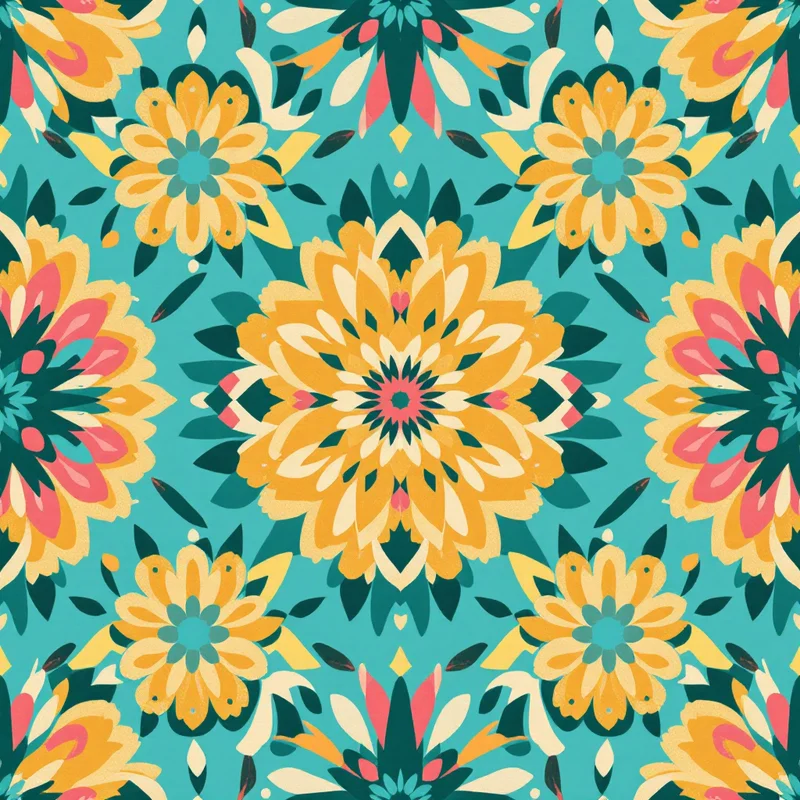
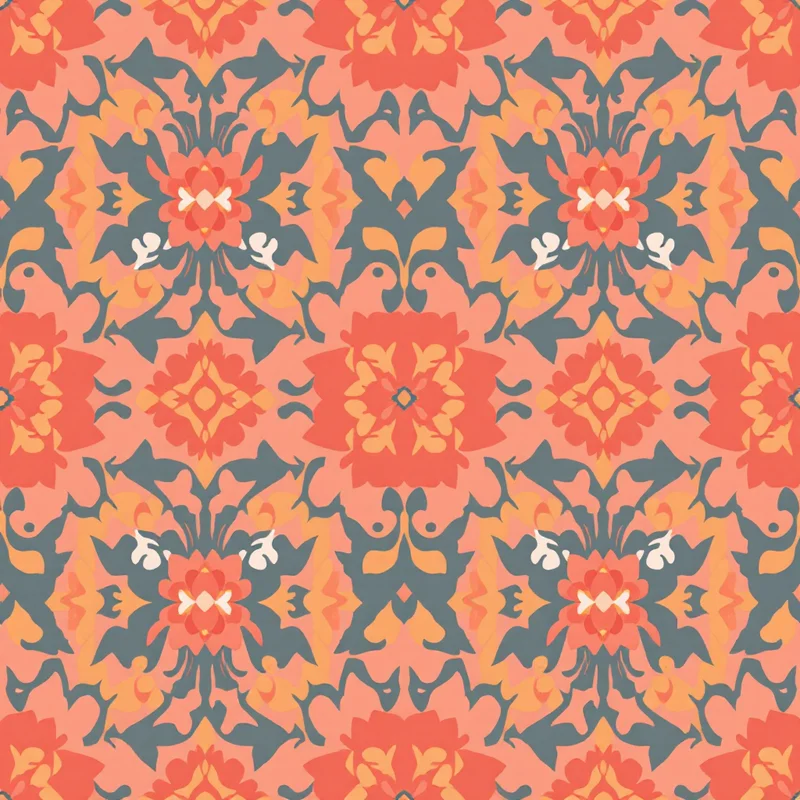
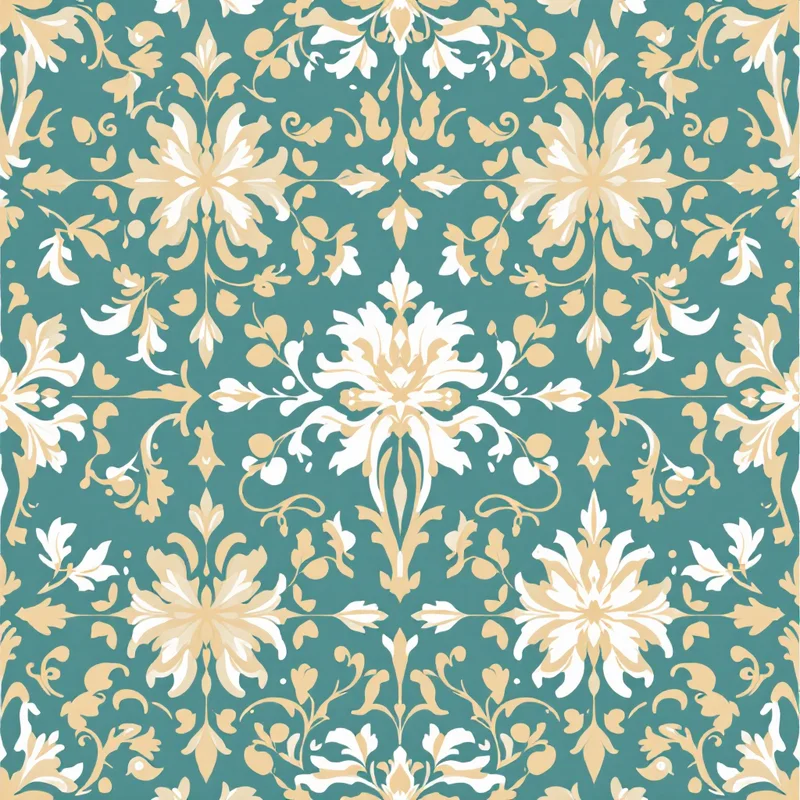
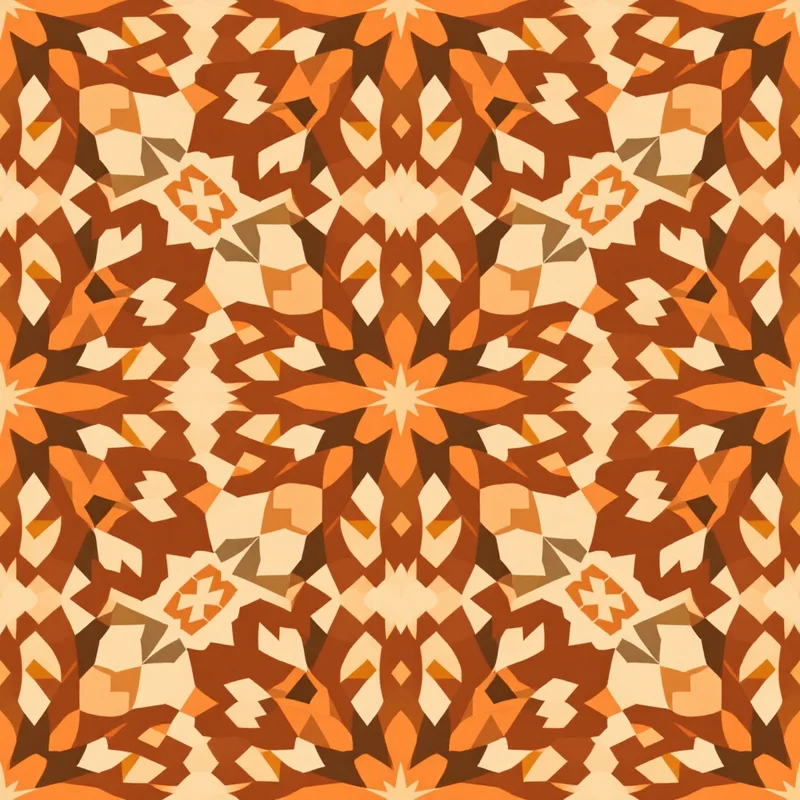
On the walls of the Taj Mahal, flowers are cut from semiprecious stone and set into white marble. That one detail explains most of Mughal pattern: precise, flat-colored shapes, cut sharply into a pale ground. The Mughal Empire ruled much of the Indian subcontinent from 1526 to 1857, and its art blended Persian and Indian traditions. The Taj Mahal was built by Shah Jahan between 1632 and 1653, and it is the most famous showcase of the style.
Pietra dura: flowers in stone
Pietra dura is an Italian term for inlay with hard stones. In Mughal buildings it is often called parchin kari. Each petal and leaf is cut from a separate stone, such as carnelian, lapis, jade or malachite, and set into marble with a hair-fine gap around it.
For a designer, the key traits are:
- Slender, upright stems with a flower at the top
- Flat color in each petal, with no shading
- Symmetrical blooms drawn from the front or in profile
- A white or pale ground that gives the colors room
Jaal: the floral net
Jaal means net. In Mughal textiles and carpets, an all-over layout can be built from flowering stems that form a lattice of diamonds or ogee shapes, with a blossom in each cell. It is a useful structure because it keeps the repeat orderly while letting the flowers be as naturalistic as you like. See our ogee pattern design guide for the geometry.
Jali: the pierced screen
A jali is a screen of stone or marble pierced with geometric or floral openings. You can see them around the cenotaphs inside the Taj Mahal and in the tomb of Salim Chishti at Fatehpur Sikri, built in the late sixteenth century. Jali patterns are usually built from stars, hexagons and circles. Because the pattern is made of openings, it works well as a bold, graphic repeat. The principles are related to those in Islamic geometric patterns explained.
The cusped arch and the garden
Two structural ideas recur. The cusped arch has a scalloped inner edge and works as a frame for a single flower or a niche of design. The charbagh garden, such as the one around Humayun's Tomb in Delhi (completed in the early 1570s), divides a square into four parts with water channels. As a layout, it gives you a quartered tile with a clear center.
Flowers to draw
Mughal artists observed flowers closely. Irises, lilies and tulips appear in the Taj Mahal's marble panels, and poppies are common in other Mughal art. Draw them upright and slim, with three to five leaves per stem, and give each flower one clear silhouette.
A palette
| Role | Color | Hex |
|---|---|---|
| Marble | Warm white | #F4F1EA |
| Sandstone | Red | #B5472E |
| Emerald | Green | #1F7A5A |
| Lapis | Blue | #264C9B |
| Carnelian | Orange | #C96A3A |
| Gold | Warm gold | #C9A24B |
Three ways to build a Mughal-style repeat
- 1Inlay style. Place single flowers on a white ground in a half-drop, each about 3 to 4 inches (7.5 to 10 cm) tall. Fill each petal in a different gem tone and outline with a thin dark gap.
- 2Jaal style. Draw an ogee lattice from curving stems, put a blossom in each cell and a tiny bud at each crossing.
- 3Jali style. Draw a grid of stars and hexagons as thick lines, about one-fifth of the cell width, in a deep red or green on cream.
For all three, check the seam, since Mughal pattern depends on symmetry and a misaligned edge shows immediately.
Using the tradition well
Mughal art is a historical and regional tradition, not a generic "Indian" look. Many of its finest works are tombs and mosques, so avoid using sacred inscriptions or calligraphy as decoration. If you want to explore the wider world of Indian textile design, our Indian block print pattern design guide covers the printed cloth, and the paisley pattern design guide covers one of its most exported motifs.
The Mughal patterns, floral patterns and cultural patterns categories are the closest matches. With Browse Styles in Pattern Weaver you can choose from 44 categories and 5,700+ styles, and Describe It lets you write a prompt in your own words, such as "pietra dura style irises and lilies on white marble, thin dark gaps".
Explore related pattern styles