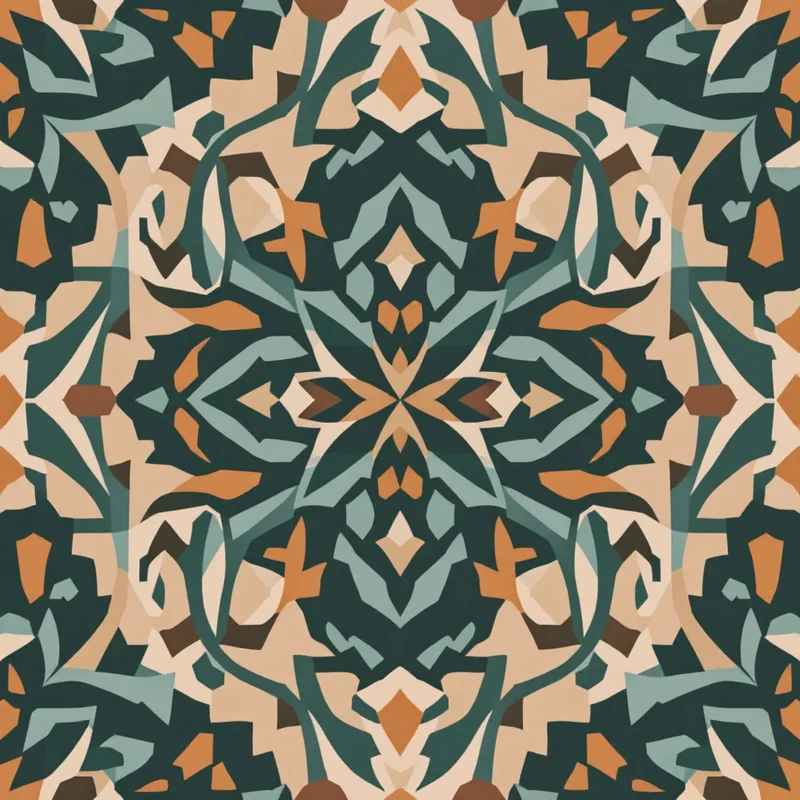
Every Islamic geometric pattern starts with a circle and a compass. The circle is divided into equal parts, the points are joined, and a grid appears, from which stars, polygons and interlacing bands grow. The designs cover mosques, madrasas, palaces, manuscripts, woodwork and metalwork from Spain to Central Asia, from the Alhambra in Granada to the tiled mosques of Isfahan.
Geometry and vegetal ornament became central in Islamic art in part because figural imagery was avoided in religious settings. Many people also read the patterns as an expression of order and unity, though the tradition does not have a single explanation. What is certain is the craft: precise, repeatable, and built in a way you can learn.
The base grids
Nearly every pattern is built on a division of the circle. The number of divisions defines the family.
| Division | Base shapes | Typical stars |
|---|---|---|
| 4 and 8 | Squares and octagons | Eight-pointed stars, including the khatem (two overlapping squares) |
| 6 and 12 | Triangles and hexagons | Six- and twelve-pointed stars |
| 5 and 10 | Pentagons and decagons | Five- and ten-pointed stars |
Four-fold and six-fold patterns repeat neatly on a grid. Five-fold patterns cannot repeat periodically on their own, so traditional designers combined pentagons and decagons with other shapes, which is where the girih tiles come in.
Girih tiles
Girih means knot. There are five shapes: a regular decagon, an elongated hexagon, a bow tie, a rhombus and a regular pentagon. All their edges are the same length, so they join freely, and each carries a set of lines that continue from one tile to the next. A long pattern scroll preserved in the library of Topkapı Palace in Istanbul, dated to around the fifteenth or sixteenth century, is one of the best-known records of how pattern makers worked.
Constructing a star pattern
The most common method is sometimes called polygons in contact.
- 1Choose a tiling. Start with squares, hexagons or a mix of shapes.
- 2Mark edge midpoints. Place a point in the middle of each edge.
- 3Draw rays. From each midpoint, draw two lines at the same angle to the edge, one going each way, until they meet lines from neighboring midpoints.
- 4Choose the angle. The angle sets the character of the pattern. Try several values on the same grid and watch the points of the stars sharpen or blunt.
- 5Remove the original tiling. Only the rays remain, and they form stars and polygons.
- 6Make them bands. Offset each line to either side to turn it into a strap with width.
Interlace
Real designs often look woven: a band passes over one band and under the next. To do this in a vector program, give each strap a fill and an outline, then break the strap at each crossing so one side goes under. Use a thin gap on each side of the break. It is the over-under logic of weaving drawn on a flat plane.
Palettes
Many designs are monochrome, but several regional palettes are well known.
- Moroccan zellige: green #1F6B4F, blue #1F4E9C, yellow #D9A21B, white #F4F1EA, brown #5A3A22.
- Persian and Central Asian tile: cobalt #1F3F99, turquoise #2BA6A0, gold #C9A24B, white.
- Stone and wood: one color, using light and shadow to define the bands.
Designing a seamless tile
- Choose a four-, six- or eight-fold pattern for a first project; they tile cleanly.
- Build the pattern inside one rectangle or hexagon, so that the edges match by symmetry.
- Keep strap widths consistent, roughly a fifth of the star's width.
- Test your tile at 3 by 3 to catch broken lines at the seams.
- See types of geometric patterns for the basics of grids and tessellation.
Using it with respect
Islamic geometric art decorates sacred places and holy books, and it comes from many cultures and centuries, not one. Name specific traditions when you can, such as Moroccan zellige, Persian tilework or Mughal jali, and avoid using Arabic calligraphy or Qur'anic text as ornament unless you are certain of what it says and where it is appropriate. For regional traditions, read the Moroccan pattern design guide and the Mughal pattern design guide.
The Islamic patterns, advanced geometric patterns and tessellation patterns categories offer starting points. In Pattern Weaver, the Tiling Fixer repairs edges when a complex line pattern does not quite meet at the seam.
Explore related pattern styles