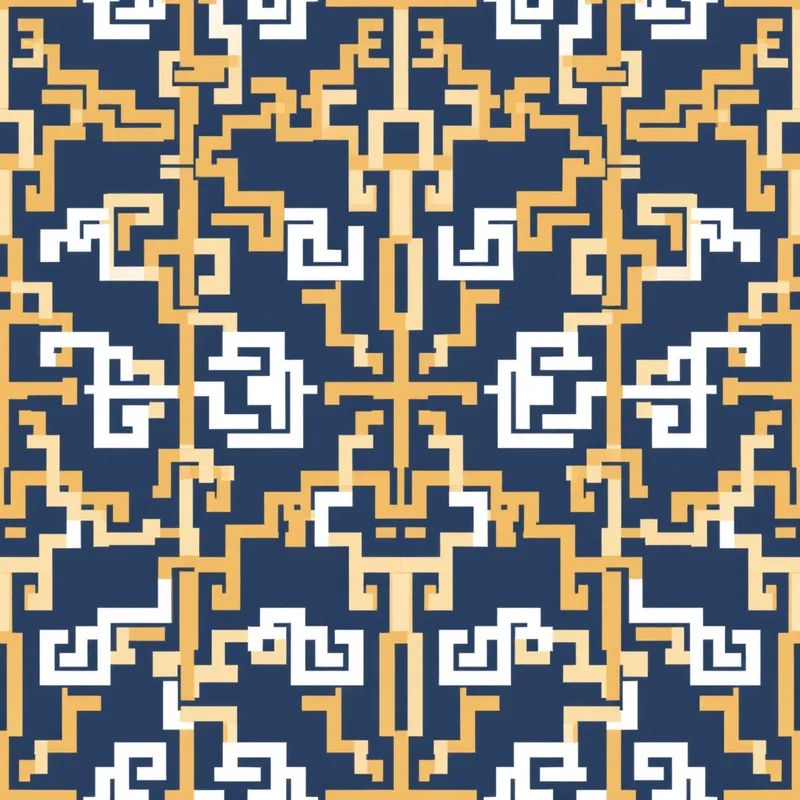
The word azulejo has nothing to do with the Spanish and Portuguese word for blue. It comes from the Arabic al-zulayj, meaning polished stone, and it points to the tilework traditions of Moorish Iberia. Blue and white came later, and is only one part of a tradition that also includes yellow, green, purple and white in rich geometric carpets.
A short history
Moorish roots. Glazed tilework was part of the architecture of Al-Andalus, the Muslim-ruled parts of the Iberian Peninsula, and Seville was a major center. Geometric tilework from the Islamic world set the grammar: stars, interlace and repeated units. See the Moroccan pattern design guide for the related tradition across the strait.
Portugal takes it up. After a visit to Andalusia, King Manuel I brought the style home, and tiles were used in the Sintra National Palace in the early sixteenth century. In the 1500s and 1600s Portuguese tilework drew on Spanish and Italian examples and moved from simple geometry toward painted figures.
Carpets in tile. In the seventeenth century, repeated polychrome tiles were arranged in panels that imitate carpets, with borders and a field of pattern, usually in yellow, green, blue and white. This is the peak of the tile-as-textile idea.
Blue and white narratives. In the late seventeenth and eighteenth centuries, influence from Dutch Delft tiles and Chinese porcelain helped establish blue and white painted panels on a grand scale, with Baroque scenes, vases and architecture. António de Oliveira Bernardes is one of the best-known masters of this period. See the Delft blue pattern history for the Dutch connection.
After the earthquake. The Lisbon earthquake of 1755 destroyed much of the city, and rebuilding created demand for simpler, repeatable patterned tiles.
Facades, stations and the metro. In the nineteenth century, buildings in Portugal and Brazil were covered in tile on the outside; São Luís in Brazil is a well-known example. The early twentieth century brought Jorge Colaço's large panels in São Bento station in Porto, and Maria Keil's modern panels for Lisbon's metro began in the late 1950s. Seville's Plaza de España, built for the 1929 Ibero-American Exposition, shows the Spanish side. The Museu Nacional do Azulejo in Lisbon is the best place to see it all.
Pattern types at a glance
| Type | Look | Colors |
|---|---|---|
| Carpet panel (tapete) | Repeated geometric field with borders | Yellow, green, blue, white |
| Blue and white narrative | Painted scenes and vases | Cobalt on white |
| Repeating facade tile | Simple florals and geometry | Often single color |
| Modern panel | Abstract or graphic compositions | Any |
A palette
- Cobalt #1F4E9C
- Ochre yellow #E0A526
- Copper green #3C7A57
- Manganese purple #5B3A5F
- Tin-glaze white #F7F4EC
Designing an azulejo repeat
- 1Start with the corner. The larger pattern forms where four tiles meet. Draw one quarter of a tile, rotate it four times, and look at how the four tile corners join.
- 2Use rotation or mirroring. Rotating the same square tile 90 degrees across a 2 by 2 block creates a secondary shape, usually a star or a flower, at the center of each block.
- 3Mind the grout. Show a 1 to 2 mm gap and slightly irregular edges. A perfect digital edge gives away that it is not ceramic.
- 4Add glaze character. Let the color pool at line edges, add a soft crazing, and avoid pure flat fills.
- 5Choose scale. Historic azulejos are often about 5 to 6 inches (13 to 15 cm) square. A 3 by 3 view of your design should still read as one coherent pattern.
For a quick start, the azulejo patterns and blue and white patterns categories are a good place to begin, and the tile pattern generator page covers repeating tile layouts. For where the market is heading, see tile and ceramic pattern trends for 2027.
With Describe It in Pattern Weaver you can write something like "azulejo tile with a four-fold rotated floral, cobalt blue on white, slightly crazed glaze", and the Tiling Fixer can clean up any edge that does not join.
Explore related pattern styles