
Sashiko means little stabs, and the name describes the whole technique: a running stitch, usually in white thread on indigo cloth. It grew from practical need. In the Edo period (1603 to 1868), farming and fishing families stitched layers of cotton together to reinforce and mend clothing, and the stitching became a decorative craft in its own right. The result is one of the clearest examples of pattern built entirely from a single line.
Three regional styles
- Shonai-zashi from the Shonai region of Yamagata.
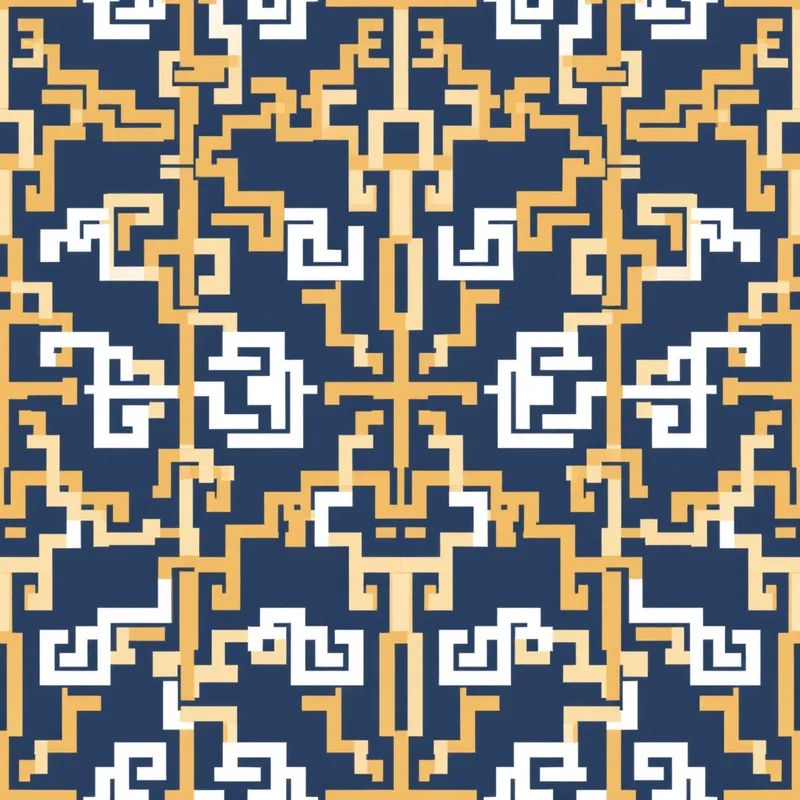
- Kogin-zashi from the Tsugaru area of Aomori, worked on counted threads in horizontal bands of diamonds and steps.
- Hishizashi from Nanbu, in Aomori and Iwate, built on diamond-shaped grids.
Each has its own character, so it is worth naming the style when you draw on it.
The traditional motifs
| Motif | Meaning of the name | How it is drawn |
|---|---|---|
| Asanoha | Hemp leaf | Six-pointed stars made of triangles in a grid |
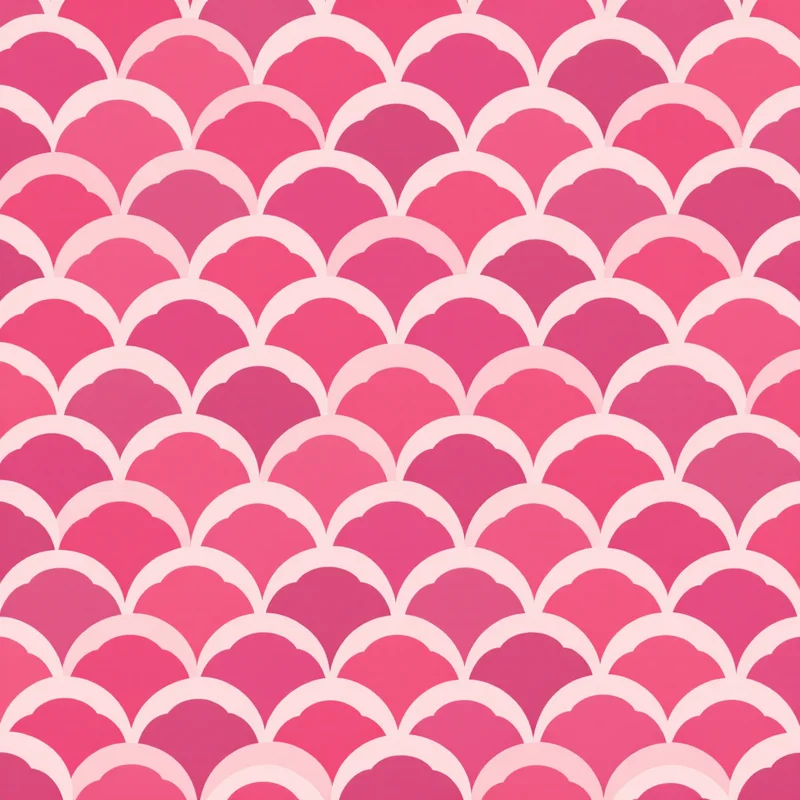
| Seigaiha | Blue ocean waves | Overlapping concentric arcs |
| Shippo | Seven treasures | Interlocking circles that form four-petaled shapes |
| Kikko | Tortoiseshell | A grid of hexagons |
| Higaki | Cypress fence | Crossed diagonal lines in a woven look |
| Kakinohana | Persimmon flower | Four-petaled flowers on a diagonal grid |
Many of these motifs carry traditional associations, such as hemp for fast, healthy growth and tortoise shells for long life. For the wider symbolic vocabulary, see our Japanese pattern design guide.
Hitomezashi: the math-like sibling
Hitomezashi, meaning one stitch, works on a grid. Each row is a line of evenly spaced stitches, and the position of the stitches shifts by one step from row to row, following a sequence you choose. The simple rule produces stepped crosses, diamonds and bridge-like shapes, and it makes a good basis for a digital pattern, because the grid does the work.
Rules the stitches follow
- Thread is thick, twisted cotton, and stitches are usually of equal length, roughly 1/8 inch (3 mm).
- Gaps are shorter than the stitches, so the line looks nearly solid.
- Where lines cross, the stitches cross each other, with no gap at the intersection.
- Corners are turned on a stitch, not in a gap.
These rules are what separate a stitched look from a dashed line.
Designing a sashiko-style seamless print
- 1Pick the ground. Indigo #22335F with thread in off-white #F3EEE0 is the classic. A deep red #8E2A2A thread on indigo is another traditional combination.
- 2Choose a motif cell. Asanoha or kikko works well in a cell of about 1.5 inches (4 cm). Make the tile an exact multiple of the cell.
- 3Draw the stitch. Use a dashed stroke with rounded caps. Keep dashes slightly longer than gaps, and make sure dashes cross at intersections.
- 4Add the cloth. Overlay a woven texture and a soft shadow under each thread to make the stitches look raised.
- 5Check the seam. The dash rhythm must continue across tile edges, so choose a tile size that holds a whole number of dash-and-gap units.
Beyond white on indigo
White on indigo is the classic, but modern sashiko is also stitched in red, yellow, gray and black threads on natural, black and denim grounds. If you design a colored version, keep enough contrast with the ground that the line still reads as thread, and use one thread color per motif.
Sashiko and boro
Sashiko is the stitching; boro is cloth that has been mended and patched over generations, often with sashiko holding the layers. Visible mending in modern fashion borrows from both. If you design in this territory, explain which one you mean.
Where it works
Sashiko-style prints suit denim, tote bags, cushions, aprons and packaging. See the embroidery patterns category, and for the blue-and-white palette try blue and white patterns. The grid logic is shared with geometric patterns. If you want to try stitch-based designs in other traditions, our types of embroidery style patterns post is a good next read.
In Pattern Weaver, the Tiling Fixer fixes edges, which is handy when a stitched line has to run cleanly across the seam.
Explore related pattern styles