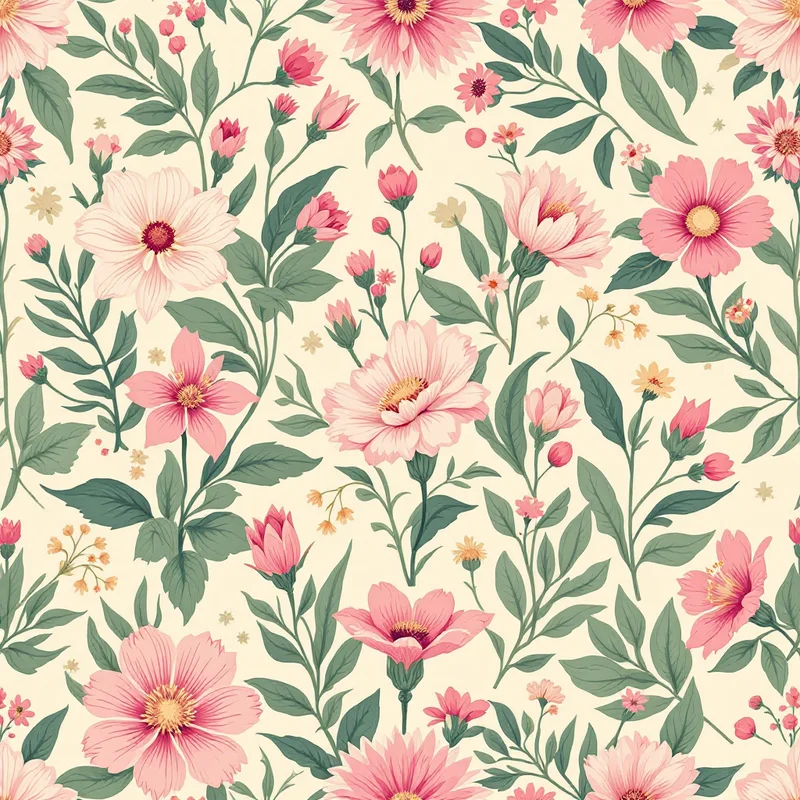
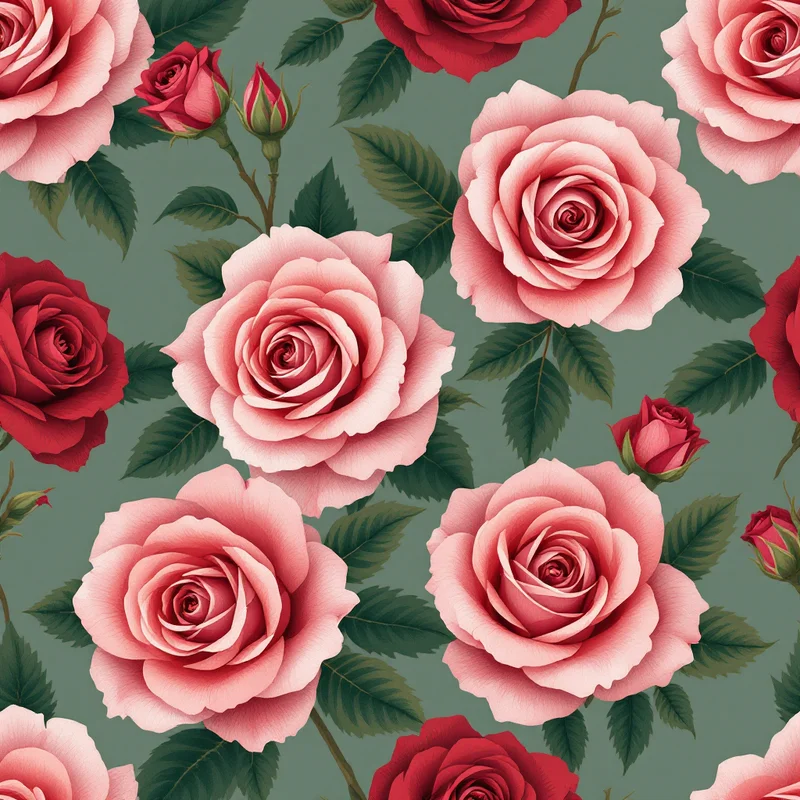
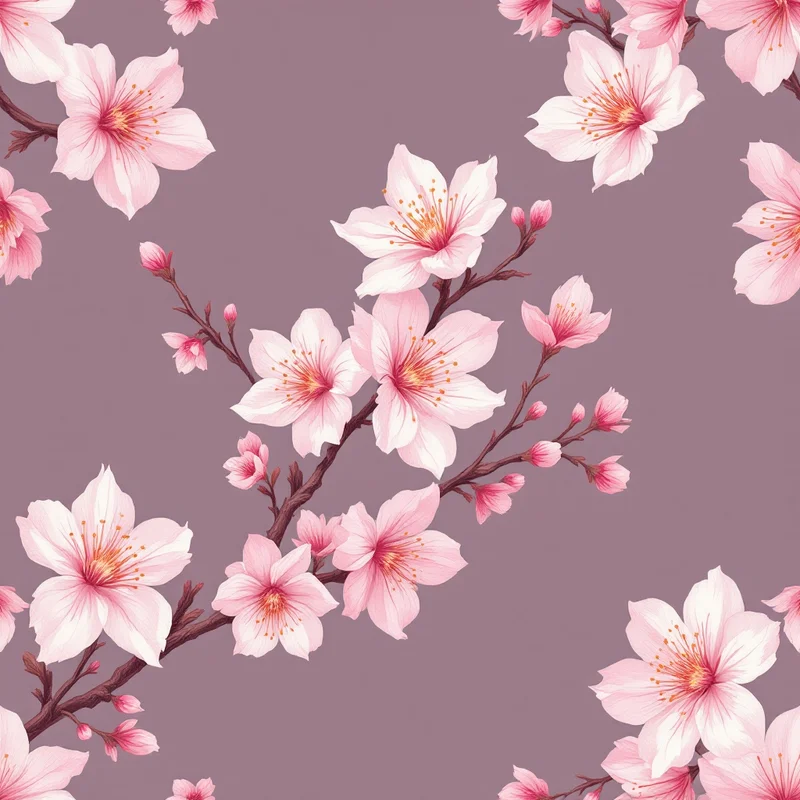
The interesting question about florals in 2027 is less "which flower?" and more "who drew it?" After several years of tidy, evenly spaced botanicals, the direction to watch is florals that show the hand: a brush that ran out of paint at the edge of a petal, an ink outline that wobbles, a bloom that is slightly off its stem.
Five rendering styles to watch
Loose gouache or ink-and-wash. Petals built from two or three visible brush strokes, with the paper color showing through. This is the commercial center of the direction, and it suits dresses, scarves and bedding. If you want the technique background, our guide to watercolor floral patterns covers it.
One-color linocut or engraving-style blooms. A single ink color on a cream or pale ground, with carved texture inside the petals. Expect this on tea towels, tote bags, stationery and the quieter end of wallpaper.
Dense chintz-style grounds. Many flowers, little background, tonal leaves tucked underneath. This is the maximalist end of floral and it pairs naturally with upholstery and curtains.
Flat cut-paper florals. Solid shapes with no outline and no shading, often in four or five saturated colors. Strong for kids' products, phone cases and anything printed small.
Pressed-flower specimens. Flowers drawn flat and slightly translucent, as if between pages, usually spaced out on a pale ground. Good for packaging and stationery.
Flowers with character
Roses and daisies will always sell, but the flowers worth adding to your library for 2027 are the ones with a distinctive silhouette:
| Flower | Why it draws well | Best rendering | Suits |
|---|---|---|---|
| Ranunculus | Layered, ruffled head, easy to simplify | Gouache, cut-paper | Dresses, bedding |
| Anemone | Dark center against pale petals | Ink-and-wash, linocut | Scarves, stationery |
| Poppy | Papery petals, seed-head variation | Loose gouache | Wallpaper, throws |
| Sweet pea | Frilled petals, curling tendrils | Pressed-flower | Nursery, packaging |
| Hellebore | Nodding heads, muted colors | Engraving-style | Heritage looks, curtains |
| Cosmos | Open, simple, good fillers | Cut-paper | Ditsy repeats, kids' |
Wild, meadow-style mixes also keep their place. See our wildflower patterns category for how irregular spacing changes the feel of a repeat.
Palettes that fit the hand-painted look
Hand-painted florals tend to look best when the palette is a little dusty and the ground is not pure white.
- Walled garden: #F1E8D8 (cream ground), #C46A5A (clay rose), #7F8F6A (olive leaf), #3F4A5C (ink blue), #D9A441 (saffron)
- Dark chintz: #1E1B24 (off-black ground), #B5485D (raspberry), #D98F3E (marigold), #4C7A64 (bottle green), #E8DCC8 (parchment)
- Pale linocut: #FAF6EE (ground), #2F3E5A (single navy ink)
The dark-ground version is the one to try if your 2026 work has been mostly cream. Raising contrast is the quickest way to make a floral look current without changing the flowers at all.
Scale by product
Scale is where floral prints most often go wrong, because a repeat that looks lovely on screen can disappear or overwhelm once it is on a real object.
- Ditsy: blooms around 1 to 1.5 inches (2.5 to 4 cm), best for shirts, kids' clothing and gift wrap. The ditsy types guide shows how to space them.
- Apparel mid-scale: blooms 3 to 6 inches (8 to 15 cm), the standard for dresses and blouses.
- Large-scale: blooms of 12 inches (30 cm) or more for wallpaper, upholstery and curtains, where you can afford to crop a flower at the repeat edge.
Whatever the size, test the repeat across at least a three-by-three grid. Loose, hand-painted florals are the easiest to break, because one over-large bloom near a tile edge will show up as a stripe.
What to leave behind
Perfectly symmetrical bouquets, identical flowers copied and pasted at even intervals, and flat vector petals with no variation are the shapes that look most 2022 now. You do not need to abandon clean work entirely, but vary the size, angle and color of each bloom, and let a few leaves overlap the flowers.
For a broader view of the category, the types of floral patterns guide is a good companion, and our botanical print forecast covers the foliage side separately.
Trying these directions
To test a few of these quickly, start with the 44 categories and 5,700+ styles in Browse Styles, or write the look in your own words with Describe It, for example "loose gouache anemones on a cream ground, dark navy centers". Each pattern comes back as a seamless tile in about 20 seconds, so you can compare three palettes before committing to one. New accounts get 5 free credits, and the floral patterns category is a good place to begin.
Explore related pattern styles