"Embroidery trend" means two different things, and mixing them up causes problems. One is real thread: stitched by hand or by machine onto cloth, with raised texture and a palette limited to the thread colors you choose. The other is the embroidery look: a flat print that borrows the style of stitches. Designers working in 2027 will probably need both, and this forecast keeps them apart. As always, these are directions to watch, not measured results.
What thread can and cannot do
Real embroidery has its own limits, and the artwork has to be adapted to them.
| Element | Thread reality |
|---|---|
| Fine hairlines | Disappear or look uneven; lines need thickness |
| Smooth gradients | Not possible; use color steps or blended stitch areas |
| Small text | Fills in; keep letters large and simple |
| Many colors | Each color adds cost and time on a machine |
| Large solid areas | Can pucker the fabric; fill stitches may be broken up |
Digitizing is the step that translates artwork into a stitch file, choosing satin stitch for borders and lines, fill stitch for areas and running stitch for details. Always brief the digitizer with a simplified design and a color list.
Tonal whitework
The quietest direction is the most likely to endure: embroidery in the same color as the cloth, or one shade apart. White on white, ecru on oat, navy on navy. The pattern shows through shadow and texture alone. It suits linen shirts, tablecloths, pillowcases and collars, and it looks expensive without announcing itself.
Cutwork and eyelet details are a natural companion. Draw simple repeated shapes, such as scallops, small flowers or leaf sprigs, with strong outlines so they read in relief.
Folk florals
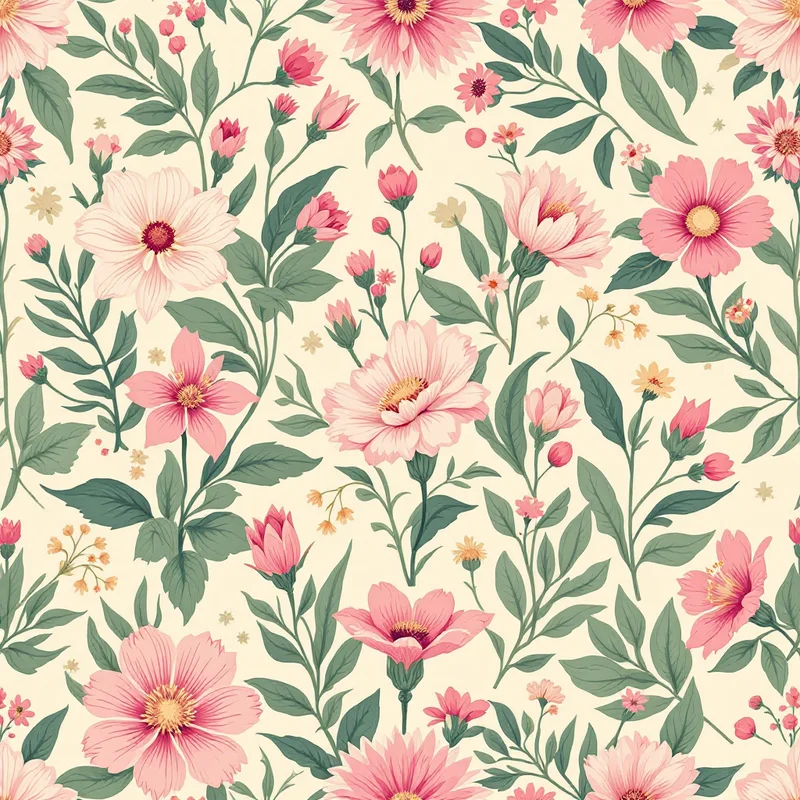
Folk art patterns have long used embroidery as a vehicle, from bold florals to birds and hearts, and expect those motifs to feature in 2027. Look for chunky, simplified flowers in strong color, such as poppy red (#C23B2A), cobalt, mustard and green on a deep ground. The charm is naive drawing: slightly lopsided symmetry, thick petal shapes, and decorative borders.
Folk embroidery belongs to specific regions and communities. Use the broad language of stylized florals, and credit the tradition you are drawing from if you reference one, for instance Otomi embroidery. The types of embroidery-style patterns guide helps you tell traditions apart.
Visible hand stitches
Another direction is the opposite of polished: big, loose, visibly hand-done stitches. Think chain stitch lines, French knots as dots, blanket stitch around an edge, and thick yarn on denim, sweaters or tote bags. Imperfect spacing is part of the charm. In machine embroidery, this look comes from longer running stitches and simple shapes; in print, it means drawing every stitch as a short mark with a slight shadow.
Patches, appliqué and puff
Embroidery is also moving off the garment surface into add-ons: patches, appliqué shapes, chenille letters and raised puff embroidery on caps. A patch is a small, bordered design, so draw it as a self-contained shape with a clear outline. Collections of several small patches can be arranged across a jacket or bag, which gives a patchwork effect without a single large repeat.
Embroidery-look prints
An embroidery-look print is a flat pattern drawn to resemble stitches, usually for apparel and home textiles. It allows more colors, finer tonal variation and lower cost, but no real texture. To make it convincing:
- Draw stitch direction, so fills show short parallel strokes rather than flat color.
- Add a slight highlight and shadow at stitch edges.
- Keep the palette limited, as thread would be.
- Use a simple outline, such as satin stitch, around main shapes.
Embroidery patterns and floral patterns are good starting categories. The look pairs well with a plain ground, such as denim or cotton twill.
Home and gift
Embroidered or embroidery-look florals suit tea towels, cushions, napkins and baby items. A small embroidered motif at the corner of a napkin or on a sleeve cuff can look more refined than an all-over print. If you design for the table, the kitchen and table linen forecast covers napkins and cloths.
From tile to stitch file
Browse Styles in Pattern Weaver offers 44 categories and 5,700+ styles, and Describe It takes a prompt such as "folk florals in chain stitch, red and cobalt on cream, bold outline". Treat the tile as artwork to simplify before digitizing. New accounts get 5 free credits.
Explore related pattern styles