
Textile design is one of those disciplines that everyone has touched and almost no one can define cleanly. You are wearing it right now. Your sofa is upholstered in it. The tea towel folded over your oven handle is a working artifact of it, and somewhere a working textile design portfolio is being built around exactly that kind of cloth. And yet ask ten people in adjacent creative fields what textile design actually is, and you will get ten overlapping but contradictory answers.
This post fixes that. We will work through a precise definition, the traditional production pipeline, the motif vocabulary inherited from major weaving and printing traditions, the technical layer that separates it from illustration, and how the practice has shifted between 2024 and 2026 as AI tooling matured.
A working definition of textile design
Textile design is the design of pattern, color, and surface structure intended for production on cloth — whether that cloth is woven, knitted, printed, or embroidered. The output is not a single decorative image. It is a system: a repeating tile, a colorway family, a scale specification, and a set of production files that a mill, a print bureau, or a digital fabric printer can run without ambiguity.
That last clause is what separates a textile designer from a person who draws nice flowers. A textile design has to manufacture. It has to tile seamlessly across an arbitrary yardage. It has to hold color through a CMYK conversion or a Pantone-matched screen separation. It has to land on grain. It has to look the same on the 50th yard as it did on the strike-off.
This is also why the textile design discipline sits at an unusual intersection of art, craft, and engineering. The aesthetic side is what gets photographed for the lookbook. The engineering side is what determines whether the print actually reaches market.
The traditional textile design pipeline
Before we talk about how the discipline has changed, it helps to understand the pipeline a working studio would have followed for most of the last hundred years. It is still the underlying template — modern tools just compress the steps.
1. Concept and mood. The designer starts with a brief: a season, a customer, a price point, a fabric base. From this comes a mood board, color references pulled from runway or interior trend reports, and rough thematic direction (small floral, conversational, geometric, ethnic, etc.).
2. Hand sketching and motif development. Individual motifs get drawn — a single peony, a single boteh, a single stripe element. This is the part of textile designing that is most visibly "art." A studio archive of motifs is a long-term asset; senior designers can pull from sketches they made fifteen years ago.
3. Layout and repeat construction. The motifs get arranged into a repeating unit. Straight repeat, half-drop, brick, tossed, mirror — each has a different feel and different production implications. This step is where the math enters. The tile has to be seamless: every motif that runs off one edge has to re-enter from the opposite edge in exactly the right place.
4. Colorway development. A single design typically ships in three to eight colorways. Each colorway is a separate, fully-resolved color combination on the same drawing. A buyer might love the layout in the navy version and order the rose version for spring. Building strong colorways is a distinct skill.
5. Color separation and production files. For screen printing, the design is separated into one file per color, each precisely registered. For rotary print, the same separations get burned onto cylinders. For digital print, the file gets converted to the printer's color space (usually a CMYK ICC profile tuned to that specific machine and fabric base).
6. Strike-off and approval. The mill prints a small sample. The designer checks color, scale, sharpness, and registration. Corrections cycle back through steps 4-5. Once approved, the design goes into bulk production.
A studio designer might spend two to three weeks on a single design from brief to approved strike-off. A freelancer selling to a converter might compress it into a few days. Either way, all six steps happen, even if invisibly.
How textile design differs from surface pattern design
These two terms get used interchangeably online, and they should not be. Surface pattern design is the broader category — any repeating decorative artwork applied to a surface. That surface could be wallpaper, gift wrap, ceramic tile, packaging, phone cases, journals, or fabric.
Textile design is the subset of surface pattern design where the surface is cloth. That sounds like a trivial distinction until you list the constraints that only apply to fabric:
- The design has to survive being woven, knit, or wet-printed at scale
- It has to behave when cut, sewn, and worn — which means thinking about how the repeat lands on a sleeve, a center front, a pant leg
- It has to register across grain when the bolt is cut on a marker
- It has to handle wash and wear, which constrains your color choices and ink systems
- Hand (the tactile feel of the finished cloth) is part of the design brief, not an afterthought
A surface pattern designer making art for a notebook cover does not think about any of this. A textile designer thinks about all of it before drawing a single motif. The tools overlap — both disciplines use Photoshop, Illustrator, Procreate, and increasingly an AI pattern generator — but the constraints are not the same. We have written about surface pattern design in more depth elsewhere if you want the long version.
The major textile design traditions
Every working designer carries an internal vocabulary of motif traditions, each tied to a specific weaving or printing technique, region, and historical period. You do not have to be a scholar of these, but you do need to recognize them. They are the language of the discipline.
Paisley
The boteh — the curved teardrop with a curled tip — originated in Kashmir, traveled west through Persian textile trade, and got mass-produced in the Scottish town of Paisley in the 19th century, which is how it got its English name. Modern paisley ranges from tight, jewel-toned Indian renderings to large-scale 1960s psychedelic versions. It remains the single most-licensed motif family in apparel. We have a dedicated walkthrough on paisley patterns if you want to design one.
Damask
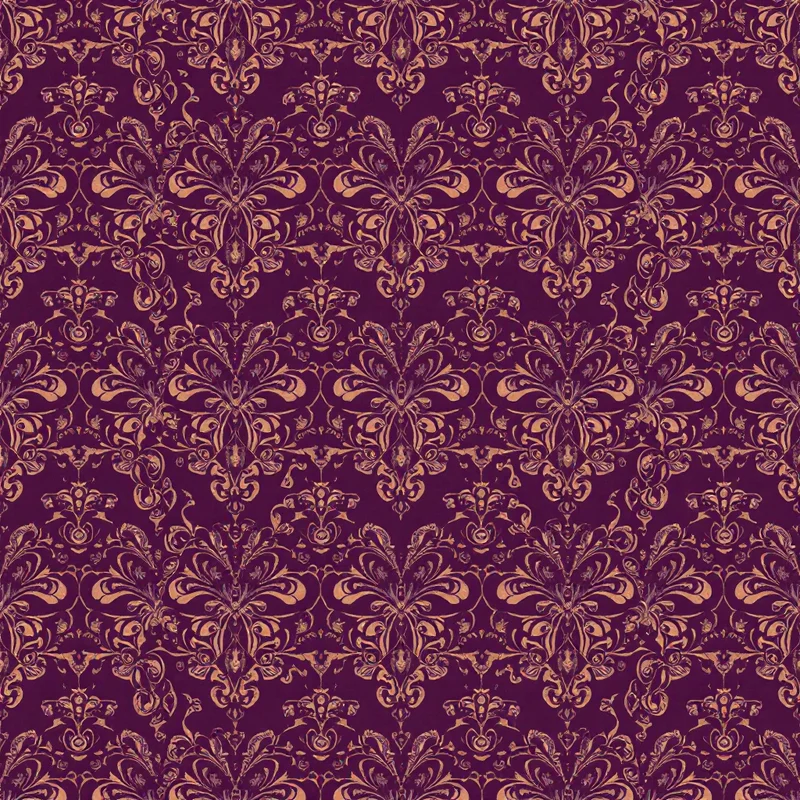
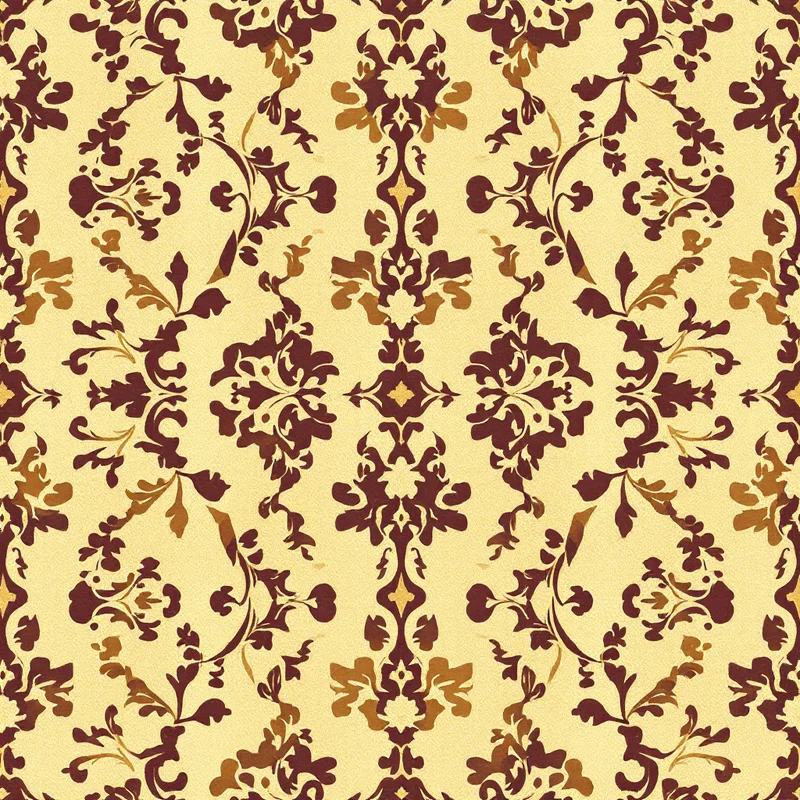
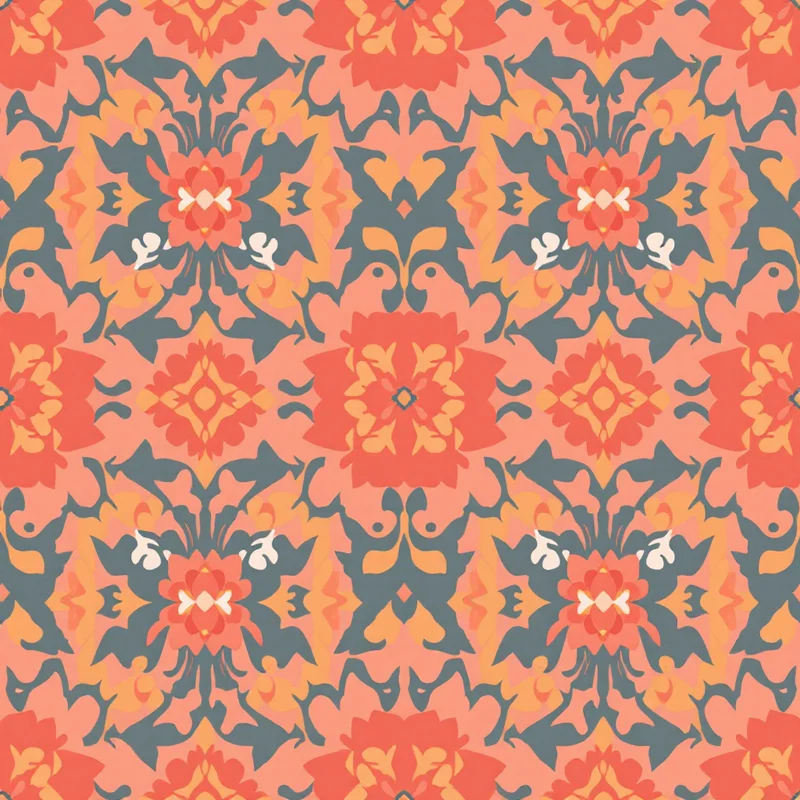
Originally a woven structure (warp-faced satin against weft-faced satin), the term now refers to the symmetrical, large-scale ornamental floral typically rendered in two tones — historically gold on cream, or tone-on-tone. It is the default vocabulary for hospitality textiles, luxury wallpaper, and formalwear linings. Browse damask patterns for the modern range.
Ikat
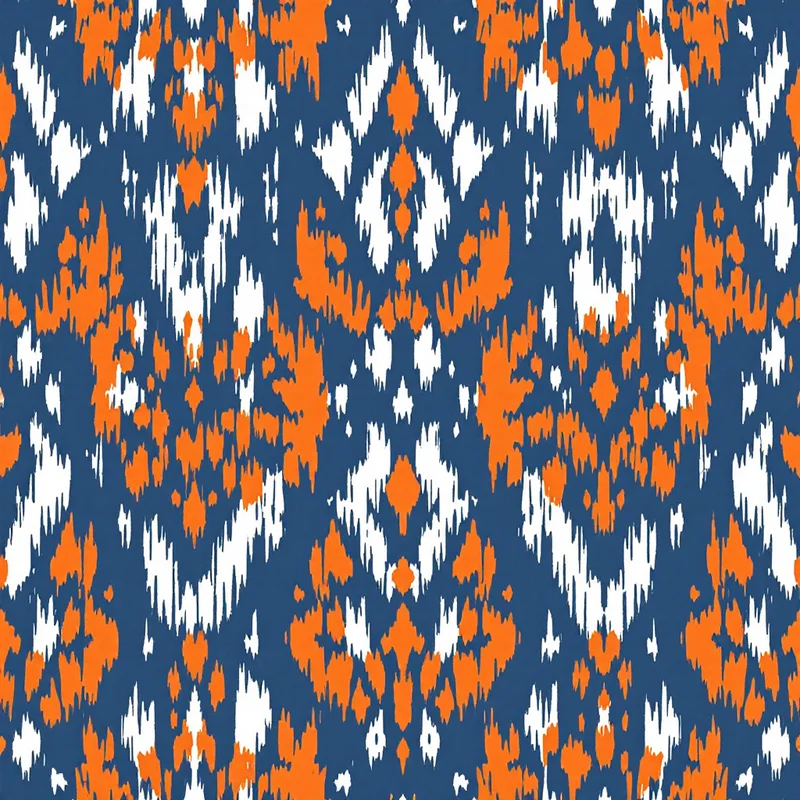
A resist-dye technique where the yarns are dyed before weaving, producing the characteristic blurred, slightly out-of-register edge. True ikat is incredibly labor-intensive. Printed ikat — a faked version where the soft edge is reproduced photographically — has been a perennial trend since the 2010s.
Toile de Jouy
The narrative pastoral scene printed in a single color on a light ground, developed in 18th-century France. Originally copperplate-printed, now mostly digital. The defining trait is figurative scenes — shepherds, ruins, animals — repeated at a scale large enough to read as illustration but small enough to function as a pattern.
Ankara (African Wax Print)
The bold, high-contrast, large-scale prints associated with West African dress, originally adapted from Dutch industrial wax-resist printing in the 19th century. Defined by saturated color palettes, conversational motifs, and a tradition where each design carries a name and often a proverb.
Otomi
The Mexican embroidery tradition from the Tenango region of Hidalgo, characterized by flat-color animals and plants on a white ground, originally hand-stitched. Now mostly printed in interior applications.
Sashiko
The Japanese running-stitch reinforcement technique, traditionally executed in white thread on indigo cloth in small geometric repeats — asanoha (hemp leaf), shippō (seven treasures), seigaiha (waves). The geometric vocabulary feeds directly into contemporary minimalist textile work.
Suzani
The large embroidered textiles of Central Asia, particularly Uzbekistan, defined by enormous medallions, pomegranates, and sun motifs in red, gold, and indigo on cotton or silk. Has been heavily referenced in Western home textiles since the early 2000s.
These eight are the minimum literacy. A working designer can name and roughly date another twenty — block print, batik, kalamkari, chintz, kente, kuba, mola, sarape, and so on. The motif vocabulary is the long tail of the craft.
The technical layer
This is the section most "what is textile design" articles skip, and it is precisely the section that distinguishes a textile designer from an illustrator who happens to draw repeats.
Seamless tiling. The repeat unit must be mathematically continuous. Every pixel that flows off the right edge must re-enter on the left at the exact same y-coordinate. Every pixel that flows off the bottom must re-enter on the top. This is what a seamless pattern maker handles automatically. Done by hand, it requires the designer to copy the tile, offset it by 50% horizontally and vertically, paint out the seams in the visible cross, and then re-flatten. A skilled hand can do this in an hour. The technique is unforgiving — a single missed seam ruins the bolt.
Color separation. For any non-digital print, every distinct color in the design becomes a separate production file. A six-color paisley needs six perfectly-registered separations, each precisely the right shape, each named with the Pantone reference for that screen. The designer is responsible for keeping the color count manageable (each additional color adds setup cost) and for ensuring the separations actually register — i.e., there are no hairline gaps or overlaps between adjacent colors.
Gamut control. Screens, fabric, and ink all have different color gamuts. A neon orange that looks fluorescent on your monitor will not exist in any commercial textile ink system. A deep navy that renders as #000033 on screen will mottle on cotton and look chalky on linen. A working textile designer chooses colors that are physically reproducible on the intended substrate — which means proofing against Pantone TPX (textile paper) or TCX (textile cotton) references, not the RGB values they see on their laptop.
ICC profiles and printer file prep. For digital print, the production file is a CMYK TIFF or PDF with an embedded ICC profile that matches the printer's color characterization for that specific fabric. A linen ICC profile differs from a polyester ICC profile because the inks behave differently on the two substrates. The file is usually delivered at 150 dpi at production scale, with the repeat unit clearly marked, the colorway documented, and a bleed margin (typically 1/4 to 1/2 inch) to allow for press alignment variation.
Scale and repeat-size discipline. A 12-inch repeat on a shirt looks different from a 12-inch repeat on a curtain. The textile designer specifies scale relative to the end product, not as an abstract number. Apparel typically wants 4-9 inch repeats. Home textiles can comfortably run 18-27 inch repeats. Bedding can go even larger.
This is the part of textile designing that takes years to internalize. The aesthetic decisions sit on top of a production stack that has its own grammar.
How AI has changed textile design between 2024 and 2026
Two years ago, the AI conversation in textile design was mostly defensive — "will it replace us, how do we protect our work, are clients going to expect free designs now." Two years on, the actual working pattern is clearer.
AI has compressed the ideation and exploration phase dramatically. A senior designer used to spend two or three days producing 20-30 directional sketches for a collection. With modern textile designer tools built around generative models, the same designer can produce 200 directional options in an afternoon and curate down to the strongest 30 — but they have to know what "strongest" means, which is exactly the literacy this article has been laying out.
AI has not eliminated the technical layer. A raw generative output is not a production file. It is not seamlessly tileable (without a model specifically trained for tiling, which is what Pattern Weaver is built on). It is not color-separated. It is not in CMYK. It has no ICC profile. It does not know the difference between a small toss on poplin and a large engineered placement on silk twill. The designer still owns all of that.
What has changed is the proportion of time spent on different parts of the pipeline. Less time on initial motif drawing. More time on curation, colorway development, technical finishing, and production setup. The skill stack has shifted toward the parts that AI is bad at — production literacy, color discipline, taste — and away from the parts where AI is genuinely competitive — exploratory variation, color repaints, layout iteration.
The studios that are doing well in 2026 are the ones that integrated AI into the front of their pipeline without compromising the back. The ones that are struggling tried to ship raw AI outputs as finished designs, got returns from buyers, and lost trust.
What a textile design "looks like" in production
When a textile design leaves the designer and goes to the printer, it does not look like the JPEG you see in a portfolio. It typically looks like this:
- A CMYK TIFF file at 150 dpi at production scale (so a 12-inch repeat is 1800 × 1800 pixels)
- Embedded ICC profile matching the printer's characterization for the target fabric
- LZW-compressed to keep file size manageable
- Named with the design number, the colorway code, and the repeat size
- Accompanied by a 1/4 to 1/2 inch bleed margin on all sides
- Sometimes flagged with registration marks at the corners
If it is going to screen print instead of digital, you would also deliver one separation file per color, each as a grayscale TIFF with the Pantone reference in the filename.
That is what the discipline produces. Not the pretty mood board image. The CMYK TIFF.
The two-axis textile design market
The industry splits along two intersecting axes, and your career strategy depends on understanding both.
Axis 1: apparel vs. home textiles. Apparel is fast, high-volume, low-margin, trend-driven. Home textiles (bedding, upholstery, curtains, table linens, towels) are slower, lower-volume, higher-margin, classic-driven. A paisley placed in apparel is dead in 18 months. A paisley placed in home textiles can sell for ten years.
Axis 2: aesthetic vs. technical/industrial. Most of this article has been about aesthetic textile design — pattern, motif, colorway. There is a parallel discipline of technical textile design — performance fabrics, smart textiles, geotextiles, automotive interiors, medical textiles. The technical side is where most of the engineering happens and where most of the money is.
Most working textile designers sit in one of the four quadrants and stay there. Apparel print, home decor, technical performance, automotive — these are largely separate career tracks with different vocabularies and different buyers.
Where to learn more and start practicing
If you have never made a repeat before, start with one motif and one repeat structure (straight or half-drop) and produce ten colorways. Do not move on until you can look at a finished repeat and immediately spot the seams without measuring. That is the entry-level literacy.
From there, the realistic path is some combination of:
- A formal program (RCA, FIT, Central Saint Martins, Chelsea, RISD — the short list is short and well known)
- A studio apprenticeship (still the dominant way the craft transmits, especially in Italy, France, and India)
- Self-directed practice using modern tooling, with the explicit goal of producing production-ready files (not just pretty JPEGs)
- Selling early work through licensing platforms or direct-to-consumer print-on-demand to get real production feedback
For the technical side, getting your first repeat printed on actual fabric — even if you have to pay for a yard of it at retail — teaches you more than a year of screen-only practice. The discipline lives in cloth. If you want to design for a specific platform, the Spoonflower-ready fabric patterns guide walks through the technical setup for print-on-demand.
Textile design is not a magic skill. It is a finite vocabulary of motifs, a finite set of repeat structures, a defined production pipeline, and a strict technical layer underneath. Anyone who pays attention to all four can learn to do the work credibly within a year or two. Mastery — the kind of taste that lets a senior designer pick the right paisley scale for a specific buyer at a specific price point — takes longer, and is mostly about exposure to a lot of cloth.
The discipline has never been more accessible. It has also never been more crowded. The differentiator in 2026 is not whether you can generate pattern. It is whether you understand what pattern is for.
Explore related pattern styles
Patterns for