The phrase "textile design vs fashion design" gets typed into search engines mostly by people about to commit four years and a small mortgage to one of them. The two disciplines look similar from the outside — both feed the clothing industry, both involve drawing and software, both end up in shops — but the day-to-day work, the skill demands, the salary curves, and the personality types who thrive in each are different enough that picking the wrong one is a painful mistake to undo.
This guide breaks down what each role actually does, where they meet, and how to decide between them. The short version is at the top for readers who already know what they want. Everyone else gets the longer answer.
Quick answer: textile design vs fashion design in one paragraph
Textile design is the discipline of inventing the surface — the print, the weave, the knit structure, the embroidery — that ends up on a garment, sofa, or wallcovering. Fashion design is the discipline of inventing the garment itself: the silhouette, the cut, the construction, the collection narrative. A textile designer makes the fabric beautiful; a fashion designer decides what shape the body will take inside that fabric. They report to different people, use different software, attend different trade shows, and sit on opposite sides of most production meetings. Many people do both at small studios. At any brand large enough to have departments, they are separate jobs.
What a textile designer actually does
A textile designer's deliverable is a repeating artwork file — usually a TIFF or AI vector — that a printer, mill, or knitting machine can turn into yardage. The job sits between art and manufacturing, and most of the working day reflects that split.
A typical week for a print textile designer at an apparel converter looks like research and mood-boarding on Monday morning, motif sketching through Tuesday, building and seam-checking a repeat on Wednesday, expanding colorways on Thursday, and prepping production files for the mill on Friday. There are pre-press calls, color approval rounds, strike-off reviews, and occasional trips to printing facilities in Como, Surat, or Guangzhou to babysit a difficult run.
The technical knowledge is specific and unglamorous. A textile designer has to know the difference between a 6-color rotary screen and a 12-color digital pigment press because the answer determines which palettes are even allowed. They have to know that a neon coral that pops in RGB will desaturate by 30% in CMYK on cotton. They have to know what 1500–3000 yards of minimum order means for the brands they pitch to, and which mills will take a 500-yard sample run for an emerging label.
The motif library matters enormously. Working textile designers usually specialize — florals, geometrics, cultural and folk, animal print, abstract painterly — and build a reputation in one or two of those buckets that gets them booked. The broad-overview generalist exists mostly in school portfolios. Industry hires for depth.
For a deeper look at the work, the textile design discipline covers the woven, printed, knit, and embroidered branches in detail.
What a fashion designer actually does
A fashion designer's deliverable is a garment — first as a sketch and tech pack, then as a sample, then as a graded production-ready spec. The job is project management as much as it is drawing, and the further a designer climbs, the less time the pencil actually touches paper.
A typical week for an apparel designer at a mid-size brand involves trend research and competitor shopping, sketching silhouette options for the next collection, marking up fit comments on samples that came back from the factory, sitting in fit sessions with a model and the technical designer, choosing trims and lining swatches, reviewing tech packs with production, and arguing with merchandising about what the line plan can actually support.
The output is a collection — 12, 30, or 80 looks depending on the brand — that hangs together visually, sits within a price architecture, and can ship to stores on a calendar that was locked nine months earlier. The hero look that walks the runway is the public face of the work. The other 70 SKUs that pay the bills are the actual job.
Construction knowledge matters more than people expect. A fashion designer who cannot draft a basic bodice or read a marker is going to lose every argument with the patternmaker and the factory. The romantic image of the fashion designer sketching while assistants execute is almost extinct outside a few couture houses. Modern fashion design is a hybrid of art direction and operations.
The clothing design workflow covers the steps from concept to production pattern in more depth.
Side-by-side: skills, tools, day-to-day work, deliverables
The two roles overlap in vocabulary and diverge in everything else. Set out plainly:
Primary deliverable. Textile designer ships a repeating artwork file. Fashion designer ships a tech pack and approved sample.
Software stack. Textile designer lives in Photoshop, Illustrator, Procreate, and increasingly an AI pattern generator for motif and repeat work. Fashion designer lives in Illustrator for flats, CLO 3D or Browzwear for 3D garment simulation, and a PLM system like Centric or Backbone for tech-pack management.
Unit of work. Textile designer thinks in tiles, repeats, and colorways. Fashion designer thinks in silhouettes, blocks, and SKUs.
Time horizon. Textile designer ships individual patterns in 1–3 weeks each, collections in 4–8 weeks. Fashion designer works on seasons that run 9–18 months from concept to retail.
Material knowledge required. Textile designer needs to know substrates from the fiber and finish angle — how this cotton accepts pigment, how this silk handles digital print. Fashion designer needs to know substrates from the drape and behavior angle — how this jersey recovers, how this wool tailors.
Who they argue with. Textile designer argues with mills, converters, and color labs. Fashion designer argues with merchandisers, factories, and patternmakers.
Travel pattern. Textile designer goes to Première Vision, Heimtextil, Surtex, and Print Source. Fashion designer goes to runway shows, factory visits, and twice-yearly market in New York, Paris, or Milan.
Industry trade shows in common. Almost none, which is why the two roles can spend an entire career adjacent to each other without ever sitting in the same room.

Salary, career path, and job market in 2026
The salary spread is wide in both fields and depends heavily on city, brand tier, and whether the role is in-house or freelance.
In the US, an entry-level in-house textile or surface designer at a mid-market brand earns roughly $55,000–$72,000. Mid-level (4–7 years) lands $75,000–$110,000. Senior designers and print directors at large brands reach $120,000–$180,000. Licensing artists who do well can clear $200,000 in royalty income, but distribution is brutally top-heavy — most licensed artists earn under $30,000 per year from licensing alone.
Fashion designers in the US start in a similar band, around $58,000–$78,000 for entry-level assistants. The mid-level range is $80,000–$130,000. Senior designers and design directors at major brands earn $150,000–$280,000, and creative directors at heritage labels push well past $400,000 with bonus. The ceiling in fashion design is higher than in textile design because the role scales with brand revenue more directly.
In the UK, entry-level textile design starts around £24,000–£32,000 in London, mid-level £38,000–£55,000, senior £60,000–£90,000. Fashion design pays roughly £2,000–£5,000 more per band on average.
In India and other South Asian production hubs, textile design pays well relative to local cost of living — entry-level around ₹4–6 lakh, senior print directors at large export houses ₹15–25 lakh. Fashion design pays similarly at the design-house level, less at the production-engineering level.
The job market in 2026 favors textile designers in a few specific niches — sustainable print specialists, AI-fluent surface designers, and licensing-ready artists with established Instagram audiences. Fashion design hiring has compressed at the mass-market end as brands consolidate design teams, but specialist roles (technical designer, sustainability lead, 3D designer) are growing.
The textile design jobs landscape breaks the salary and hiring data down by region.
Education routes: degrees, courses, and self-taught paths
Both disciplines have parallel education systems, and the overlap is smaller than students assume.
A BA in Textile Design at Central Saint Martins, Chelsea, RISD, or Pratt teaches surface practice — print, weave, knit, embroidery, mixed media — with little to no garment construction. A BA in Fashion Design at the same schools teaches silhouette, draping, patternmaking, and collection development, with a few elective weeks on print or surface. Students who graduate from one and want to do the other have meaningful retraining to do.
Online programs have specialized accordingly. Pattern Observer and Make It In Design are surface-pattern focused, with strong commercial repeat construction and licensing modules. Parsons Continuing Education, FIT online, and Coursera's fashion tracks teach the garment side. Skillshare and Domestika cover both, with predictably variable quality.
The self-taught route is more viable for textile design than for fashion design, mostly because the feedback loop is faster. A textile designer can produce a finished repeat, print it on demand fabric, and evaluate it within a week. A self-taught fashion designer needs to draft patterns, source fabric, sew samples, and grade for fit, all of which require equipment and skills that are harder to bootstrap alone. The fashion side rewards apprenticeship and atelier time in a way the textile side does not.
A detailed comparison of the surface-side options sits in the textile design courses guide for readers leaning that way.
Overlap zones: print designers, surface designers, and fashion-textile hybrids
There is a real middle ground, and most working professionals occupy it to some degree.
Print designers inside fashion houses. Many fashion brands employ in-house print designers who report to the design director and produce custom prints for the seasonal collection. The role is technically textile design, but the calendar, sensibility, and creative brief come from the fashion side. Roles like this exist at Etro, Dries Van Noten, Erdem, Liberty, and most heritage print-driven brands.
Surface pattern designers who freelance to fashion. A licensing artist can sell a print to a fashion brand, a homewares company, and a gift-wrap manufacturer in the same week. The work is identical — a finished repeat — but the end-uses span industries. Most full-time freelance surface designers work this way.
Fashion designers who develop their own prints. Small independent fashion brands often have one designer who does both — sketches the silhouette, develops the print, builds the tech pack. The work suffers in depth in both directions but the brand identity gets unusually coherent. Many emerging brands start here.
Knit designers. Knit sits in a category of its own because the textile and the garment are produced simultaneously on the same machine. A knit designer at a sweater brand is usually closer to a fashion designer in calendar and team structure but closer to a textile designer in technical knowledge.
Embroidery and trim designers. A small but real specialty inside both luxury fashion and home textiles, sitting between the two disciplines and reporting wherever the brand structure happens to put them.
Fashion print design covers the specific overlap where surface work meets garment work most directly.
How to decide which one fits you
The honest decision rarely comes down to which discipline sounds more glamorous. It comes down to a few personality and lifestyle questions.
Do you care more about the pattern or the body? If a beautifully patterned curtain holds your attention as much as a beautifully cut jacket, the answer points at textile design. If the curtain bores you and the cut of the jacket gets studied, fashion design fits.
How do deadlines that span 18 months feel? Fashion design runs on long calendars with fixed market dates that cannot move. Textile design has shorter project cycles and more rhythm flexibility. Both have stress; they have different shapes.
Are meetings energizing or draining? Senior fashion design roles are mostly meetings — with merchandising, factories, marketing, retail. Senior textile design roles involve fewer meetings and more solo or small-team creative work. A designer wired to manage people and processes scales further in fashion. A designer who wants to keep drawing as long as possible into a career stays in textile.
How comfortable is travel and production oversight? Fashion designers spend meaningful time in factories and at market. Textile designers travel less and often work remotely once they have established mill relationships.
Higher ceiling or more stable career? Fashion design's top end is higher. Textile design's middle is more stable, especially for designers who license effectively. Pick what fits the risk tolerance.
Sustained editing of taste? Fashion design requires sustained collection thinking — every piece in the line has to defend its place. Textile design rewards taste at the single-piece level. Both eventually need editing skill, but fashion punishes the lack of it sooner.
If three or more of these point in the same direction, that is the answer.
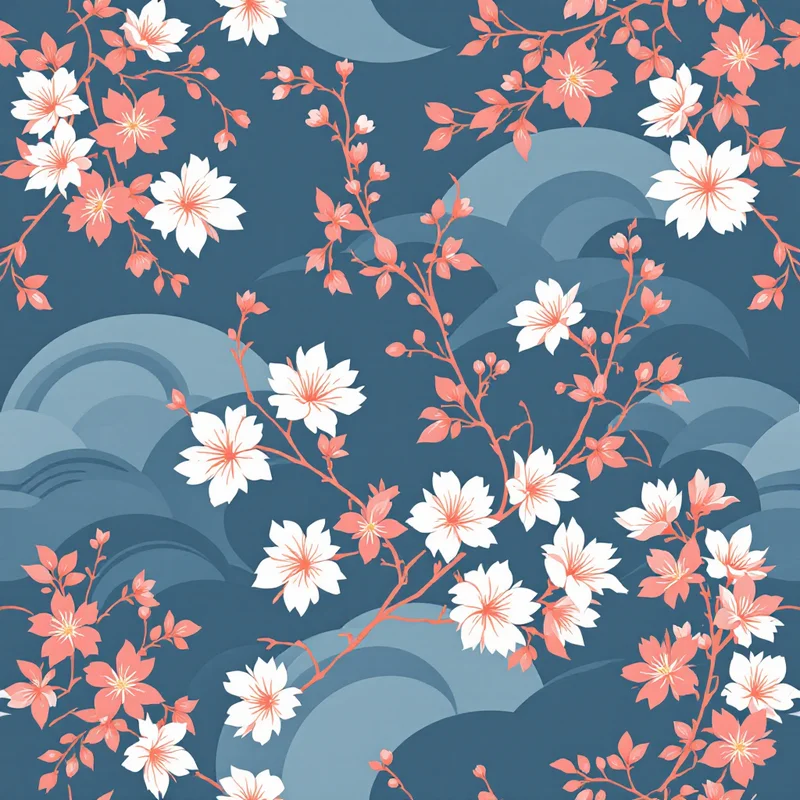
How AI pattern tools are reshaping both disciplines
The toolset has shifted under both careers in the last three years, and not symmetrically.
For textile design, AI has collapsed motif development, repeat construction, and colorway expansion from days of work to minutes. A surface designer who used to ship four prints a week can now ship four prints a day on the execution side, with the bottleneck moving to curation and brief-writing. The skills that matter have shifted from drawing technique toward art direction — being able to specify exactly what is wrong with a generated tile and direct it toward a usable result. Designers who have folded an AI pattern generator into their stack are pulling away from designers who have not.
For fashion design, AI has changed the workflow less dramatically. 3D garment simulation in CLO and Browzwear has matured into a real production tool. Generative sketching tools help with ideation but do not yet produce usable tech packs. The bottleneck in fashion design has always been physical sampling and fitting, and software has not moved that wall meaningfully. The biggest AI shift in fashion has been on the print side — fashion designers who used to commission a textile designer for every custom print can now generate competent print options themselves, which has reshaped the boundary between the two roles.
The practical implication for a student choosing between the two: textile design's tool fluency requirements have changed substantially, and a graduate without AI-tool literacy will be playing catch-up on day one of any commercial studio. Fashion design's tool requirements are still mostly 3D and PLM. Both are worth learning early.
Bottom line: which one to choose
For readers who want a clean recommendation rather than another comparison list:
Choose textile design if drawing, motif, and the physical surface of cloth are what hold attention; if a stable mid-career income with a portable freelance option matters more than a creative-director title; if working alone or in small studios feels right; and if learning a new generative toolset every year sounds energizing rather than exhausting.
Choose fashion design if silhouette, construction, and the way a garment moves on a body are what hold attention; if running collections, managing teams, and operating inside a fixed market calendar is appealing rather than draining; if the higher career ceiling justifies the longer climb; and if travel and production oversight fit the lifestyle.
Pick a hybrid path if a small independent brand is the goal and one person needs to do both jobs at lower depth.
Whichever direction the answer points, the credential is no longer the whole story. Tool fluency, portfolio depth, and a consistent point of view matter more than the school name in 2026. Pattern Weaver's studio is one of the places working designers in both disciplines now build that portfolio depth without the per-project cost compounding. Commercial license is included on all paid credit packs, and exports run up to 8K (8192×8192 px) in PNG, JPG, WEBP, TIFF, PDF, and SVG.
For deeper reads on either side: the textile designer career guide covers the surface side end to end, the clothing design workflow covers the garment side, and the blog has the long-form pieces on salary, courses, portfolio, and process that make the decision easier. Credit packs and the comparison of Free, Starter, Pro, and Max sit on pricing for readers ready to start producing rather than reading.
The choice between textile design and fashion design has never been a strict either-or. It is a question of where the energy goes first, and which direction the rest of a career can grow from. Pick the one that holds attention on a slow Tuesday, not the one that sounds best at a party.
Explore related pattern styles