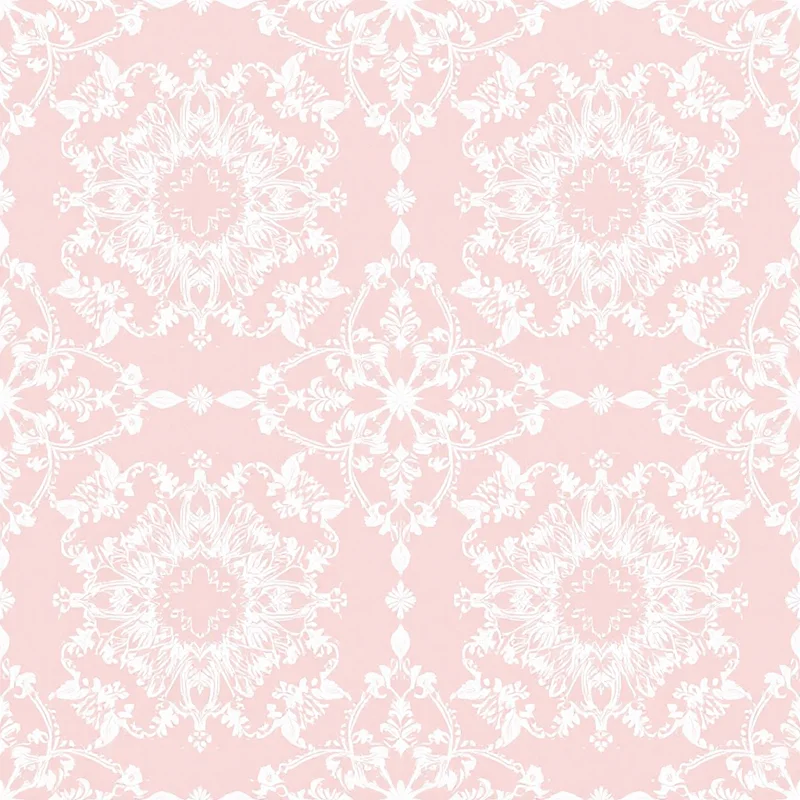

Lace is defined by what is missing. The holes are the design, and the thread exists to hold them open. That one idea explains why lace is hard to fake in print and why the best lace-look patterns are drawn with the same logic as the real thing.
Three ways lace is made
- Needle lace. Built stitch by stitch with a needle and a single thread. It is the most sculptural form, and the motifs can be raised.
- Bobbin lace. Dozens of threads wound on bobbins are twisted and crossed on a pillow. It can produce delicate nets and flat, flowing designs.
- Machine lace. Lace made on industrial machines, a major business in Nottingham, England in the 1800s. Most lace you can buy by the yard today is machine made.
Crochet and tape-based laces are separate families, and they have their own looks.
Named laces worth knowing
Alençon. A needle lace from Alençon, France. Floral motifs sit on a fine net, each one outlined in a slightly thicker raised thread called a cordonnet. The cordonnet is the detail to copy if you want a lace print to look expensive.
Chantilly. A bobbin lace named for the French town of Chantilly, known for delicate flowers, scrolls and ribbons on a light net. Chantilly in black silk is the version most people picture.
Valenciennes. A flat bobbin lace with a diamond-shaped mesh and soft scalloped edges, often used as narrow trim.
Guipure. Lace with no net ground at all. The motifs are joined by bars, so guipure reads as bold medallions and chunky florals. Venetian lace is a heavier, raised relative.
Battenberg. Tape lace, where woven tape is shaped into loops and filled with stitched bars. It was popular in the late 1800s and feels crisp and graphic.
Irish crochet. Raised flowers and leaves, crocheted separately and joined by a crocheted mesh. It developed in 19th-century Ireland.
Eyelet (broderie anglaise). Technically embroidery, not lace. Small holes are cut or punched and edged with stitches. It is a favorite for summer cotton and baby clothes.
The anatomy to copy when you draw lace
- 1The ground. Net, mesh or nothing. A guipure-style design has no ground, and the motifs need bars between them. A Chantilly-style design has a fine hexagonal net.
- 2The motif. Flowers, leaves, scrolls and ribbon bows. Keep them fairly flat and symmetrical.
- 3The outline. A heavier line around each motif, standing in for the cordonnet.
- 4The edge. Scallops, and tiny loops called picots, along the border.
- 5The contrast. Lace in print needs something behind it. Without a dark or colored underlay, the open areas are just white paper.
Lace-look print types
| Print type | How it reads | Good for |
|---|---|---|
| All-over lace florals | Chantilly-style flowers on mesh | Lingerie prints, scarves |
| Scalloped border lace | A placed edge with a flat field above | Hems, curtain edges, gift wrap |
| Guipure medallions | Round motifs joined by bars | Tote bags, blouses |
| Eyelet dot lace | Small holes with stitched outlines | Summer cottons, nursery textiles |
| Crochet doily | Concentric rings and loops | Coasters, stationery |
Palettes depend on the effect you want. Classic ivory lace is #F4EEDF on a #2A2230 plum ground. Black Chantilly is #16151A over a #E8C9C0 blush underlay. For a modern take, try a soft #C8D8E4 blue lace on white.
Scale and placement
A lace repeat works best between three and eight inches for apparel and up to a foot for wallpaper. Keep the lines fine but not so fine that they vanish in print, and test at actual size. If you are printing a border, pair it with a quieter all-over such as dots or a ditsy floral, like the ones in types of borders and trims.
Where lace-look prints fit in a collection
Lace belongs with the soft, vintage and romantic families. It also pairs with embroidery-style designs, which the embroidery pattern guide explains, and with the ribbon-and-bow look in coquette patterns. Browse lace patterns, romantic patterns and white patterns for references.
To try one, Browse Styles in Pattern Weaver lets you pick from 44 categories and 5,700+ styles, and the Tiling Fixer repairs the edge if a scalloped lace tile does not quite meet itself.
Explore related pattern styles