There is a reason tiger stripe pattern has refused to leave fashion for the better part of a century — it carries weight on the surface that almost no other print can match. The stripes signal motion, confidence, and a kind of borrowed wildness, which is why the motif keeps reappearing on runways, sofas, packaging, and album covers in every cycle. This guide breaks down what makes a tiger stripe pattern actually work, where the motif comes from, how to color it, and how to build a clean seamless repeat in Pattern Weaver in under five minutes.
What is tiger stripe pattern?
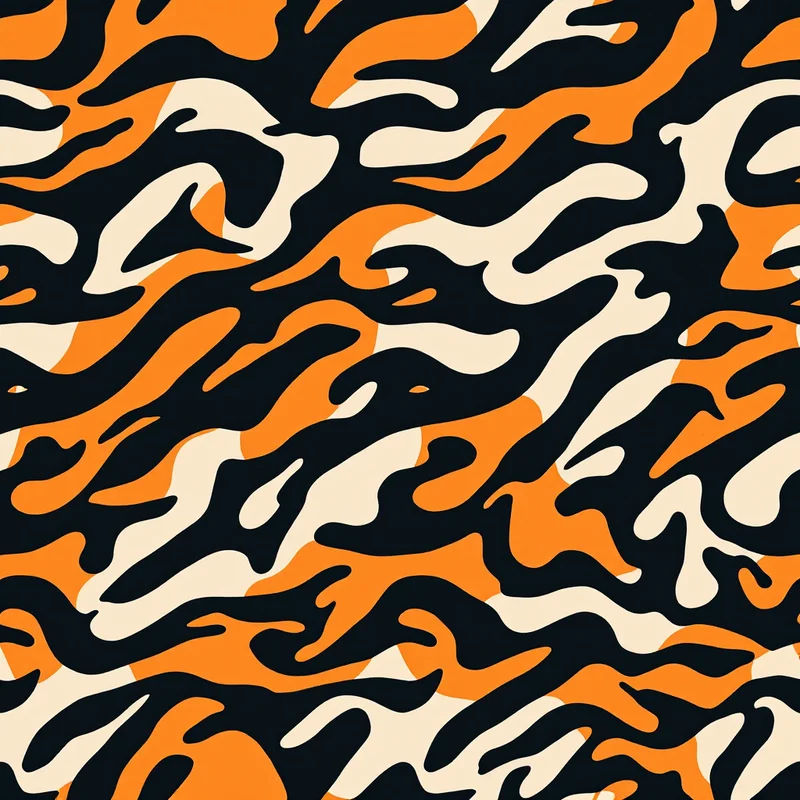
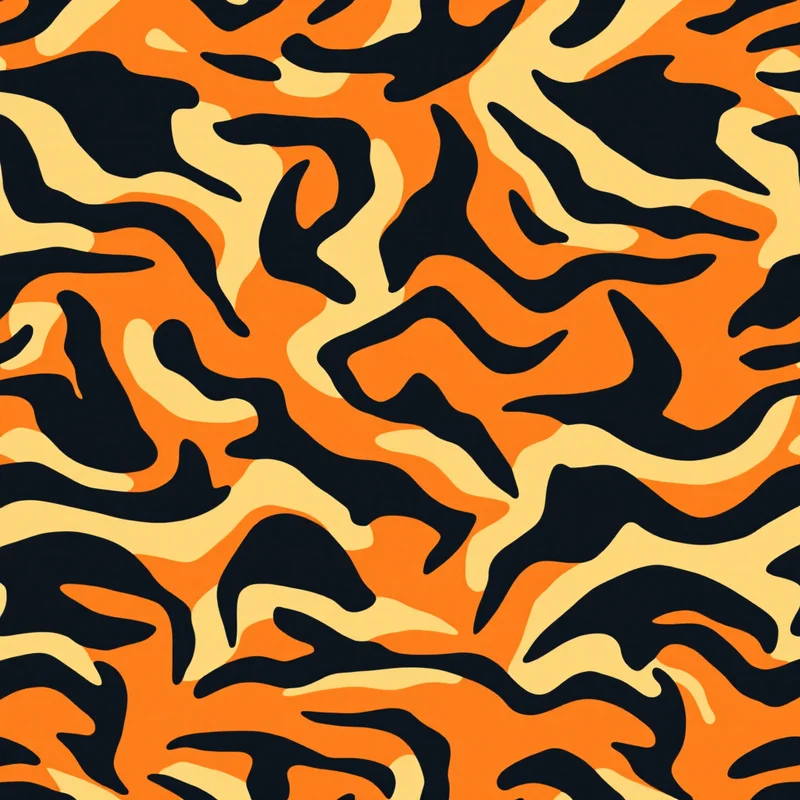
Tiger stripe pattern is a surface motif built from irregular dark bands that taper, fork, and curve across a warmer base color. The defining characteristic is asymmetry — no two stripes are identical, and many split into double or triple branches before fading into the ground. The eye reads it as organic rather than geometric, which is what separates a convincing tiger stripe pattern from a striped fabric that just happens to use the wrong colors.
A working textile designer will tell you the difference comes down to three things: stripe edge quality (broken and slightly feathered, not vector-crisp), stripe rhythm (varied widths within the same tile), and ground modulation (the base color is never perfectly flat). Get those three right and almost any palette will read as tiger.
Where tiger stripe pattern comes from
The motif's design history begins long before fashion adopted it. Tiger imagery sits at the heart of Tang and Song dynasty Chinese textiles, Mughal court textiles in 16th and 17th century India, and Korean folk painting where the tiger represented both protection and mischief. Each tradition stylized the stripes differently — Mughal courts rendered them in dense gold-on-indigo embroidery, while Korean minhwa kept them loose and almost cartoonish.
The Western fashion adoption traces to the early 20th century through Orientalist costume and Hollywood. Christian Dior's house used tiger stripe pattern on resort collections in the 1950s. Kenzo built a brand identity around the tiger motif from the 1970s onward. By the 1990s the print had cycled through punk, glam, hip-hop, and high streetwear, accumulating cultural baggage along the way.
Today the motif sits in fashion's perennial category. It cycles in intensity but never disappears. The 2026 reading is softer and more painterly than the bold 1990s version, with watercolor edges and tonal palettes taking over from the high-contrast amber-black classic.
Visual hallmarks of tiger stripe pattern
A strong tiger stripe pattern usually shows the following:
- Tapered ends. Stripes do not start or stop with hard square edges. They feather and thin out toward the tips.
- Branching. Single stripes split into two or three at irregular points, which is the single most recognizable feature of the motif.
- Varied widths. Within the same tile, stripe widths vary by a factor of three or more — chunky core stripes alongside thinner secondary marks.
- Implied directionality. The stripes follow an invisible muscle direction, usually flowing along a curve rather than running parallel to the tile edge.
- Modulated ground. The base color shifts subtly across the tile — warmer in one quadrant, cooler in another — which mimics the natural variation of a real coat.
- Edge quality. The stripe edges are slightly broken, feathered, or painterly. Vector-crisp edges read as graphic stripe, not as tiger.
How to generate tiger stripe pattern in Pattern Weaver
Pattern Weaver's studio collapses what used to be an evening of repeat construction into a few minutes of curation. The workflow:
- 1Open the studio and pick Animal Print. Sign in and open the studio. From the category menu choose Animal Print, then select Tiger Stripe as the substyle. This loads the correct motif weighting so the generator focuses on irregular tapered bands rather than spots or scales.
- 1Choose your palette. Pick a color palette before you generate. Classic Bengal uses amber, charcoal, and cream. Snow tiger uses ivory and slate. Modern alternatives include emerald-black, blush-chocolate, and pastel reworks. The palette picker accepts hex codes if you are matching a brand guide.
- 1Set scale and density. Move the scale slider to control how wide each stripe sits in the final tile. Aim for mid-scale on apparel briefs, oversized for outerwear and home textiles, micro for shirting. Density controls how tightly packed the stripes are — heavier density reads as a full coat, lighter density gives you breathing room between bands.
- 1Generate and curate. Run the generator. The studio returns a batch of variations. Compare them on the preview tile and on the live repeat view to see how each option behaves at scale. Pick the strongest result and refine with regeneration if a specific area needs work.
- 1Export production files. Choose your export resolution up to 8K (8192 by 8192 pixels) and pick the format your end-use needs — PNG, JPG, WEBP, TIFF, PDF, or SVG. The studio runs a final seamless check on export so the tile repeats cleanly across edges with no visible join.
Color palette ideas for tiger stripe pattern
Palette is where tiger stripe pattern earns or loses its modern read. A few combinations worth testing:
- Classic Bengal. Burnt amber (#C8651D) with deep charcoal (#1F1A14) stripes over cream (#F4E4C4). This is the default and reads as luxury when rendered well.
- Snow tiger. Ivory (#F2EEE3) with cool slate (#3F4651) stripes. Reads as winter editorial.
- Emerald and ink. Deep emerald (#0F4D3A) with near-black (#0B0B0D) stripes. Reads as modern luxury, especially on velvet.
- Blush and chocolate. Soft blush (#E8B4A8) with warm chocolate (#3D2418) stripes. Reads as feminine and current.
- Mustard and aubergine. Dark mustard (#B8862C) with deep aubergine (#2D1B2E) stripes. Reads as autumn editorial.
- Pastel rework. Lavender (#D4C4E0) with navy stripes. Reads as streetwear or children's apparel.
Best use cases
The pattern translates across categories with adjustments to scale and palette:
- Apparel. Mid-scale stripes between 3 and 6 cm work on dresses, blouses, and shirting. Oversized scale works on coats and statement pieces. Activewear has adopted the print at micro scale for leggings and sports bras.
- Wallpaper. Tonal palettes and oversized scale dominate the wallpaper category in 2026 — large painterly tiger stripe pattern designs in chocolate-on-cream or ink-on-blush.
- Packaging. Beauty and fragrance brands use micro-scale tiger stripe pattern for luxury reads. Spirit brands favor classic Bengal at mid-scale.
- Accessories. Scarves, bags, and shoes usually crop a section of the repeat rather than tiling it, which gives the design room to breathe.
- Home decor. Cushions, throws, and upholstery handle the motif well at mid to oversized scale. Velvet finishes amplify the directional read.
For a wider look at the category, browse animal print options in the studio's category menu.
Pro tips for stronger tiger stripe pattern repeats
A few things that separate a usable repeat from a great one:
- Keep the high-action stripes away from tile edges. The eye catches seams when busy detail crosses them. Design with calm zones at the edges and dense stripe action in the center.
- Vary stripe orientation across the tile. Real tiger coats do not have stripes all running the same way. A small angular variation across the tile makes the print feel organic.
- Test at three scales before locking. What looks balanced at preview size often reads completely differently at production scale. Generate proof prints at 100%, 50%, and 200% scale before committing.
- Add a hero stripe. One disproportionately bold stripe in each tile gives the eye a hook and makes the overall pattern more memorable.
- Check the colorway under different light. Amber reads warm under tungsten and cooler under daylight. Approve final colors under the lighting the product will live in.
For more on the underlying repeat math, the seamless pattern construction guide covers the fundamentals. For brand work, the print-on-demand workflow explains how to prep tiger stripe pattern files for platforms like Printful and Society6. And the broader AI pattern generation walkthrough covers techniques that apply across the studio.
Generate your own tiger stripe pattern
Pattern Weaver was built to compress the slowest parts of textile design — repeat construction, colorway expansion, format conversion — so the time you spend stays on the parts that actually need taste. A tiger stripe pattern that used to take an afternoon now takes a few minutes from blank canvas to production file.
Open the studio and run a Bengal palette in classic mid-scale as a first pass. Try a snow tiger variant. Push one into emerald or blush and see how the motif holds. Free credits cover personal-use exports; paid credit packs unlock commercial licensing and full 8K production resolution. The full breakdown of Free, Starter, Pro, and Max tiers sits on pricing. The motif is timeless. The execution is what makes yours.