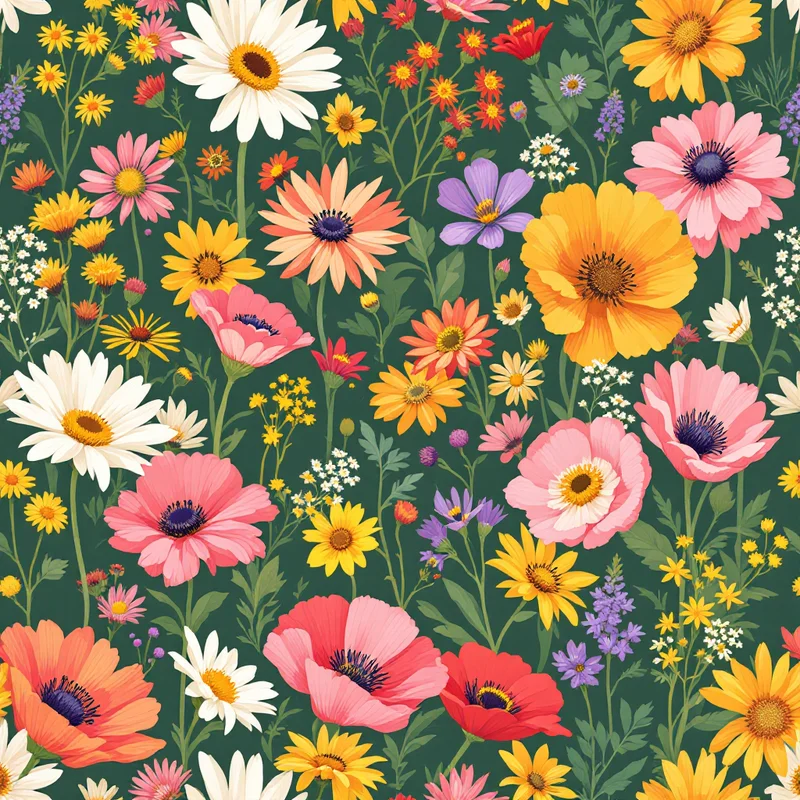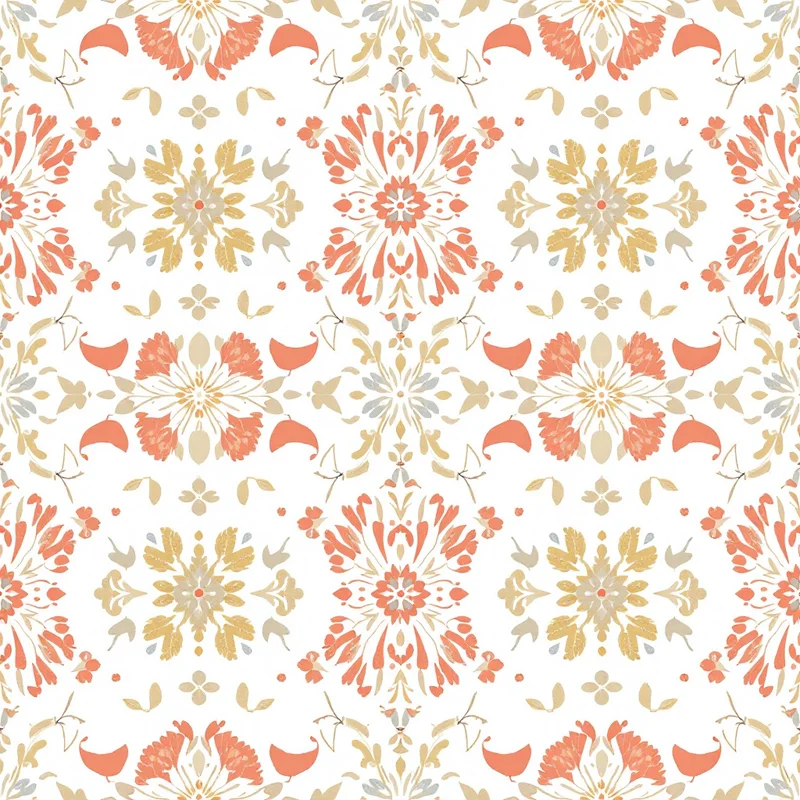
Traditional wycinanki were cut with the large shears used for shearing sheep, and the sharp, snipped edge of the paper is still the signature of the style. Wycinanki (singular wycinanka) are Polish folk paper cuttings, made by rural families to decorate their homes, often for holidays. The name comes from the Polish verb for cutting out.
Fold, snip, unfold
Most wycinanki start with a folded sheet. Cut a motif into one half and unfold, and you have a perfectly mirrored design. That folding is why the style is so symmetrical, and it is also why it adapts so well to pattern design: a half motif and a mirror are the whole method.
Two regional styles
The best-known styles are named for regions of Poland.
| Kurpie | Łowicz | |
|---|---|---|
| Color | Usually one color, cut from a single sheet | Many colors, built in layers |
| Layout | Strongly symmetrical, vertical or radial | Circular, fan-like or bouquet-like |
| Subjects | Trees, stars (gwiazdy), roosters, animals | Roosters, flowers, wheels, bouquets |
| Ground | Plain contrasting paper | Colored background with layered cutouts |
Kurpie work comes from the Kurpie region in northeastern Poland. Łowicz work comes from the area around the town of Łowicz in central Poland and is known for bright colors. Naming the region, rather than calling a design "Polish folk," is the first step toward using the tradition accurately.
Motifs and what they do
- The rooster. A frequent subject, drawn with a fan tail made of curls and notches.
- The tree of life. A symmetrical tree with paired birds or flowers.
- Stars and rosettes. Radial designs that show off the folded-paper method.
- Flowers. Tulips, daisies and bell flowers, often fringed.
- Borders. Narrow bands of repeated leaves and hearts.
The paper-cut look
Several features define it, and all are easy to reproduce:
- Flat color, no gradients
- Pointed or notched edges, like pinking shears
- Small teardrop and circular cutouts that show the background
- Tiny irregularities in the cut, so no curve is perfectly smooth
- A slight shadow under layered pieces, which gives the Łowicz look its depth
A palette
For Łowicz-style work:
- Red #C8102E
- Leaf green #3F8F3A
- Sun yellow #F2B705
- Blue #1E5AA8
- Pink #E65A8A
- Paper white #FAF7F0
For Kurpie-style work, use one dark color, such as ink black #1A1A1A or deep green #1F4D36, on white.
Designing a wycinanki-style pattern
- 1Draw half. Sketch half a rooster, tree or rosette on one side of a center line.
- 2Add edges and cutouts. Notch the outline and add teardrop cutouts inside.
- 3Mirror it. Reflect the half to complete the motif. The mirror repeat tutorial shows how to do this in a seamless tile.
- 4Layer for Łowicz. Add two or three colored layers beneath, each slightly offset, with a faint shadow.
- 5Set the repeat. Place motifs in a half-drop with small leaves and hearts filling the gaps. For a border, repeat a single motif in a row.
- 6Scale it. A rosette of about 3 to 5 inches (7.5 to 13 cm) works on cushions and gift wrap; the same drawing at half the size suits packaging.
Where the look works
Wycinanki-style repeats suit gift wrap, holiday cards, children's room textiles, tea towels and tableware, because the flat color and strong silhouettes print cleanly at small and large sizes. They also scale well into borders for stationery. Keep the motifs bold; thin cut lines vanish when a pattern is reduced.
Many cultures cut paper: Mexican papel picado, Chinese jianzhi and German and Swiss Scherenschnitte all use scissors or knives to turn folded sheets into patterns. Wycinanki have their own regional vocabulary, so treat them as their own tradition. For more folk art vocabulary, read our Scandinavian pattern design guide and the Ukrainian vyshyvanka patterns guide.
The Polish folk patterns, folk art patterns and floral patterns categories are good starting points. In Pattern Weaver, Describe It lets you write a prompt in your own words, such as "Łowicz-style layered paper-cut roosters and flowers in red, green and yellow", and your pattern arrives as a seamless tile in about 20 seconds.
Explore related pattern styles