Houndstooth is one of the most recognisable and structurally interesting geometric patterns in textile design. The distinctive broken-check pattern with its irregular four-pointed shapes alternating against a contrasting field has anchored menswear suiting, womenswear accessories and home decor textiles for centuries, and it continues to provide one of the most reliable commercial geometric vocabularies in contemporary surface pattern design. The pattern is simple enough to read instantly and complex enough to support significant variation through scale, palette and contextual application.
Understanding houndstooth structurally — what makes it work, what makes it fail, how the visual relationships function across scales — is essential for designers who want to use this vocabulary effectively. This guide examines the underlying anatomy of houndstooth pattern, the scale and palette strategies that produce commercially successful designs, and the application categories where the pattern continues to excel.
The Structural Anatomy
Houndstooth — known in French as "pied de poule" (hen's foot) and in older texts as "shepherd's check" or "dogtooth" — is fundamentally an irregular tessellation. Each houndstooth "tooth" is a four-pointed jagged shape produced by the weave structure: a 4×4 thread woven check produces straight-edged squares, but a 2/2 twill weave with a specific colour sequence produces the characteristic irregular projection that makes houndstooth distinctive.
The original textile production of houndstooth relied on this specific weave structure, with the visual effect emerging from the interplay of warp and weft colours through the twill weave. Contemporary digital design and printing can produce houndstooth patterns without the underlying weave structure, but understanding the weave origin helps designers create authentic-feeling houndstooth designs rather than generic broken-check patterns that read as cheap imitations.
Each individual houndstooth shape has specific proportional characteristics. The shape is wider than tall, with a base that typically spans roughly 1.5 to 2 times its height. The two upper points project upward and slightly inward at angles that produce the distinctive jagged silhouette. The two lower points mirror the upper but project downward and outward. The internal proportions of these projections affect how the pattern reads — overly sharp projections produce an aggressive feel, overly soft projections produce a generic check feel.
The arrangement of shapes follows a regular tessellating logic. Each houndstooth shape interlocks with its neighbours through the points and recesses of adjacent shapes. The result is a fully tessellated surface where the pattern repeats horizontally and vertically with consistent rhythm.
The two-colour structure is essential. Traditional houndstooth uses two contrasting colours — typically black and white, or two strongly contrasting tones — with each colour producing approximately equal field area within the design. This balanced field area creates the characteristic visual rhythm where neither colour dominates and the two colours read as participating in a dynamic visual exchange.
Scale Strategy
Houndstooth scale dramatically affects the pattern's character and commercial application. Small-scale houndstooth — individual teeth roughly 5 to 10 millimetres in major dimension — reads as a textile texture rather than as a distinct pattern, particularly at viewing distances of more than a metre or two. This small scale is traditional for menswear suiting fabric and produces patterns that read as quality wool textile rather than as decorative pattern.
Medium-scale houndstooth — individual teeth roughly 15 to 25 millimetres — reads as a distinct pattern that can be enjoyed as a decorative element while still maintaining traditional houndstooth character. This scale is typical for accessories, scarves, jacket linings and small-format applications where the pattern needs to read as houndstooth without dominating the surface.
Large-scale houndstooth — individual teeth roughly 40 to 80 millimetres — reads as a statement pattern that consciously declares its houndstooth character. This scale is typical for modern home decor textiles, statement fashion pieces and contemporary applications where the pattern is the visual focus rather than the supporting texture.
Oversized houndstooth — individual teeth above 100 millimetres — reads as a graphic interpretation of houndstooth, often used in contemporary wallpaper, large-format wall art and statement upholstery where the pattern functions almost as decorative motif rather than as textile pattern.
The scale choice should match the application. Suiting fabric benefits from small scale. Throw pillows benefit from medium to large scale. Statement wallpaper benefits from oversized scale. Mismatched scale choices — small-scale houndstooth on a throw pillow, oversized houndstooth on a suit — produce patterns that read as incorrect or awkward.
Palette Strategy
Traditional houndstooth in black and white remains the foundational palette and produces patterns with maximum graphic clarity. The pure black against pure white maximises the visual contrast that gives houndstooth its essential character. This palette works across essentially every commercial application and time period.
Contemporary palette variations open up significant design possibilities while preserving houndstooth structural character. Warm dark with cream — chocolate brown with warm cream, navy with cream — produces patterns with slightly softer character that work well in contemporary home decor and casual fashion contexts. Cool palette variations — grey with white, deep navy with white — maintain the traditional graphic clarity while opening modest palette variety.
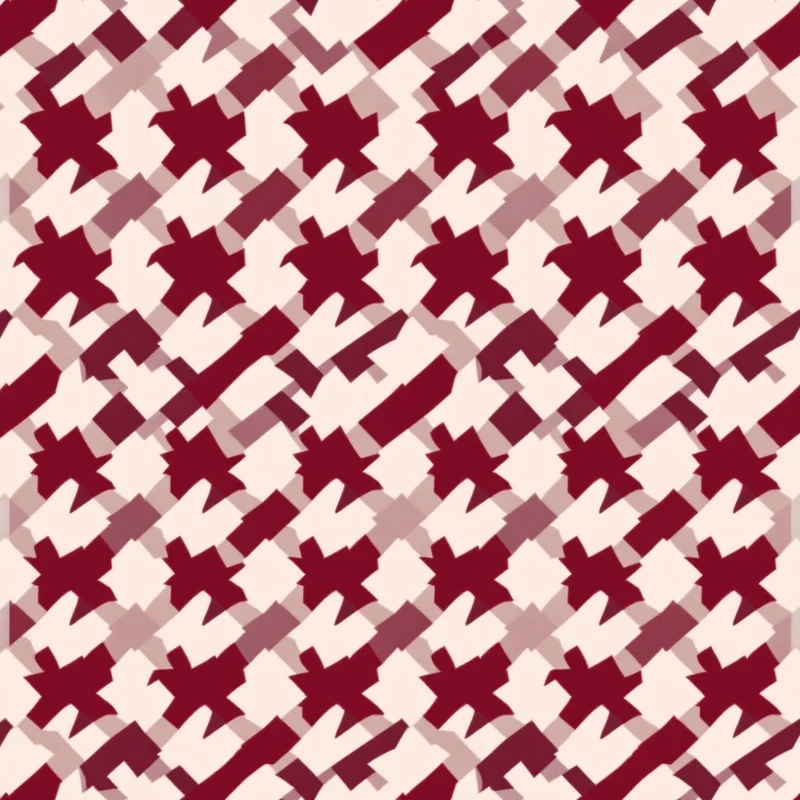
Saturated colour variations — burgundy with cream, forest green with cream, ochre with cream — produce patterns with more decorative character that work well as statement pieces in home decor and contemporary fashion. The high contrast requirement of houndstooth requires that the two colours maintain strong tonal separation regardless of hue, so these saturated variations work when the deeper colour has sufficient depth to provide that contrast.
Multi-colour houndstooth variations — three or four colours arranged across the pattern — sit outside traditional houndstooth vocabulary and read as contemporary interpretation. These designs can work but require careful colour relationships to preserve the underlying houndstooth rhythm rather than becoming generic geometric patterns with houndstooth-shaped elements.
Contemporary Applications
Menswear and tailoring continues to use houndstooth as a foundational vocabulary. Jackets, trousers, suits, accessories and ties all support traditional houndstooth design at various scales. The category rewards designs that respect the traditional weave-derived structure and palette conventions.
Womenswear has used houndstooth extensively in recent decades, particularly in coats, skirts, dresses and accessories. Contemporary womenswear interpretations include both traditional black-and-white houndstooth and saturated palette variations, with the latter providing distinctive seasonal collections.
Home decor textiles use houndstooth across throw pillows, blankets, drapery and upholstery in both traditional and contemporary positioning. The category supports the full range from small-scale traditional patterns to oversized contemporary statement pieces.
Wallpaper applications include both traditional small-pattern houndstooth wallpaper and contemporary oversized statement applications. The category has grown substantially in recent years as design-forward homeowners use houndstooth wallpaper as accent and statement elements.
Stationery and paper goods use houndstooth for distinctive sophisticated positioning. Gift wrap, journals, planners and greeting cards all support houndstooth designs that signal classical sophistication.
Branding and identity design uses houndstooth as a foundational pattern for brands seeking heritage, quality, masculine or sophisticated positioning. The pattern's deep cultural associations support brand vocabularies built on classical references.
Common Pitfalls
Several pitfalls recur in contemporary houndstooth design. The first is incorrect proportional structure — designers who do not understand the underlying anatomy sometimes produce patterns where the teeth have generic geometric proportions rather than the specific houndstooth proportions. These designs read as broken check patterns rather than as houndstooth, and the difference is perceptible.
The second pitfall is insufficient contrast. Houndstooth depends on strong tonal contrast between the two field colours. Designs with insufficient contrast produce patterns that read as muddled rather than as crisp houndstooth. Designers should verify the tonal contrast at the actual viewing scale of the intended application.
The third pitfall is overly aggressive scale-up. Houndstooth scales up effectively to large and oversized applications, but at extreme scales the visual character can shift toward graphic abstraction rather than reading as houndstooth. Designers should test the design at actual production scale to confirm the pattern still reads as houndstooth at the intended viewing distance.
The fourth pitfall is poor palette adaptation. The strong cultural associations of houndstooth mean that palette choices that seem stylistically appropriate may read as wrong within houndstooth tradition. Soft pastel houndstooth, neon houndstooth, or other extreme palette interpretations can work for specific applications but generally undermine the pattern's character.
Houndstooth is a pattern that rewards careful attention to its specific structural and palette conventions. The designers who produce successful houndstooth designs understand the underlying anatomy, choose the scale appropriate to the application, maintain the contrast requirements and respect the palette conventions while introducing thoughtful variation. The result is pattern work that draws on centuries of textile tradition while remaining commercially current across many application categories.
Explore related pattern styles
Patterns for