
# Greek Key Pattern Design: The Meander Motif Explained
The greek key pattern is one of the oldest and most recognizable designs in the world: a single continuous line that turns at right angles and folds back on itself, marching along in a tidy band. You have seen it on Greek pottery, on the hem of a designer dress, on a luxury handbag, and bordering a hotel lobby rug. Designers also call it the meander motif, and once you learn to read its geometry you can build it, recolor it, and scale it for almost any product. This guide explains where the greek key pattern comes from, what makes it work visually, and how to generate a clean, seamless version in minutes.
What is the Greek key pattern?
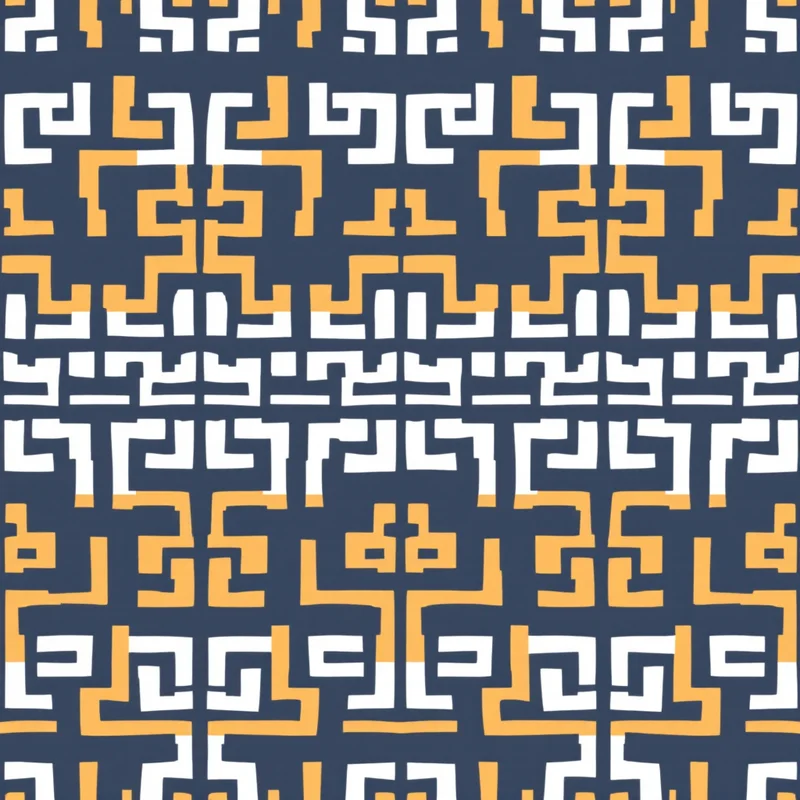
The greek key pattern is a geometric border built from one unbroken line that bends only at 90-degree angles. As the line travels, it spirals inward, reverses, and repeats, creating a chain of interlocking hooks or "keys." Because the path never lifts off and never crosses itself, the eye follows it as a single continuous journey. That is why the meander motif is so satisfying to look at: it reads as both intricate and orderly at the same time.
The simplest version is a single-line fret. More elaborate forms double the line, nest two keys together, or alternate the direction of each hook to create a woven, basket-like rhythm. All of them share the same DNA: right angles, even spacing, and a path that resolves perfectly so it can repeat forever.
Origins of the meander motif
The name "meander" comes from the Maeander River (today the Büyük Menderes in Turkey), famous in antiquity for its winding, looping course. Ancient Greek artists abstracted those river bends into a strict geometric line and used it to frame everything from vases to temple friezes around the 8th century BCE.
To the Greeks, the greek key pattern carried meaning. Its endless, unbroken path symbolized eternity, unity, and the flow of life and death, and it was linked to ideas of the labyrinth and cosmic order. The meander motif spread across the Mediterranean and well beyond, appearing in Roman mosaics, Chinese bronzes, and Mesoamerican textiles, each culture arriving at the same elegant logic of a folded, repeating line. That deep, shared history is part of why the design still feels both ancient and modern.
Visual hallmarks
A few features define a true greek key pattern and separate it from generic geometric trims:
- Right angles only. Every turn is 90 degrees. Curved or diagonal lines break the effect and read as a different motif entirely.
- One continuous path. The line should feel like a single ribbon, not a collection of separate shapes.
- Even spacing. The gaps between line segments are consistent, which gives the meander motif its rhythmic, machine-precise look.
- Mirror or rotational symmetry. Many versions flip or rotate the unit so adjacent keys lock together.
- Strong contrast. The pattern lives on the boundary between line and ground, so contrast is what makes it legible.
When all of these line up, the greek key pattern looks crisp at any size, from a thin border to a bold all-over repeat.
How to generate it in Pattern Weaver
You do not need to plot grid points by hand. Here is the workflow inside the studio, and it matches the steps in the how-to above.
- 1Describe the meander motif. Open the studio and write a prompt like "seamless greek key pattern, continuous meander border, crisp right-angle lines." Plain language is enough.
- 2Set style and structure. Choose a geometric style and a grid or border structure so the lines keep their clean 90-degree turns instead of softening into curves.
- 3Tune color, scale, and density. Start with a high-contrast palette such as black on white, then use the scale and density sliders to decide whether the greek key pattern sits as a tight texture or an airy frame.
- 4Generate and preview the tile. Generate, then open the tile preview to confirm the meander motif repeats seamlessly with no broken corners where the edges meet.
- 5Export print-ready files. Export as SVG for infinitely scalable line art, or as a high-resolution raster up to 8K (8192x8192) for fabric, packaging, and physical products.
If you are new to seamless work, our walkthrough on how to create seamless patterns explains why edge-matching matters and how the tile preview saves you from costly reprints.
Color palette ideas
The greek key pattern is famously flexible with color. A few directions that consistently work:
- Classical: black line on a white or bone ground, the look of Greek pottery and marble.
- Nautical luxe: navy on cream, or navy paired with warm gold for a coastal, high-end feel.
- Earthen modern: terracotta and sand, or olive and oat, for a contemporary interiors mood.
- Jewel and metal: emerald or sapphire lines with brass and ivory accents.
- Tonal: the meander motif one shade off its background for a quiet, textural finish.
Keep contrast high when the design is small, and you can relax it as the scale grows. To plan palettes that survive the move from screen to physical product, see our notes on pattern design for print on demand.
Best use cases
Because it is a border by nature, the greek key pattern excels as trim: on dishware rims, towel edges, curtain hems, and signage frames. As an all-over repeat it makes confident wallpaper, upholstery, gift wrap, and tile. In fashion it shows up on knitwear, scarves, swimwear, and accessories, where its clean geometry photographs well at small sizes. For print-on-demand sellers, the meander motif is a dependable evergreen: it never looks dated and it suits mugs, phone cases, leggings, and tote bags equally.
Pro tips
- Mind the corners. When you wrap a greek key pattern around a rectangular frame, the corner is where amateurs slip. Mirror the unit into the corner so the line resolves cleanly.
- Pick line weight before color. A heavier line reads bolder and tiles tighter; a thin line feels refined. Decide this early.
- Test at final size. A meander motif that looks great large can turn into mud when shrunk onto a label. Zoom out before you export.
- Save a vector master. Exporting SVG once gives you a scalable source you can recolor forever without quality loss.
- Vary the rhythm. Try a double-line or alternating-direction variant to make a familiar design feel fresh.
Start designing
The greek key pattern proves that a single, disciplined line can carry thousands of years of meaning and still feel new. With Pattern Weaver you can describe the meander motif in plain words, fine-tune its color and scale, and walk away with seamless, print-ready files in minutes. Browse ready-made starting points on the create page, compare what each plan includes on the pricing page, and if you want a broader primer, read our guide on how to make a pattern with AI. Then open the studio and let your first greek key pattern take shape.