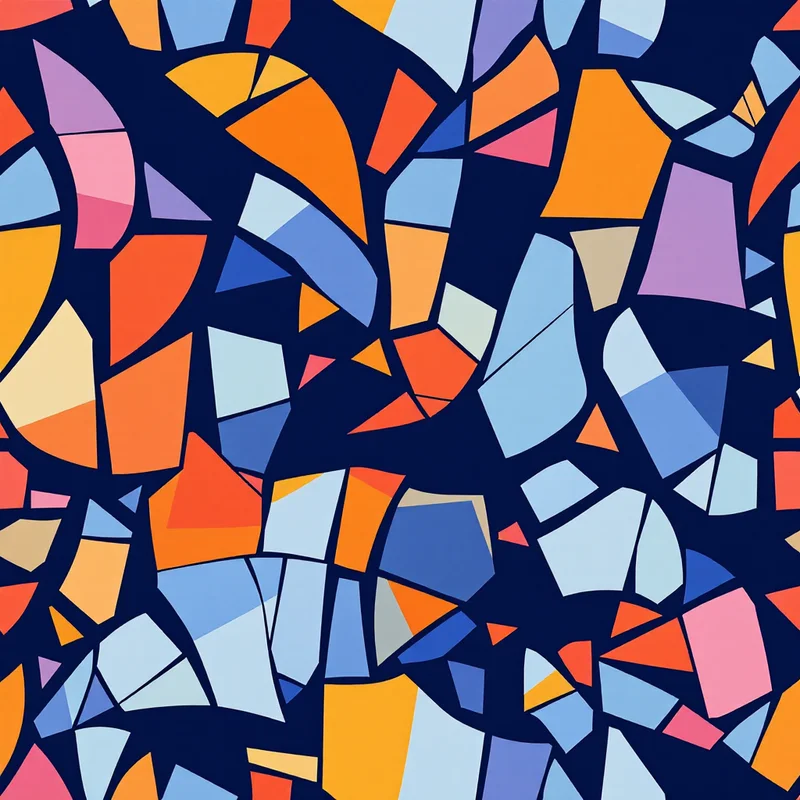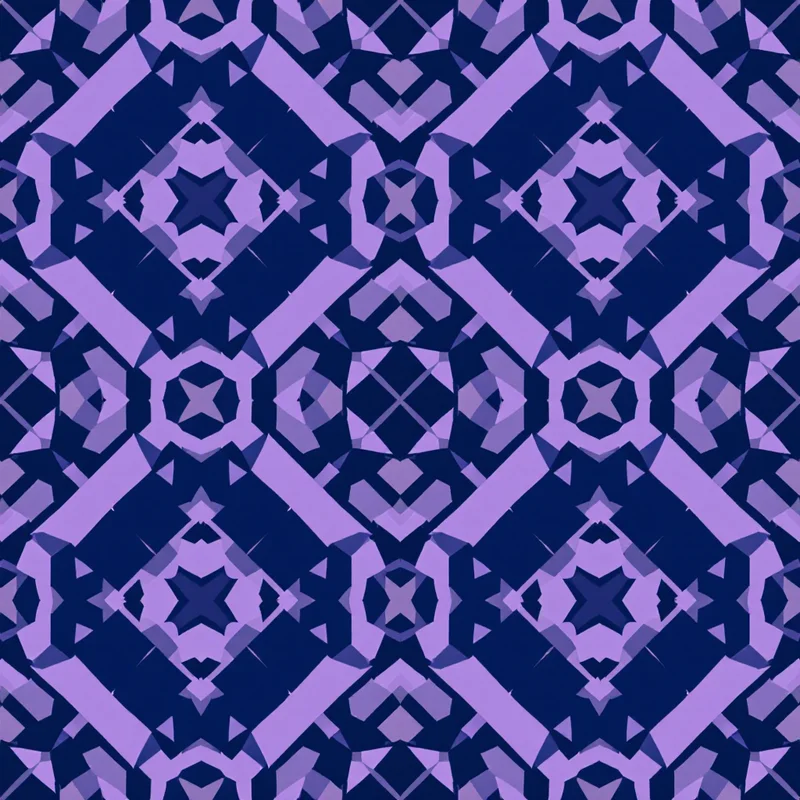
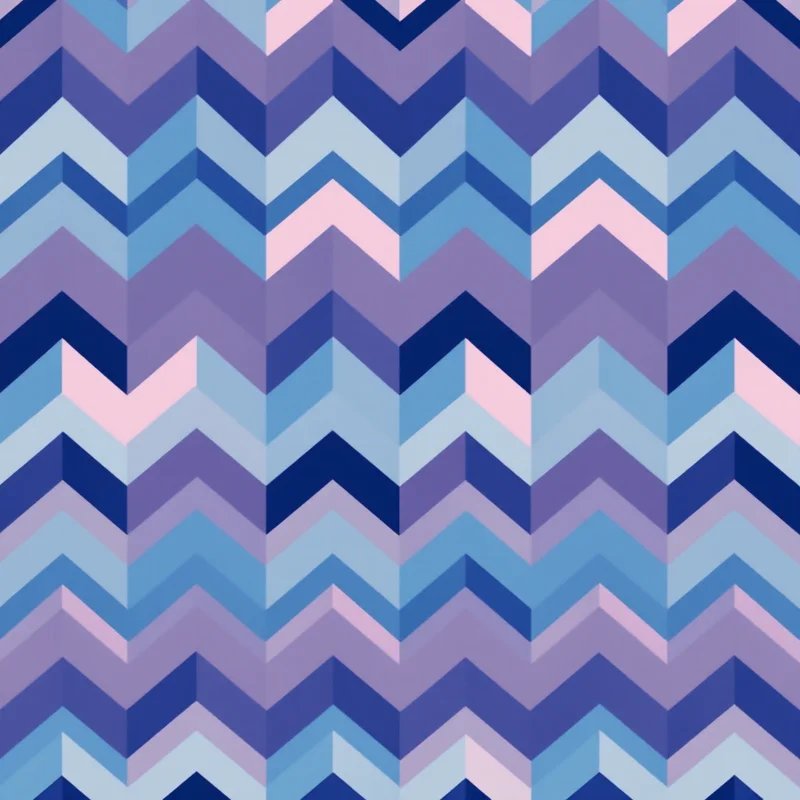
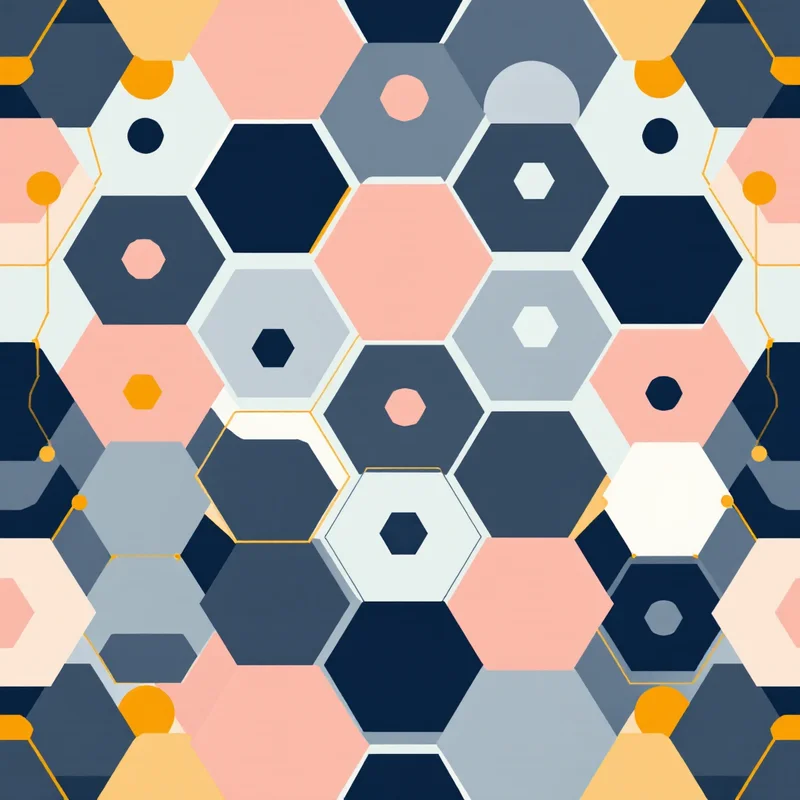
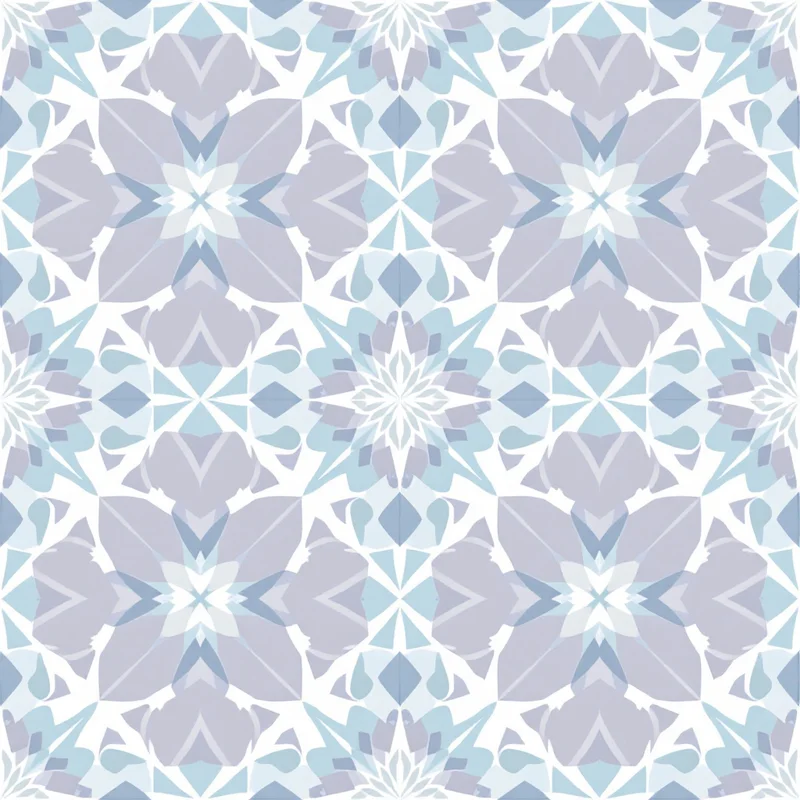
Geometrics are splitting into two camps. One stays with the ruler: hard corners, perfect circles, mathematically even spacing. The other looks as if someone cut the shapes out of paper with scissors and arranged them on a table. For 2027, the second camp is where the new energy appears to be.
Direction one: hand-cut shapes
Take a circle, a half-circle, an arch and a quarter-square, and draw each as if cut freehand. Edges are slightly off, corners slightly rounded, the curve of an arch not quite symmetrical. The result still reads as geometric but carries warmth.
- Palette: #E4572E (tomato), #F2B134 (mustard), #2E4057 (ink blue), #F6EFE0 (cream ground)
- Scale: shapes 1 to 3 inches (2.5 to 8 cm) for apparel and gift wrap, 4 to 8 inches (10 to 20 cm) for cushions and bedding
- Suits: kids' clothing, tote bags, wrapping paper, ceramics
Keep the spacing loose and avoid a visible grid. If every shape sits on an obvious row, the hand-cut feeling disappears.
Direction two: soft-cornered grids
Checkerboards, windowpanes and lattices with rounded corners and inconsistent line weights. This overlaps with checks, so for the gingham, windowpane and tartan side see our check and plaid forecast.
For a true geometric treatment, try a grid of rounded squares where each one is a slightly different tone of a single color. The eye reads it as a pattern up close and a gradient from afar.
- Palette: #D9C7A8, #C4AE8B, #AB946F, #8C7753 (a four-step tan run) with #2B2B2B for accents
- Suits: upholstery, rugs, wallpaper in quiet rooms
Direction three: optical waves and moiré play
Op-art style lines, concentric rings and wave stripes that seem to move. This is the high-energy end of the category, and it is where phone cases, streetwear and posters will probably spend most of 2027.
Practical notes: keep line weight consistent, since optical effects fall apart when thickness varies by accident, and test the print at its final size. A pattern that vibrates on a monitor can be too much on a throw pillow. Our optical illusion patterns category shows the range from subtle to extreme.
Direction four: modular tessellations
Interlocking shapes that fill a surface with no gaps: fish scales, hexagons, interlocking arches, Truchet-style tiles in which one quarter-circle tile is rotated four ways to build large flowing forms. Tessellations suit repeat design because the tile structure is built in. The tessellation patterns category is a good starting point.
- Palette: two or three colors only, for example #1F3A5F, #C9D6E3 and #F2E8CF
- Scale: 6 to 12 inches (15 to 30 cm) per module for walls and rugs, smaller for ties and scarves
- Suits: tiles, wallpaper, bags, swimwear linings
What to avoid
Gradient-heavy "tech" geometry and neon-on-black hexagon grids look dated quickly because they carry one specific moment in digital design. Likewise, thin-line triangle meshes drawn identically across a whole composition are now the default look of stock files. Add something human: variation, hand marks, or an unexpected color.
How geometrics sit beside other motifs
Geometrics work best in a collection as the quiet partner. A floral, an animal print or a toile can be the hero, with a soft-cornered grid or hand-cut shape as the coordinate. We compare how the two families behave in geometric vs. botanical patterns, and the types of geometric patterns guide gives names for the shapes you are working with.
Quick product guide
| Product | Direction to try | Shape scale |
|---|---|---|
| Wrapping paper | Hand-cut shapes | 1 to 2 in (2.5 to 5 cm) |
| Rugs | Soft grids, tessellations | 6 to 12 in (15 to 30 cm) |
| Phone cases | Optical waves | Fill the case, no visible repeat |
| Bedding | Tonal grid | 4 to 6 in (10 to 15 cm) |
| Shirts | Hand-cut shapes | 1 to 2 in (2.5 to 5 cm) |
Building and testing one
All four directions can be described in your own words. Try "hand-cut paper arches and circles in tomato, mustard and ink blue on a cream ground" in Describe It, or pick from the geometric patterns category in Browse Styles. Each result arrives as a seamless tile in about 20 seconds, and if an edge looks off, the Tiling Fixer repairs it. New accounts get 5 free credits to try the palettes above.
Explore related pattern styles