Wallpaper has a paper trail that begins with a scrap: a fragment found at Christ's College, Cambridge, in 1911, block printed with a pomegranate on the back of a sixteenth-century proclamation. From that scrap to a room-sized Pacific landscape took about three centuries, and the milestones in between are some of the most useful references a surface designer has.
Chinese export wallpaper
From the eighteenth century, hand-painted Chinese papers reached Europe, painted with birds, flowering branches, rocks and garden scenes on pale or colored grounds. Many hung in the country houses of Britain, and the Royal Pavilion in Brighton, remodeled in an orientalist style in the early nineteenth century, used Chinese wallpaper as part of its decor. These papers were usually painted as sets of panels, not as a repeating pattern, so the branches grow across the whole wall.
The lesson: the pre-repeat approach. Birds and branches are placed individually, so the composition feels alive. See Chinese patterns for the vocabulary.
Réveillon and the Paris luxury trade
In the 1780s the Paris manufacturer Jean-Baptiste Réveillon produced fine papers with arabesque borders and classical ornament. His factory was attacked in the riots of April 1789. The episode is a reminder that wallpaper was once a luxury trade, not a cheap one. His designers are among the people in famous wallpaper designers.
Dufour: *Les Sauvages de la mer Pacifique*
Joseph Dufour's scenic panorama of 1804-05, drawn by Jean-Gabriel Charvet, took imagery from accounts of Captain Cook's Pacific voyages and turned it into a room-sized landscape of islands, palms and figures. It is also a European fantasy, idealized and inaccurate about the people it shows, and today it is discussed as a record of how Europeans imagined the Pacific, not of the Pacific itself.
The lesson: a scenic is composed like a painting, with foreground, middle ground and a horizon that continues across seams. It also shows the danger of using other cultures as scenery.
Zuber: *Vues d'Amérique du Nord*
The Alsace manufacturer Zuber & Cie issued its scenic Vues d'Amérique du Nord in 1834, with views of places such as Boston harbor, Niagara Falls, New York Bay, West Point and the Natural Bridge in Virginia. A set hangs in the Diplomatic Reception Room of the White House, installed in 1961. Zuber still prints scenics from its original woodblocks.
The lesson: an enormous amount of color work from hand blocks. Many hundreds of blocks per set are what give the soft gradations of a painting.
Pugin at the Palace of Westminster
After the fire of 1834, the Palace of Westminster was rebuilt in the Gothic style, with A.W.N. Pugin designing interiors including wallpaper. His patterns are flat and heraldic, with tracery and crowns, and they are a clear statement that a flat wall should have flat pattern. See vintage wallpaper for how that look is revived.
Morris's Trellis
William Morris's first wallpaper, Trellis, was designed in 1862 and issued in 1864. A trellis of rose stems carries birds drawn by Philip Webb. It set the template for the dense, natural Arts and Crafts wall; our William Morris pattern inspiration post has the full approach.
Lincrusta and Anaglypta: relief you can paint
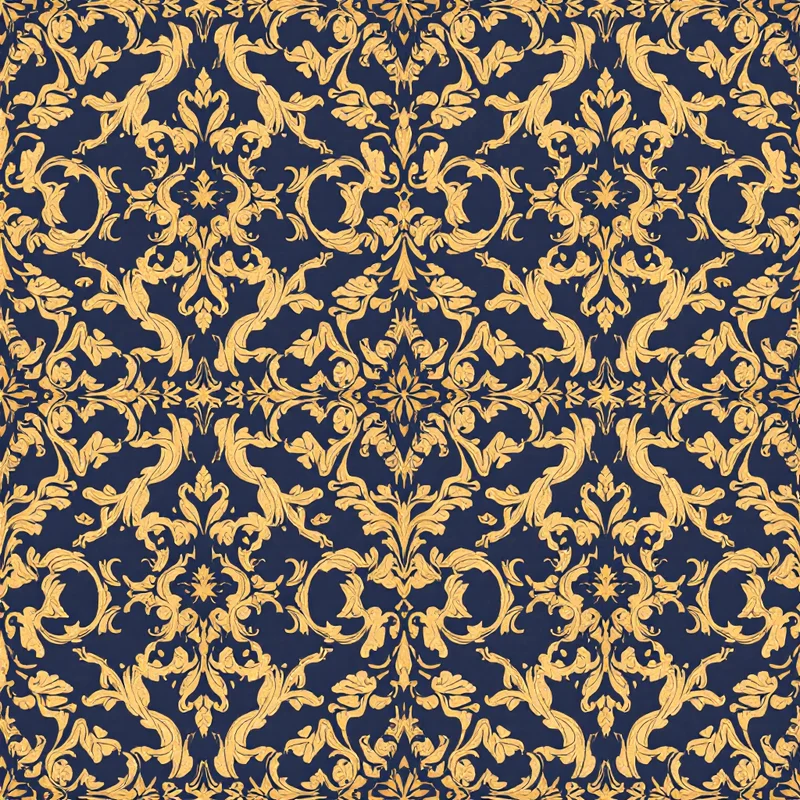
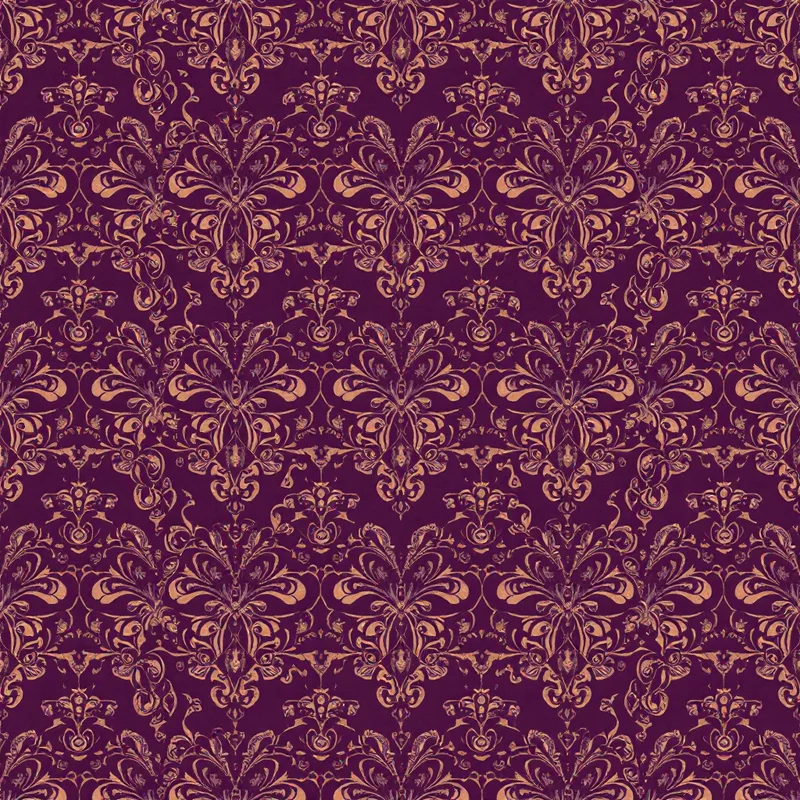
Frederick Walton patented Lincrusta in 1877, an embossed, washable wallcovering, and Anaglypta followed in 1887. Both were designed to be painted, with deep relief patterns, often damask-like, used on lower walls and in hallways. They are a good reminder that texture counts as pattern.
The lesson: if you design for a relief or flocked paper, draw bold shapes with room between them, because shadow will fill in the detail.
Wallpaper techniques, side by side
| Type | Look | Best for |
|---|---|---|
| Hand-painted panel | Individual branches, birds, no repeat | Statement walls |
| Scenic woodblock | Continuous landscape | Dining rooms, halls |
| Block-printed repeat | Dense, natural | Studies, bedrooms |
| Embossed relief | Texture, damask-like | Lower walls, hallways |
What to take away
Nearly every damask wallpaper on sale today descends from one of these approaches. The most useful habit is to ask which approach your design belongs to before you start drawing: a repeat, a panel or a scene. In Pattern Weaver, Describe It lets you write a prompt in your own words, so you can try "a Chinese-style wallpaper of branches, birds and rocks on a pale green ground" and check how it tiles.
Explore related pattern styles