The first commercial Christmas card, commissioned in London in 1843 by Henry Cole and illustrated by John Callcott Horsley, showed a family raising glasses at the center, flanked by scenes of charity. It was ornate, framed and a little moralizing, and that combination set the tone for decades of Victorian holiday design.
Where the look came from
A few well-documented developments shaped the Victorian Christmas image:
- The Christmas card. After Cole's 1843 card, printed greetings became a popular custom as postal services grew. By the 1870s printers such as Boston's Louis Prang were known for lavish color cards in America.
- The royal tree. An 1848 engraving of Queen Victoria, Prince Albert and their children around a decorated tree helped make the Christmas tree a fashion in Britain, and a version of that image was reprinted in the United States soon after.
- Chromolithography. Printing in many layers of ink made rich color affordable. That is why Victorian prints are lush, shaded and gilded.
- Die-cut scraps. Embossed, colorful paper cutouts, often produced in Germany and Britain, were glued into albums and onto cards. They are the source of many of the cluttered, collage-like compositions we call Victorian.
Decorative wrapping paper as a product mostly arrived in the early twentieth century, so what we call a "Victorian wrap" is really Victorian card, scrap and wallpaper imagery adapted for wrap.
Motifs to draw from
- Robins. A common Victorian greeting motif, often explained by the red coats of postmen of the time, who were nicknamed "robins."
- Holly, ivy and mistletoe. Evergreen botanicals that appear in garlands and borders.
- Snowy villages and carolers. Cottages, church spires, lamplit streets.
- Children and angels. Sentimental figures, usually in period dress.
- Flowers. Cards were not always wintery: violets, roses and pansies appeared next to holly.
- Ornate frames. Scrolls, ribbons and lace borders that cradle the central image.
Cards of the period were often built in layers: an ornate frame, a central scene and a scatter of small ornaments around it. For a repeat, you can treat that structure as a medallion, with the frame and scene as one unit tiled in a half-drop, and the small ornaments as a filler between units.
Palette
| Name | Hex | Role |
|---|---|---|
| Crimson | #8A1C2B | Ground, berries, ribbon |
| Bottle green | #1E3D2F | Foliage, ground |
| Antique gold | #B8893A | Frames, details |
| Ivory | #F3EBD8 | Paper, highlights |
| Sepia | #5B4332 | Linework |
| Midnight | #1B2338 | Night sky |
Making it modern
Victorian ornament is generous, and that is the point of modernizing it: take what works and edit.
- 1Cut the palette to three colors. A deep green, an ivory and one gold is a very contemporary combination.
- 2Enlarge the scale. Make the holly leaves bigger and give them room, instead of filling every corner.
- 3Go flat. Replace shaded, lithographic rendering with clean vector shapes or woodblock-style fills.
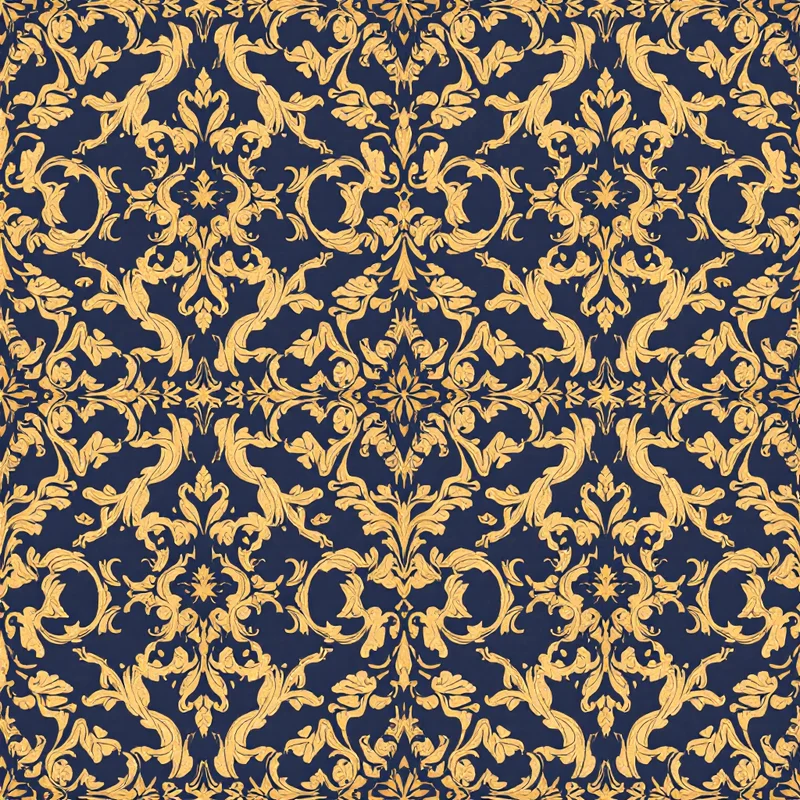
- 4Use [damask](/create/damask-wallpaper/) structure for the ground. A tone-on-tone damask in a dark ground gives the old luxury without the clutter, and a single motif on top can carry the Christmas message.
- 5Mix eras. Pair one Victorian element, such as a robin or a frame, with modern negative space.
Where it sells
Victorian prints suit heirloom gift wrap, formal table linens, stationery, wallpaper for a library or hallway, tree-skirt borders and luxury packaging. The formal feel works best at a larger scale and on rich materials like velvet, linen and heavy paper.
How it compares to other directions
Victorian Christmas is the formal, dark, layered end of the spectrum. Vintage Christmas pattern ideas covers the bright, playful mid-century look, and Christmas pattern design ideas places Victorian beside Nordic, farmhouse and other directions. For the wider period language, see Victorian patterns, and for table-setting versions, Christmas tablecloth and table linen patterns.
To explore ornate options, browse Christmas patterns in Pattern Weaver, where Browse Styles offers 44 categories and 5,700+ styles. For the rich, shaded finish, Restyle changes the finish of a pattern, and Pro exports up to 8K so fine linework holds up on a large print.
Explore related pattern styles