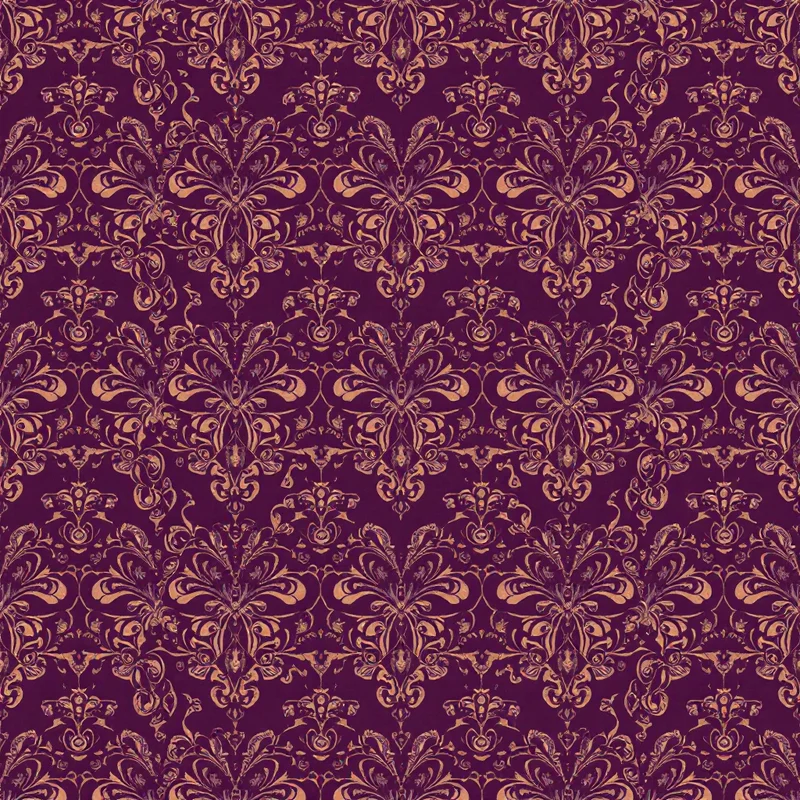
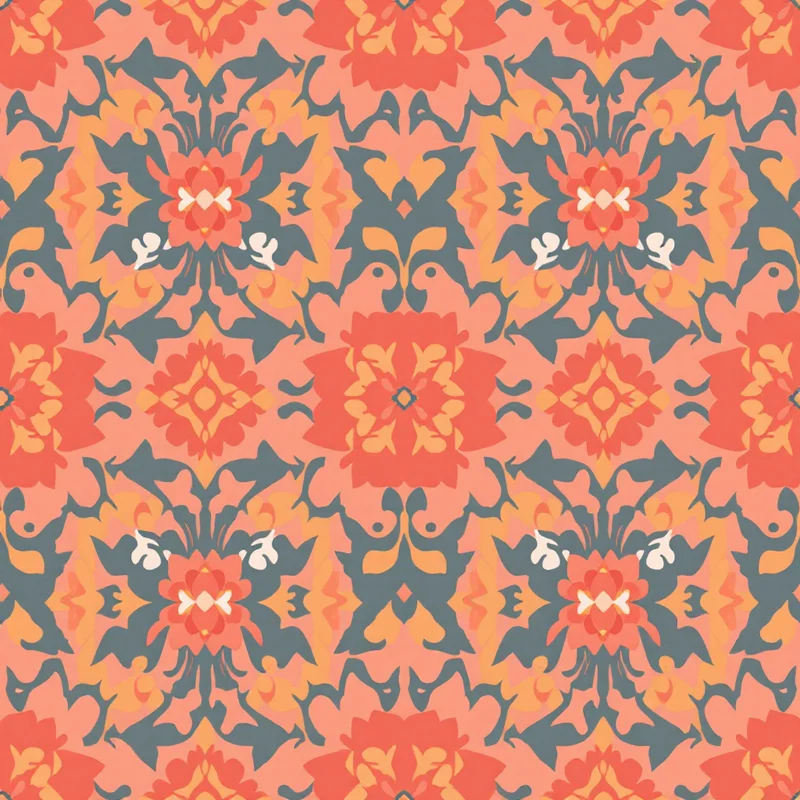
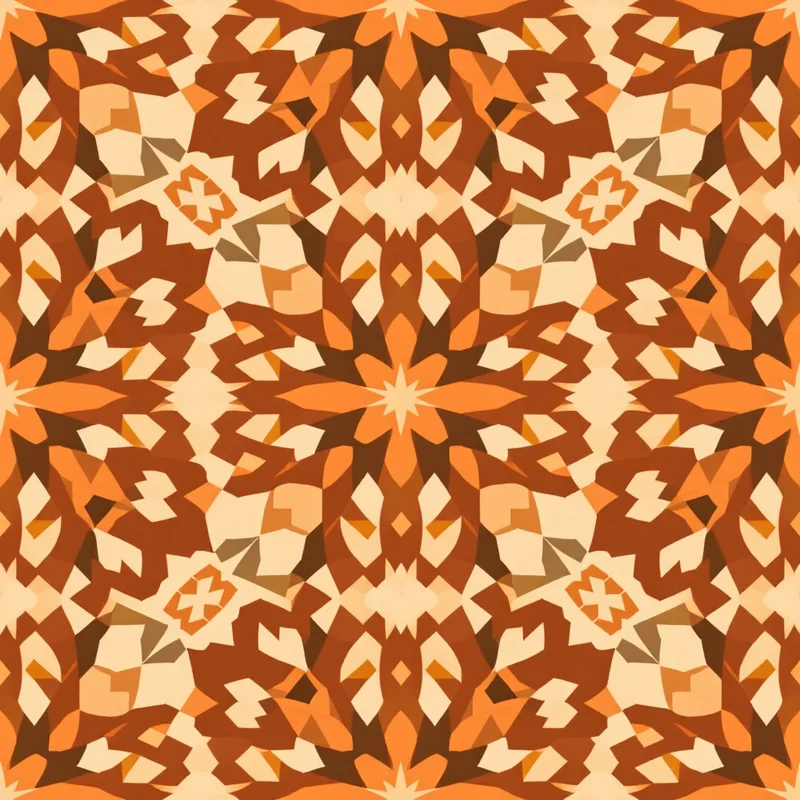
Diwali — the Hindu festival of lights, celebrated also by Jain, Sikh and Buddhist communities — is one of the visually richest festivals in the global calendar. Across five days in late October or early November, communities celebrate with oil lamps (diyas) lit throughout homes and public spaces, intricate rangoli patterns drawn on doorsteps and floors, gold and red decorative elements throughout homes, fireworks, family gatherings and the exchange of gifts. The visual abundance of Diwali — bright colours, glowing lights, decorative geometric patterns, floral motifs and metallic ornamentation — provides one of the richest sources of inspiration for contemporary surface pattern design.
For pattern designers building Diwali-themed work, the festival offers extraordinary visual vocabulary while requiring serious cultural understanding. The motifs and traditions carry deep religious and cultural significance for billions of practitioners across South Asia and the South Asian diaspora. Approaching Diwali pattern design with awareness of cultural context produces work that honours the festival's significance while serving the substantial commercial market for festival-themed products.
The Cultural Context
Diwali commemorates several major events depending on regional and religious tradition. In northern India, it celebrates the return of Lord Rama to Ayodhya after defeating the demon king Ravana, with the city's residents lighting oil lamps to welcome him home. In southern India, it celebrates Lord Krishna's defeat of the demon Narakasura. In western India, it honours Lakshmi, the goddess of wealth and prosperity. Jain Diwali commemorates Lord Mahavira's attainment of moksha (spiritual liberation). Sikh Diwali (called Bandi Chhor Divas) commemorates Guru Hargobind's release from imprisonment.
Across these traditions, the unifying theme is the triumph of light over darkness, knowledge over ignorance and good over evil. The lighting of oil lamps and decorative lights throughout homes and communities is the central visual practice. The lighting is understood as both literal beautification and symbolic welcoming of prosperity, wisdom and divine presence.
The five days of Diwali each have specific significance. Day one (Dhanteras) marks new beginnings and is associated with purchasing gold, silver and household items. Day two (Naraka Chaturdashi) involves early morning ritual purification. Day three (Lakshmi Puja) is the main Diwali night with prayers to Lakshmi, lamp lighting and family gatherings. Day four (Govardhan Puja) celebrates Lord Krishna's protection of his devotees. Day five (Bhai Dooj) honours the relationship between brothers and sisters.
For pattern designers, understanding this cultural foundation provides context for working with the visual vocabulary in ways that respect the festival's significance. Patterns designed without understanding can produce work that reads as generic "Indian festival" aesthetic without the specific cultural grounding that gives the work its real meaning.
Visual Motifs and Symbols
Several motifs recur across traditional Diwali decoration and provide the foundational visual vocabulary for Diwali-themed pattern design.
Oil lamps (diyas) are perhaps the most iconic Diwali motif. The traditional terracotta diya — a small earthen lamp filled with oil and a cotton wick — appears in countless visual variations across Diwali decoration. Stylised diya motifs, glowing flame imagery, lit lamp arrangements and abstract light vocabulary all draw on this central symbol.
Rangoli patterns are the elaborate floor designs drawn at doorsteps and entrances during Diwali. Traditionally made with coloured rice powder, flower petals, coloured sand or chalk, rangoli typically feature geometric medallion compositions with symmetric floral and decorative elements. The compositions often follow specific traditional layouts — concentric circles, eight-pointed stars, peacock and elephant motifs, lotus designs.
Lotus flowers are central to Diwali symbolism, representing purity, divine beauty and Lakshmi herself. Lotus motifs appear throughout traditional Diwali decoration in various stylisations — open lotus blooms, lotus medallions, lotus borders.
Peacocks are auspicious motifs strongly associated with Diwali and Indian decorative tradition broadly. Peacock motifs appear in textiles, decorative arts and rangoli patterns. The peacock feather pattern is particularly distinctive — the eye-spot of the feather is a beloved motif in Indian decorative design.
Floral garlands (toran) hang in doorways throughout the festival. Marigolds (genda) and mango leaves are particularly important traditional materials, and their visual reference appears throughout Diwali design vocabulary.
Decorative borders, paisleys (boteh), elephants and various geometric ornamental elements provide additional motif vocabulary drawn from broader Indian decorative tradition.
Colour Symbolism and Palette
Diwali colour conventions have deep symbolic significance. Red represents auspiciousness, vitality, love and the colour of Lakshmi. Gold represents prosperity, divine light and wealth. Marigold orange represents the marigold flower used in Diwali decoration and represents auspicious energy. Yellow represents knowledge, learning and prosperity. White represents purity, peace and new beginnings. Green represents fertility, prosperity and the start of new life.
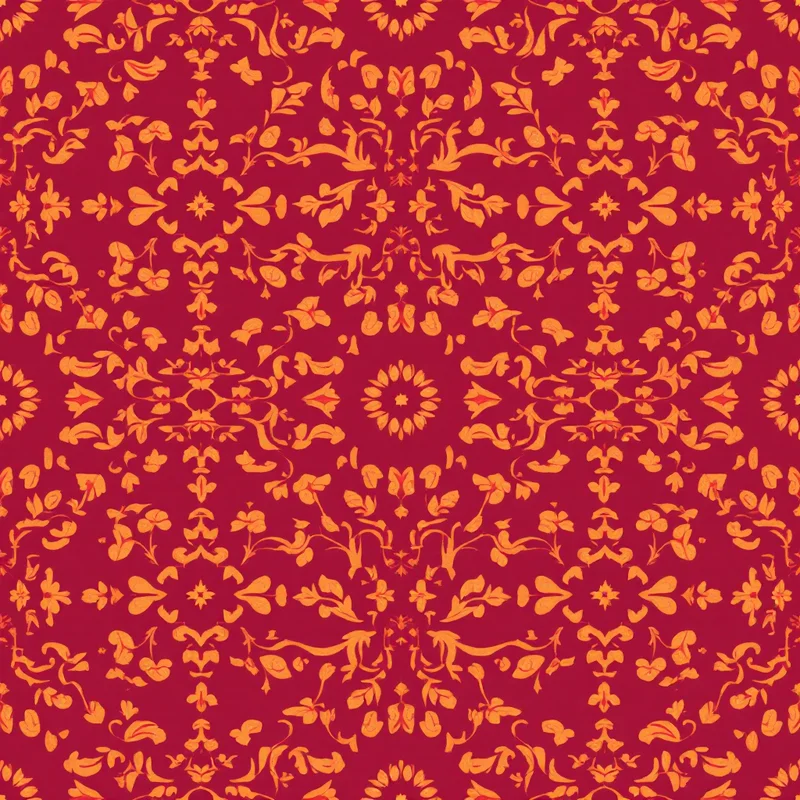
The palette structure of traditional Diwali decoration typically combines several of these colours in vibrant combinations. Red and gold is perhaps the most iconic combination, used extensively in clothing, decoration and gift packaging. Marigold orange with red and gold produces patterns with strong festive energy. Multi-colour combinations including red, gold, marigold, green and pink produce patterns with full festival vibrancy.
Contemporary palette interpretations have expanded the vocabulary while preserving the underlying symbolic logic. Deeper jewel tones — burgundy, deep maroon, deep teal — read as sophisticated contemporary interpretation while maintaining the festival association. Soft pastel interpretations with gold accents read as modernised festive aesthetic. Earth-tone palettes with metallic gold provide contemporary sophisticated festive vocabulary.
For pattern designers building Diwali collections, the palette commitment matters. Diwali is a festival of vibrant colour, and overly muted or restrained palettes can read as missing the essential festival character. Designs that preserve significant colour vibrancy — while perhaps moderating the saturation slightly for contemporary commercial applications — read as authentically Diwali.
Compositional Approaches
Several compositional approaches work effectively for Diwali pattern design. Central medallion compositions draw on rangoli tradition with a strong focal motif (often a lotus, oil lamp or geometric medallion) surrounded by symmetrical decorative elements. This compositional logic produces patterns with significant visual presence and clear cultural reference.
All-over festive compositions distribute Diwali motifs across the surface in regular or rhythmic patterns. Lit lamps in rhythmic arrangements, paisley repeats, lotus repeats, and combinations of motifs all support this compositional approach.
Border-and-field compositions use a strong ornamental border framing a simpler central field. This approach works particularly well for sari-inspired designs, table linens and gift wrap applications.
Layered compositions stack multiple Diwali references — central motif, surrounding decorative ring, border, corner elements — producing patterns with significant decorative richness.
The compositional choice should consider the application. Wallpaper and textile applications benefit from compositional approaches that can repeat seamlessly. Gift wrap benefits from compositions that work across the unpredictable orientation of wrapped gifts. Greeting cards and stationery benefit from compositions that allow for typographic integration.
Contemporary Applications
Diwali pattern design has strong commercial presence across several categories. Home decor textiles for Diwali — table linens, throw pillows, decorative pieces — represent significant seasonal sales for many retailers. The category supports both traditional vibrant designs and more contemporary sophisticated interpretations.
Gift wrap and packaging for Diwali is essential to the festival's gift-giving tradition. The category supports designs ranging from traditional red-and-gold compositions to contemporary interpretations.
Greeting cards for Diwali have strong commercial presence in both traditional and contemporary markets. The category supports designs that integrate festive visual vocabulary with typographic greetings.
Fashion textiles for Diwali — particularly traditional Indian clothing including saris, lehengas, sherwanis, kurtas and accessories — represent enormous commercial market in South Asia and the South Asian diaspora. The category supports both traditional and contemporary interpretation.
Home decor accessories — diya holders, rangoli kits, decorative items, candle holders — also represent significant seasonal commercial activity. The pattern design considerations extend beyond surface design into product design proper, but pattern designers can contribute through textile elements and decorative pattern work.
Respectful Contemporary Practice
For non-Indian designers working with Diwali pattern design, several practices support respectful work. Studying Diwali traditions and cultural significance specifically — not generic "Indian aesthetic" but the actual cultural foundation of the festival — provides the depth needed to work with the visual vocabulary meaningfully.
Acknowledging the source tradition specifically in marketing and product copy provides appropriate attribution. Diwali-themed work that is marketed as generic "festival" design without specific cultural attribution fails to honour the cultural source.
Avoiding sacred or religious imagery for casual commercial use is important. Images of deities (Lakshmi, Ganesh, Krishna, etc.) carry serious religious significance and require particular care or avoidance in commercial pattern applications.
Supporting Indian designers, producers and cultural organisations materially through collaboration, fair-trade sourcing or financial support provides meaningful engagement with the originating culture.
Working with Indian designers as creative leads — rather than producing inspired-by interpretations independently — provides the most direct support for the originating culture and typically produces more authentic work than non-Indian designers working alone with the vocabulary.
Diwali pattern design rewards designers who engage seriously with the cultural foundation, respect the religious and spiritual significance of the festival, and produce work that contributes to the broader recognition and celebration of the tradition. The commercial market for Diwali-themed products is substantial and growing — both within South Asia and globally — and provides meaningful commercial opportunity for designers who approach the work with the respect it deserves.
Explore related pattern styles
Patterns for