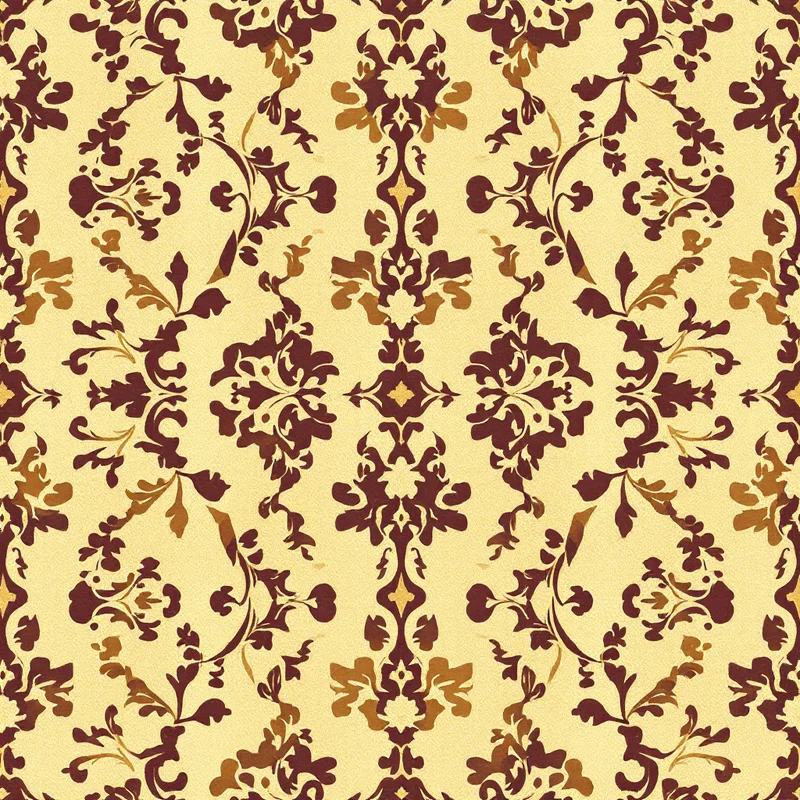
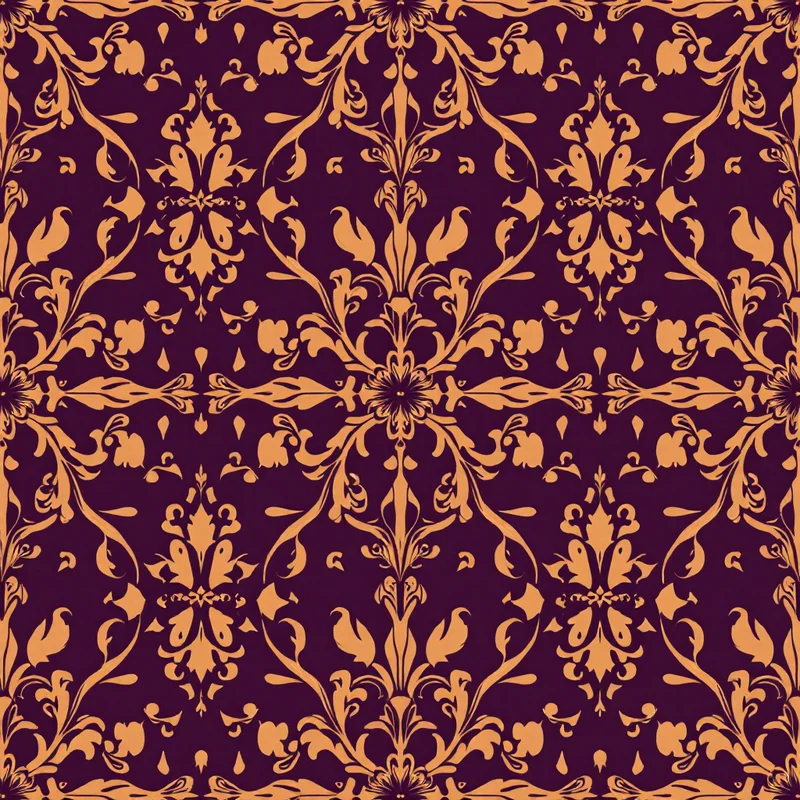
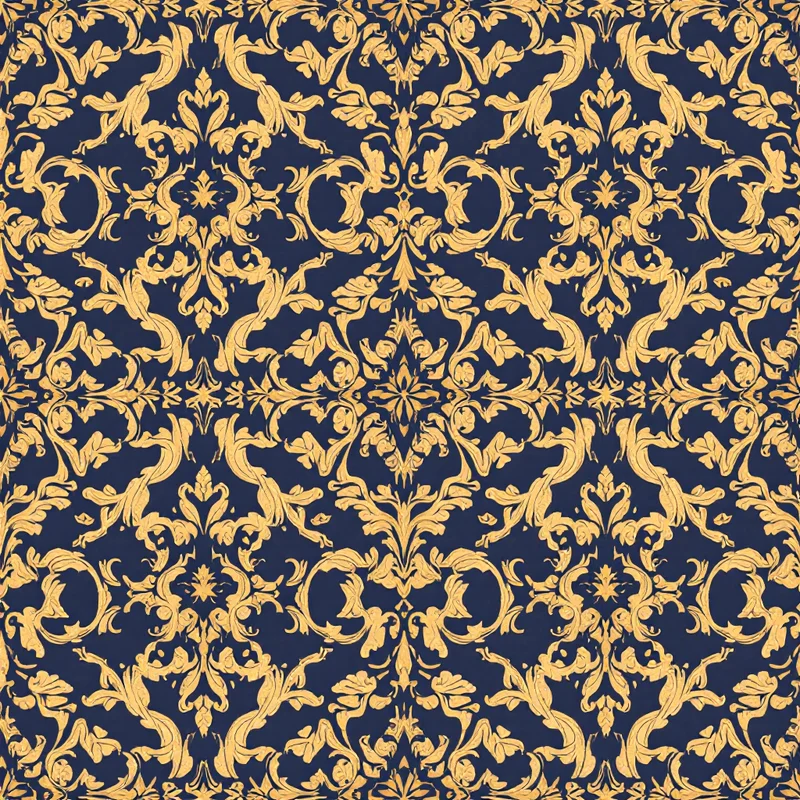
Damask patterns are the closest thing surface design has to a universally recognized luxury code. A single symmetrical medallion on a tonal ground signals heritage interiors, formal apparel, and high-end packaging within half a second of looking at it, which is why the visual language has survived nine hundred years of fashion cycles without losing its readability. This guide breaks down what damask patterns actually are, where they came from, what makes them work visually, and how to generate production-ready damask repeats in Pattern Weaver without spending a week aligning mirror axes by hand.

What is damask patterns?
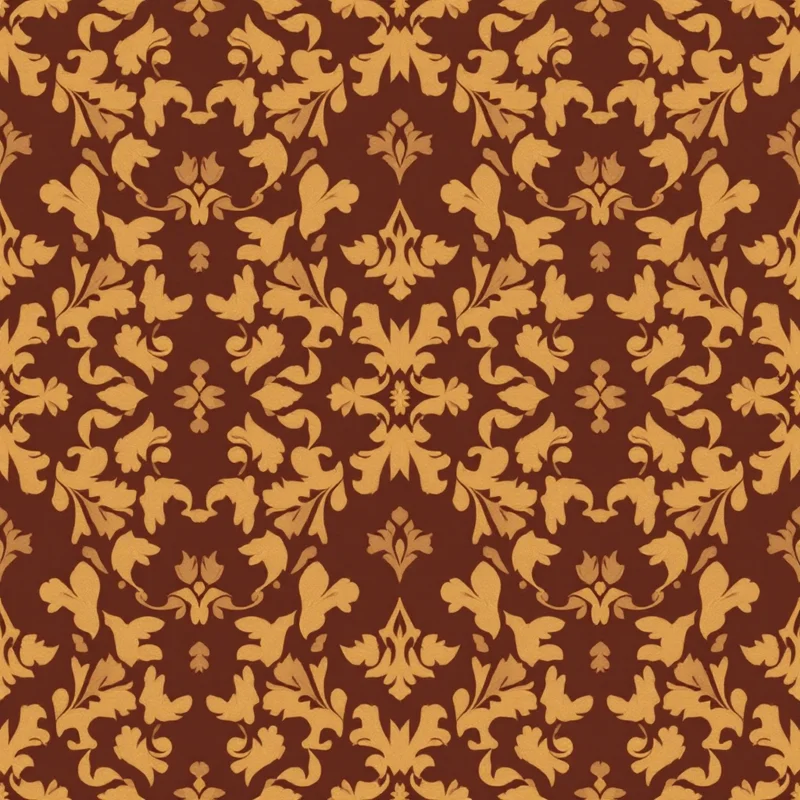
Damask patterns are symmetrical ornamental designs built around a central floral or foliate medallion that mirrors across a vertical axis and repeats in a half-drop or straight tile across a surface. The defining feature historically was technical — a single warp and weft creating contrasting satin and matte areas, so the figure read as sheen against matte in a single color rather than as a multi-color print. That tonal logic is still what makes damask patterns recognizable, even when they are now printed in digital ink on cotton, paper, or vinyl rather than woven in silk.
The motif vocabulary is consistent across the centuries: stylized acanthus leaves, pomegranates, pineapples, tulips, palmettes, and scrolling foliage arranged around a central axis. The motifs are never literal — a damask pomegranate is a geometric abstraction of a pomegranate, not a botanical drawing. That distance from realism is what gives damask patterns their formal, almost architectural feeling.
Where damask patterns comes from (history/origin)
Damask patterns take their name from Damascus, the trading hub through which figured silks from Byzantine and early Islamic weaving centers reached European markets between the 9th and 13th centuries. The technique was not invented in Damascus — it traces back through Sasanian Persia to Han China — but the name stuck because that was where merchants bought it.
The technique migrated to Italy in the 14th century, where Genoa, Venice, and Lucca turned damask weaving into the dominant European luxury textile industry. By the 17th century, the French silk industry centered on Lyon had absorbed the vocabulary into Baroque interiors, and English manufacturers at Spitalfields followed in the 18th century. The Victorian revival of the mid-19th century is what most contemporary readers actually picture when they think of damask patterns — dense, dark, formal, often paired with mahogany furniture and gas lamps. Modern damask patterns work with all of that history available as reference but are no longer bound to any single era's density or palette.
Visual hallmarks of damask patterns
Five visual rules define damask patterns and separate them from adjacent ornamental styles like brocade, jacquard florals, or Indienne prints.
Vertical mirror symmetry. Every damask motif mirrors across a vertical axis. Asymmetrical ornamental design exists but does not read as damask.
Central medallion. The repeat is anchored by a dominant central motif — usually a floral or foliate medallion — surrounded by smaller satellite motifs that fill the space without competing for attention.
Tonal palette. Historically single-color; contemporary damask patterns keep the tonal logic by using two values of the same hue or a low-contrast pairing rather than full polychrome.
Stylized rather than realistic motifs. Damask flowers are geometric abstractions, not botanical illustrations. This is the line that separates damask patterns from chintz or floral patterns in the realistic tradition.
Half-drop or straight tile repeat. The repeat structure has to resolve cleanly across walls, which means the tile geometry is mathematically strict. There is no painterly looseness to damask patterns.

How to generate damask patterns in Pattern Weaver
The repeat construction is what makes damask hard to draw by hand. Pattern Weaver collapses the symmetry math into the generator, so the working time goes to motif choice and palette rather than mirror alignment.
- 1Pick the damask style preset. Open the studio and choose Damask from the style grid. Set substyle to Baroque, Victorian, or Modern Damask depending on the era and density you want.
- 2Set a tonal palette. Choose two values of the same hue for the most authentic look — ivory on champagne, charcoal on graphite, or navy on midnight. Polychrome palettes also work for modernized variations but read less as heritage damask.
- 3Tune density and scale. Set density to medium and scale to large for wallpaper, or medium for apparel. Damask patterns rely on breathing room around the central medallion, so avoid maximum density unless intentionally heavy.
- 4Generate and check the symmetry. Run the generation. Inspect the central medallion for clean mirror symmetry across the vertical axis. If the mirror reads off-balance, regenerate with a stricter substyle or lock the seed and adjust the brief.
- 5Export at production resolution. Once the tile is approved, export at 8K (8192×8192 px) in PNG or TIFF for wallpaper and packaging, or PDF for vector-ready printing.
The whole sequence takes about three minutes from a blank brief to a usable tile.
Color palette ideas for damask patterns
Tonal pairs are the strongest starting point because they respect the original technical logic of damask weaving.
Champagne on ivory. The default luxury read — soft, formal, works on wedding stationery and wallpaper.
Charcoal on graphite. Modern, masculine, used heavily in contemporary boutique hotel interiors.
Navy on midnight. Heritage formal — works on packaging for spirits and high-end menswear lining.
Burgundy on oxblood. Victorian revival — dense, dramatic, suited to restaurant interiors and book covers.
Sage on celadon. Contemporary soft luxury — popular in wellness and apothecary branding.
Black on cream. Highest-contrast classical pairing — formal, instantly recognizable as damask.
Blush on champagne. Modern wedding and bridal — lower contrast, softer feeling.
Polychrome damask patterns work but require restraint. Three colors is the maximum before the design stops reading as damask and starts reading as ornamental floral.
Best use cases
Damask patterns work across more product categories than most ornamental styles because the visual code translates between scales and substrates without losing readability.
Wallpaper. The canonical use. Wallpaper damask is typically designed at a 21–27 inch repeat to fit standard roll widths and read at room distance.
Apparel. Damask runs much smaller on garments — 6–12 inch repeats for dress fabric, 2–4 inches for tie silks and pocket squares. Damask linings inside tailored jackets are a heritage menswear staple.
Packaging. Spirits, perfume, chocolate, and tea brands use damask patterns on labels, boxes, and tissue paper as an instant luxury signal.
Stationery and invitations. Wedding invitations are still one of the largest commercial markets for damask patterns; the formal symmetry reads correctly at small print sizes.
Upholstery. Heritage furniture brands and contemporary boutique hotels both use damask upholstery, though usually in scaled-down or muted palettes.
Accessories. Scarves, ties, bags, and hangtags carry damask well because the symmetry survives folding and partial cropping.
The full range of substrates is covered in the print-on-demand pattern guide for designers planning to sell across product categories.

Pro tips for stronger damask patterns repeats
A few details separate competent damask from outstanding damask.
Lock the central medallion before tuning satellites. The medallion is the anchor — get it right first, then let the surrounding motifs flow from it.
Keep negative space honest. Damask patterns rely on the ground showing through. If the design becomes 90%+ figure with no breathing room, it stops reading as damask and starts reading as wallpaper noise.
Mirror the motif vocabulary, not just the geometry. Strong damask repeats use the same motif family — all acanthus, all pomegranate, all tulip — rather than mixing motif types. Variety comes from scale and orientation, not from species.
Check the half-drop transition. Generate the tile, then preview it as a 2×2 repeat. The half-drop edge is where weak damask falls apart.
Match the substyle to the era. Baroque is dense and curvaceous; Victorian is dense and vertical; Modern Damask is sparse and clean. Mixing substyles within one design usually reads as muddled rather than eclectic.
The seamless pattern construction guide covers the underlying tile mechanics in more depth for designers who want to understand what the generator is actually doing.
Generate your own damask patterns
Damask patterns reward designers who treat them as a system rather than a single look. The symmetry rule, the tonal logic, the stylized motif vocabulary, and the strict tile geometry are all part of the same package, and once that package is understood the variations are practically endless — Baroque density, Victorian formality, modern restraint, contemporary palette experiments.
Pattern Weaver's Damask style preset handles the symmetry and repeat math automatically, which leaves the design decisions where they belong: motif family, palette tonality, density, and end-use scale. Open the studio to generate a first damask tile, browse the full category grid for related ornamental styles, or check pricing for credit packs with commercial license included on every paid tier. The Free plan gets a designer through a few test generations; Starter, Pro, and Max scale up from there depending on how much production work the studio takes on. Damask patterns are one of those designs that look complicated and feel inevitable once the construction logic clicks — Pattern Weaver shortens the distance between those two states from weeks to an afternoon.