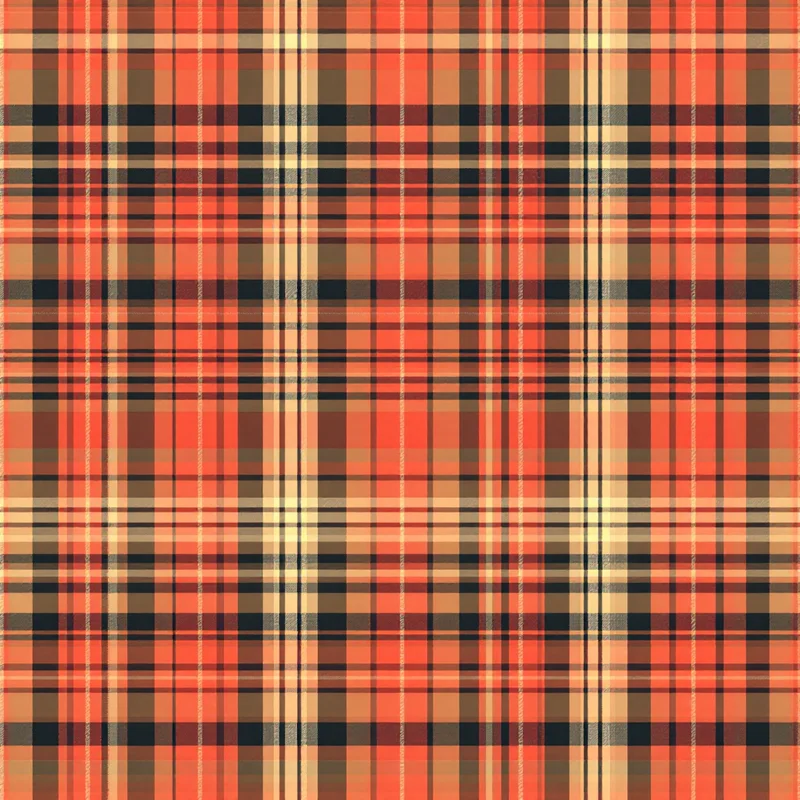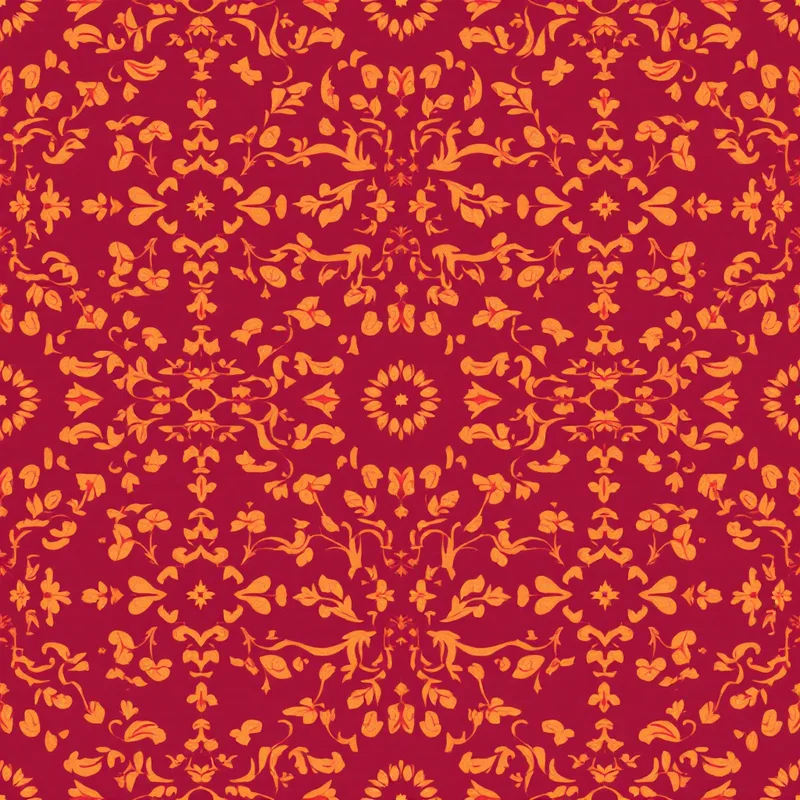
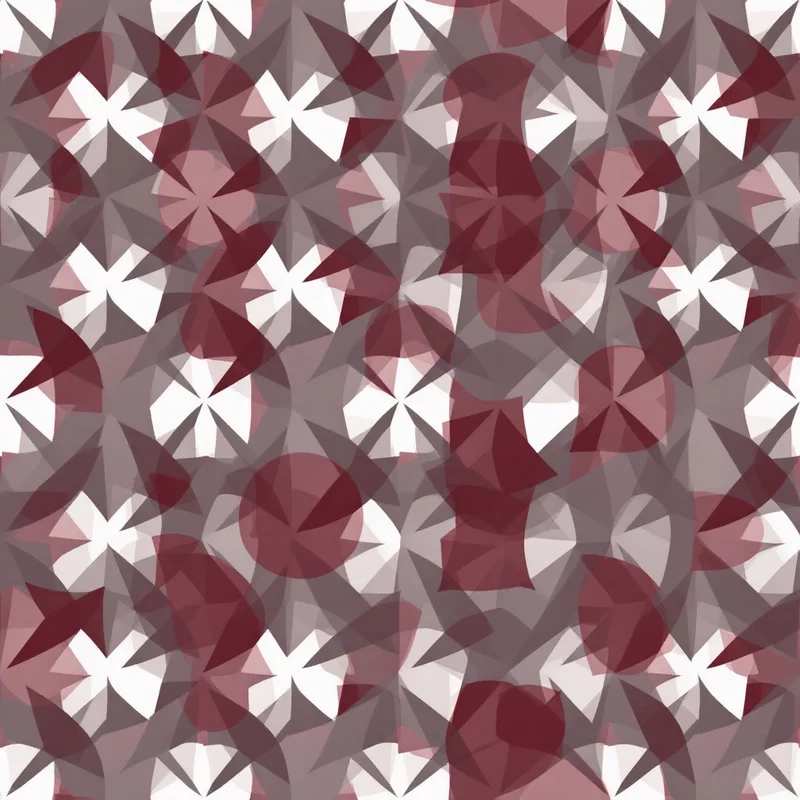
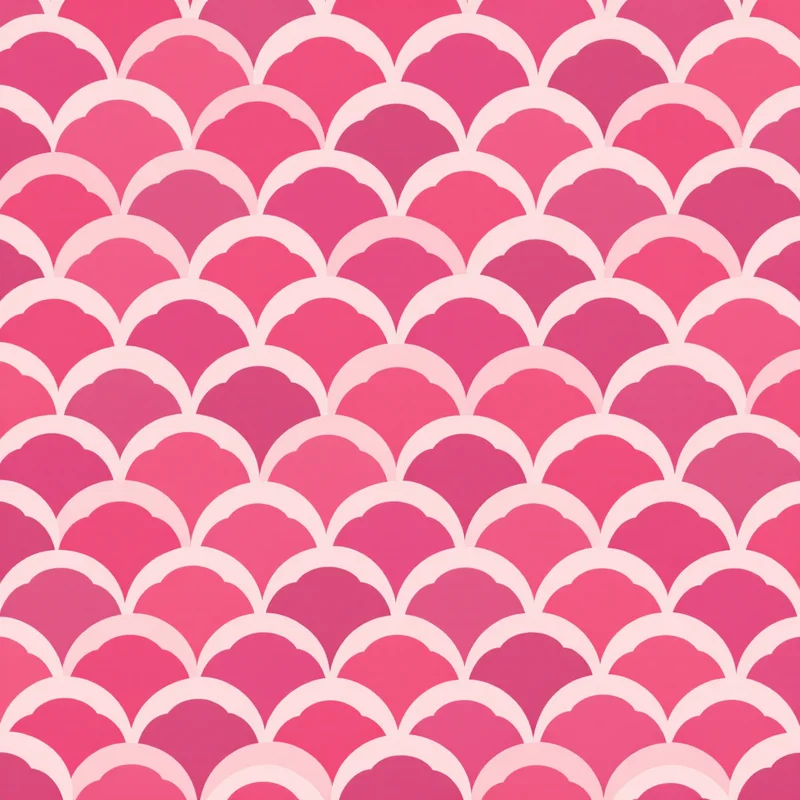
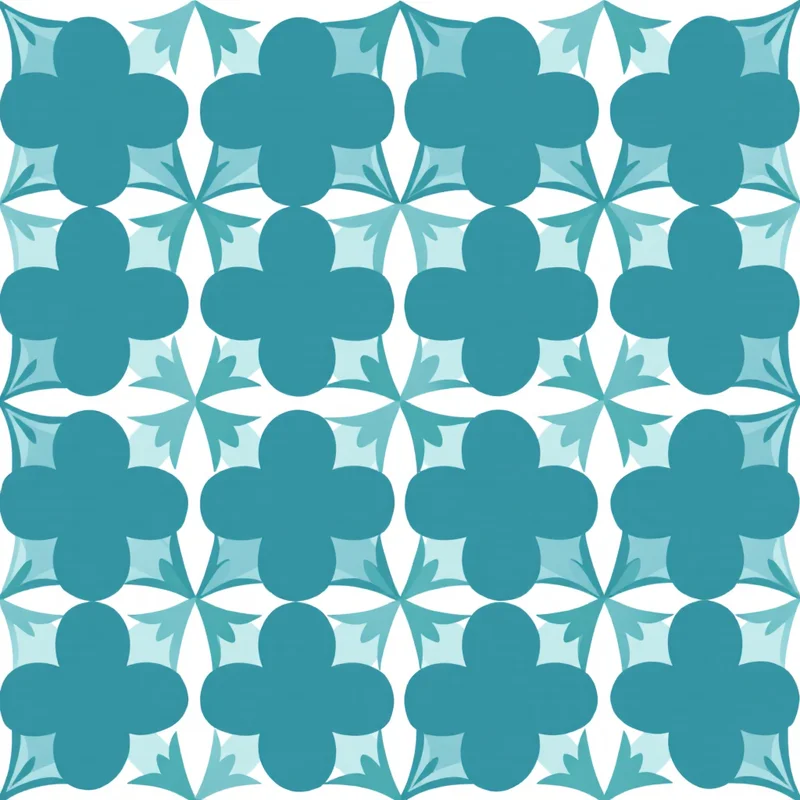
Every repeat pattern has symmetry, including the ones that look random. A tossed floral still repeats by sliding the same tile across the plane, and that slide is a symmetry. Once you can name the moves, you can choose them on purpose instead of stumbling into them.
The four moves
| Move | What it does | Easy example |
|---|---|---|
| Translation | Slides the motif along a line | A row of identical polka dots |
| Reflection | Mirrors the motif across a line | A damask with a mirror axis down the center |
| Rotation | Turns the motif around a point | A four-petal flower, a pinwheel |
| Glide reflection | Mirrors, then slides along the mirror line | Footprints along a path |
Translation is the foundation. Every seamless tile uses it, because the tile itself is copied across the plane by sliding. Everything else is a layer on top.
Frieze patterns: symmetry in a strip
A border or trim repeats in one direction only. Mathematically there are exactly seven ways to do it, built from the same moves: slide only, slide plus mirror across the strip, slide plus mirror along it, slide plus half-turn, and so on. Designers meet these as hems, ribbons, Greek key borders and cornice trims. Alternating leaves that point up, then down, are a glide reflection.
Wallpaper groups: symmetry across a plane
When a pattern repeats in two directions, the number of fundamentally different ways it can do so is 17. Fedorov completed the list in 1891. You do not need to memorize the names, but it helps to sort them by rotation:
| Highest rotation | Number of groups | What it looks like |
|---|---|---|
| None (translation, mirrors, glides) | 4 | Tossed prints, simple mirrored repeats |
| 2-fold (half-turn) | 5 | Brick-like and rectangular repeats |
| 3-fold | 3 | Triangular and clover-like repeats |
| 4-fold | 3 | Square grids with pinwheels or stars |
| 6-fold | 2 | Honeycomb and hexagonal stars |
Two practical limits come out of this. First, only 2-, 3-, 4- and 6-fold rotations can repeat. A five-fold flower or an eight-fold star cannot fill a plane by repetition alone, so traditional geometric design combines them with other shapes. Second, the six-fold groups are the most symmetrical, which is why snowflake and honeycomb patterns feel so tightly organized.
Using each in real work
Translation only. Tossed florals, ditsy scatters, polka dots, most conversational prints. The motifs vary, but the tile just slides. A half-drop is still translation, with the next column offset by half the tile height. See the half-drop repeat guide and the repeat types overview.
Mirror. Damask, butterflies, face-to-face animals and kaleidoscopic prints. Mirroring creates formality, a dependable axis and a built-in seam match. The mirror repeat tutorial shows how to set it up. The risk is the butterfly effect: mirroring any organic shape tends to produce a visible Rorschach seam.
Rotation. Pinwheels, medallions, mandalas and starbursts. Rotation around a point makes a focal center, so use it when you want a pattern to feel anchored. For radial layouts see mandala patterns.
Glide reflection. The least-used move and the most underrated. Alternating flipped motifs, such as leaves, fish or feathers, feel lively because the eye sees a path. It avoids the stiffness of a pure mirror.
Combined. Kaleidoscope prints stack mirrors and rotation around a single point, then tile the result. Explore this in kaleidoscope patterns and the broader advanced geometric patterns.
Choosing symmetry for the mood
- Formal and traditional: mirror and rotation, such as damask and medallions.
- Casual and playful: translation with random rotation of motifs, as in tossed prints.
- Dynamic: glide reflection and diagonal repeats.
- Calm and orderly: square and brick grids with small, repeated motifs.
Breaking symmetry on purpose
Perfect symmetry can feel mechanical. Designers loosen it by varying size, color and angle in each copy, while keeping the underlying structure. A mirrored damask with slightly different leaf details on each side feels hand-drawn, and a radial design with irregular petals feels alive. The structure carries the pattern, and the variation carries the personality.
Tool tip
In Illustrator, the Pattern Options panel offers grid, brick and hex tile types, which map onto rectangular, offset and hexagonal repeats. Choose the tile type that matches your symmetry, then draw inside it.
In Pattern Weaver, each pattern comes back as a seamless tile in about 20 seconds, and Browse Styles lets you choose from 44 categories and 5,700+ styles, a quick way to see how different symmetries look in practice.
Explore related pattern styles