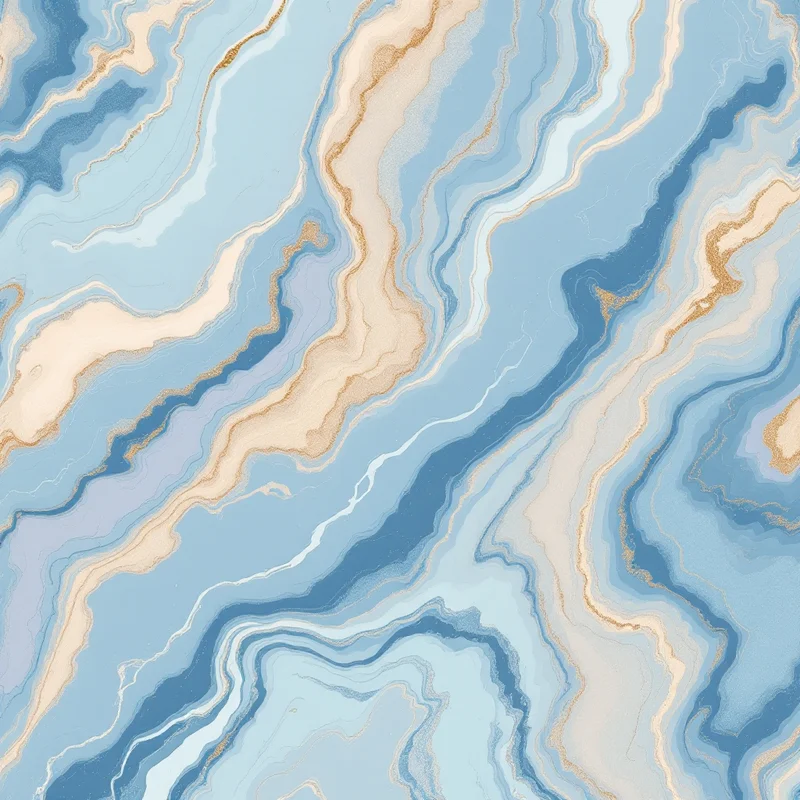

Marble and stone patterns look like one category and behave like several. Marble is about flow, granite is about speckle, travertine is about bands, and slate is about layers. Each one needs a different set of marks, and an easy way to spot a weak stone print is to see that it uses the wrong marks for the stone it claims to be.
Marble: veins are the design
Carrara. From the marble quarries around Carrara, in Tuscany, Italy. White to light gray, with soft, feathery gray veins. It is the calm marble, which makes it a good background for countertops, packaging and tablecloths.
Statuario. A whiter marble from the same region, with bolder gray veins. It sits between Carrara and Calacatta.
Calacatta. A very white ground with thick, dramatic veins, often with gold or brown tones. It reads as luxury, so use it sparingly at large scale, where the veins can sweep across a surface.
Nero Marquina. A black Spanish marble with sharp white veins. It makes a graphic, high-contrast print that works for packaging, tiles and bags.
Emperador. Brown marble from Spain with lighter veins, ranging from chocolate to caramel. A warm alternative to the cool grays.
Green marble. Deep green stones with white or gray veins suit jewelry boxes and hospitality interiors. Try #2E5B49 with veins of #D9E2D6.
Drawing marble
- 1Start with a soft, cloudy ground in two or three close tones.
- 2Draw a few main veins that run diagonally across the tile, thick in places and hairline in others.
- 3Add secondary veins that branch off the main ones at sharp angles.
- 4Blur a few veins slightly, and leave others crisp. Real marble has both.
Because veins are continuous, a marble tile must be matched at the edges. A mirror repeat, like the one in the mirror repeat tutorial, is a design version of the bookmatching that stone fabricators use when they open two adjacent slices like a book.
Stone: grain, bands and layers
| Stone | Defining mark | Palette |
|---|---|---|
| Granite | Dense speckles from visible mineral grains | #8C8C8C, #3A3A3C, #D6C7B5 |
| Travertine | Horizontal bands with pits and voids | #D8C6A5, #B89F78, #EFE6D3 |
| Slate | Dark matte surface with layered, cleft texture | #3E4348, #5A6168 |
| Limestone | Fine, even grain, occasional fossil flecks | #E1D9C6, #C9BFA6 |
| Onyx | Translucent banded swirls | #E8B96A, #F5E6C8 |
Granite is an igneous rock, so it is built of crystals, not veins. Draw it as speckles of three or four sizes in dark, light and mid tones, with no flowing lines at all. See granite patterns for references.
Travertine forms in layers, and it keeps natural holes. Rome's Colosseum is built partly of it. Draw parallel soft bands with small irregular pits.
Slate splits in sheets. It needs a matte, uneven surface and subtle layering.
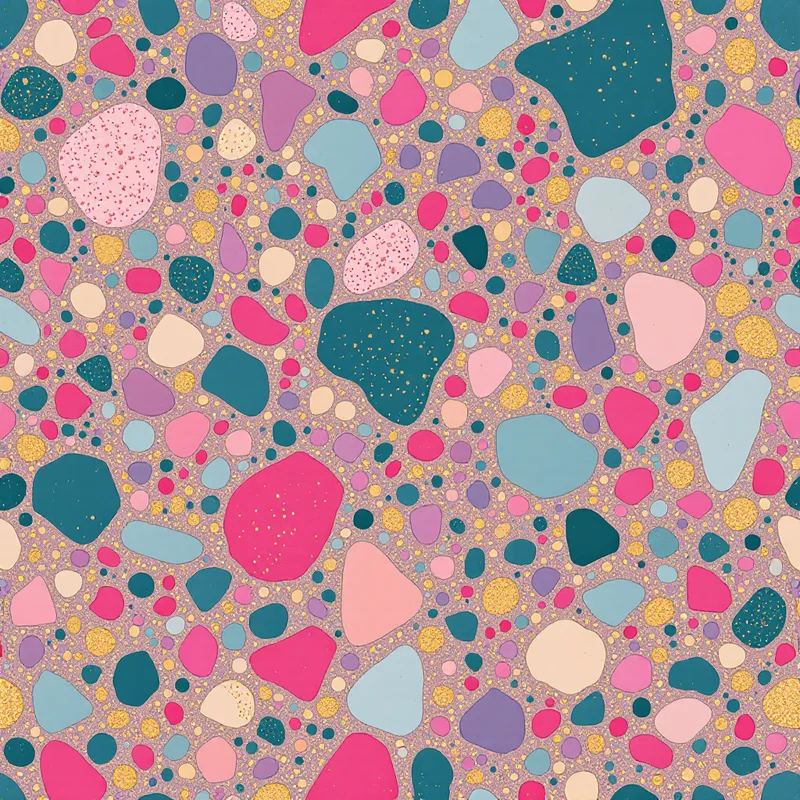
Terrazzo: stone as confetti
Terrazzo is made of chips of marble and other stone set into cement or resin, and it began in Italy as a way to use stone offcuts. In print it becomes scattered chips in a pale ground. Mix three chip shapes and four colors, vary chip sizes, and keep the spacing uneven. Our terrazzo patterns page collects references.
Making stone patterns seamless
- Keep vein and band paths continuous across the tile edge, or mirror the tile so the edges match.
- Avoid strong light and shadow. A stone with a bright spot in the corner will show the repeat immediately. Flatten the lighting.
- Keep granite and terrazzo scatters away from the very edge, or wrap them across it.
Choosing scale
Stone prints change character with size. At large scale (a single vein across a foot or more), marble looks like slab. At small scale, it becomes a texture. Granite and terrazzo are usually best at a scale where you can still pick out individual chips. Shrink them too far and the chips blur into noise.
For related surface looks, see types of texture patterns and the trend notes in tile and ceramic pattern trends. Browse stone patterns to start.
Pattern Weaver's Tiling Fixer repairs tile edges, which is handy for veins that miss the border, and Pro exports go up to 8K for large-format surfaces.
Explore related pattern styles