Dots are the simplest shape in pattern design, and they carry more variety than most people expect. Change the size, spacing or arrangement and you move from nursery to boardroom. Here are the named types, followed by the four layouts that change how any of them feel.
The named types
| Type | Size | Arrangement | Feel |
|---|---|---|---|
| Polka dot | Medium, evenly sized | Regular grid or staggered | Friendly, classic |
| Pin dot | Tiny | Close, even | Neat, almost a texture |
| Micro dot | Smaller than pin dot | Dense | Quiet, shirting-like |
| Coin dot | Large, like a coin | Spaced wide | Bold, graphic |
| Swiss dot | Small, evenly spaced | Regular | Light, delicate |
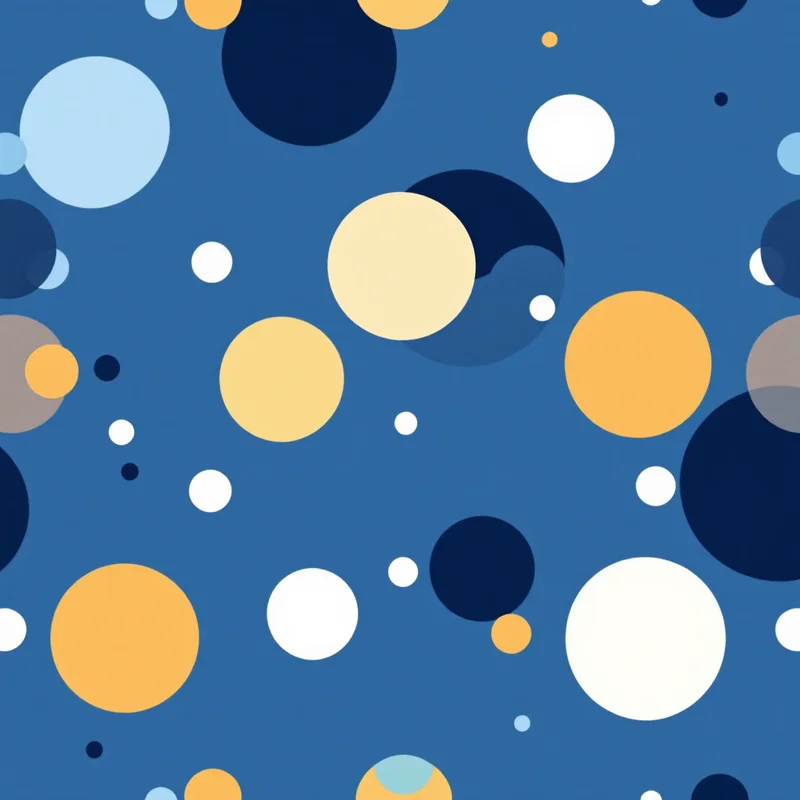
| Confetti dot | Mixed sizes and colors | Random | Playful, festive |
| Halftone | Varying sizes in rows | Grid, gradient | Graphic, print-like |
| Ben-Day | Uniform, large halftone | Grid | Comic book, pop art |
| Pointillist | Many colors, tiny | Dense scatter | Painterly |
| Concentric dot | Ring within ring | Regular | Target, bubble |
Polka dot. Evenly spaced circles on a plain ground. The name comes from the polka, a dance that spread across Europe and America in the 19th century. See the polka dot design guide for the full treatment.
Pin dot and micro dot. Small enough that, from a distance, they merge into a tonal texture. They are a staple of shirting, ties and quiet packaging.
Coin dot. Large circles, spaced generously. Coin dots work like a graphic shout at furniture and tote-bag scale.
Swiss dot. Named for the sheer cotton called dotted Swiss, which has small raised dots. In print, it is a light, regular dot on a fine ground, used for summer dresses and baby clothes.
Halftone and Ben-Day. Halftone uses dots of different sizes to build tones, which is how newspapers printed photographs. Ben-Day dots are a related printing technique from the late 1800s, and Roy Lichtenstein enlarged them into pop art in the 1960s. Use them for retro, comic and street styles.
Pointillist dots. Tiny dots of pure color placed side by side so the eye mixes them, the approach Georges Seurat used in the 1880s. In pattern work, scatter dots of two or three related hues.
Concentric dots. Rings inside rings, like targets or bubbles. Browse concentric circle patterns.
A note on context: dot-based painting from Aboriginal Australian communities carries specific cultural and ceremonial meaning. It is not a generic dot pattern, and should not be borrowed as one.
Four layouts that change the feel
- 1Square grid. Dots in straight rows and columns. Orderly and graphic, the clearest "polka dot."
- 2Half-drop or brick. Each column offset by half a step. The dots feel more natural and the lines are less visible. See the half-drop repeat guide.
- 3Hex or staggered. Each dot surrounded by six neighbors. This is the tightest packing and the one that reads most like a texture.
- 4Random. Dots scattered with a minimum gap so none touch. Relaxed and playful. Without the minimum gap, random dots clump and leave holes.
Choosing size and spacing
- Dot diameter to gap. A gap of about one dot diameter makes a classic polka dot. A smaller gap makes the pattern denser and more graphic. A gap of two or three diameters makes it airy.
- Scale to product. Pin dots are best under an eighth of an inch on apparel. Polka dots work from a quarter inch to two inches. Coin dots can go to several inches for wallpaper and upholstery.
- Contrast. High contrast, such as black on white, is bold. Tone on tone, such as cream on ivory, is subtle and elegant.
Palette ideas
| Look | Hex values |
|---|---|
| Classic | #FFFFFF dots on #1E2A4A |
| Retro red | #FFFFFF dots on #C8352B |
| Soft pastel | #F7D6E0 dots on #FFF7EE |
| Pop art | #F2C230 dots on #D6283A |
Pairing dots with other patterns
Dots are one of the best "blender" patterns, meaning a quiet partner for a busier print. A pin dot in the same color family as a floral is a safe choice, and dots pair easily with the stripes in types of stripes. For a clean modern approach, see minimalist patterns, and browse polka dot patterns for references.
To test a few sizes quickly, Browse Styles in Pattern Weaver lets you pick from 44 categories and 5,700+ styles, and the Product Mockups (free) show your dots on 20 products.
Explore related pattern styles