


Design characteristics
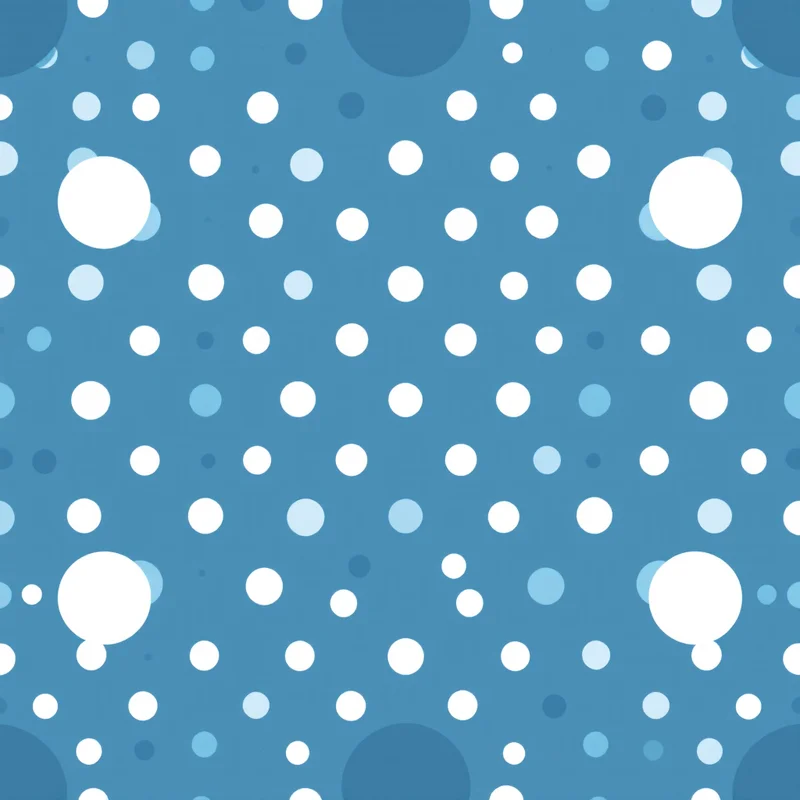
The visual power of polka dots comes from their perfect balance of order and playfulness. The repeating circle is the simplest geometric form, and its regularity creates a clean, rhythmic surface. But circles also read as friendly and approachable — there are no sharp edges, no aggressive angles. This dual character makes polka dots uniquely adaptable. A tiny dot on a navy background reads as conservative and sophisticated, suitable for a corporate blouse or men's tie. A large, high-contrast dot in primary colors reads as bold and fun, perfect for children's products or pop-art branding.
Commercial applications
In fashion, polka dots are a perennial staple that transcends seasons. They appear in haute couture and fast fashion alike. Yves Saint Laurent, Christian Dior, and Marc Jacobs have all built collections around the dot. Polka dot dresses, blouses, scarves, and swimwear sell consistently year after year. The pattern scales beautifully — pin dots for refined tailoring, coin dots for casual dresses, oversized discs for statement pieces. Dots also mix well with other patterns, making them a reliable layering element in maximalist styling.
Where to use polka dot patterns
Home décor and stationery represent another major market for polka dot patterns. Cushions, bedding, wallpaper, wrapping paper, greeting cards, and party supplies all use dots extensively. In children's rooms and nurseries, polka dots create a cheerful, gender-neutral backdrop that pairs easily with other motifs. For packaging and branding, dots convey whimsy and approachability — making them popular with bakeries, boutiques, beauty brands, and gift companies. The pattern also translates well to ceramics, tableware, and textile accessories like tote bags and makeup pouches where a clean, cheerful motif adds visual charm without overwhelming the product form.
Customization & export
From a design theory perspective, polka dots offer a masterclass in rhythm and repetition. The spacing between dots creates negative space that is just as important as the dots themselves — tight spacing feels energetic and dense, wide spacing feels open and airy. Designers can manipulate this relationship to control the visual weight of a surface. Polka dots also combine beautifully with other pattern elements — stripes with dots, florals over dots, and dot borders framing solid panels are all classic compositional strategies in textile and graphic design.
The generator produces seamless polka dot repeats with precise control over dot diameter, spacing, grid arrangement, and color palette. Choose from regular grid dots, staggered half-drop dots, random scatter dots, or graduated size dots. Apply rendering styles from crisp vector circles to watercolor blots to metallic foil discs. Experiment with multi-color dot palettes, tone-on-tone monochrome, or high-contrast graphic combinations. Export production-ready tiles at up to 8K resolution for textile printing, wallpaper manufacturing, or digital applications. Generate dozens of size and color variations in minutes to find the perfect balance for your project.