Paj ntaub, usually translated as "flower cloth," is the Hmong word for the needlework that covers collars, sleeves, hats, baby carriers and, since the late 1970s, story cloths. It is a living craft, traditionally passed down through families, and it deserves to be described by what it is before it is described as a source of motifs.
Who makes it, and where
The Hmong are an ethnic group with roots in the mountains of southern China, with communities in China, Vietnam, Laos and Thailand. After the war in Laos ended in 1975, many Hmong families fled and resettled in the United States, France, Australia and elsewhere, so the needlework is now made on several continents. Subgroups such as White Hmong and Green (or Blue) Hmong have their own dress and stitching traditions, and this guide cannot speak for all of them.
The core techniques
Hmong cloth work is a set of related hand techniques, often combined on a single garment.
- Reverse appliqué. Layers of cloth are stacked and the top layers are cut away in spirals, steps or stars to reveal the colors beneath. The cut edges are turned under and stitched down.
- Appliqué. Shapes and strips are sewn on top of a base cloth.
- Cross-stitch and embroidery. Tiny, even stitches build geometric bands and medallions.
- Batik. Among some communities, beeswax is drawn onto hemp or cotton, the cloth is dipped in indigo, and the wax is boiled out to leave a pale design on a deep blue ground.
Story cloths
Story cloths are the best-known modern form. They began in refugee camps in Thailand from the late 1970s, when Hmong needleworkers started stitching pictures of village life, farming, the war, the crossing of the Mekong River and life in the camps. The skill was traditional. The pictorial format was new, and it served two purposes at once: recording history in a form that could be shared, and earning an income.
That matters for designers. A story cloth is a testimony. Lifting its scenes onto a tote bag is a different act from studying how a stitched border is built.
What a designer can learn from the structure
Individual motifs carry meanings that differ by family, region and maker, and those meanings are not ours to decode or reassign. The structural qualities of the work, though, are open to study:
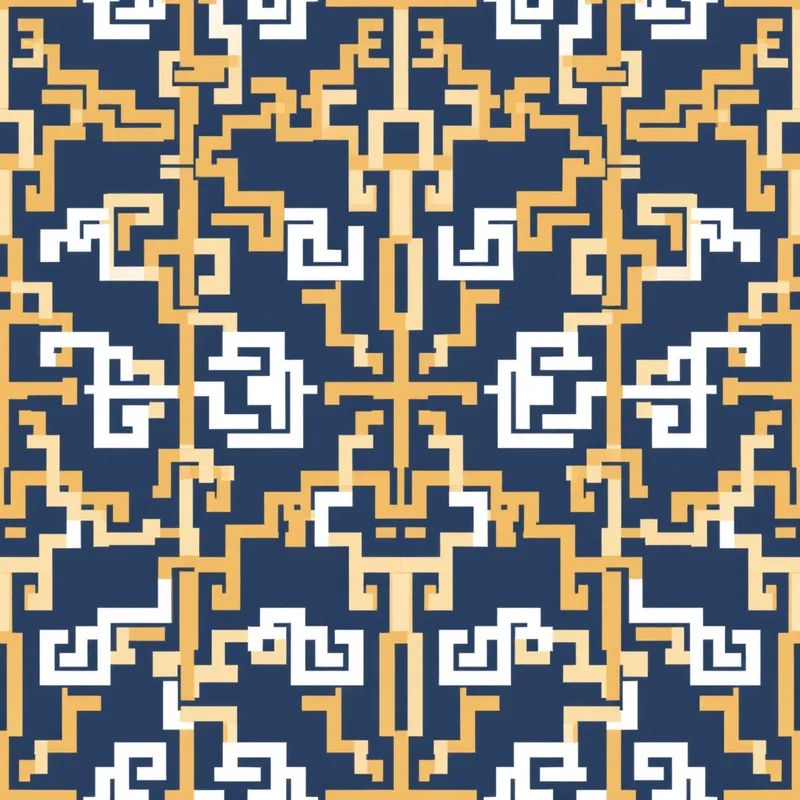
- Dense banding. Narrow strips of repeating geometry stacked into a collar, hem or panel.
- Strong symmetry. Mirror and four-fold symmetry, with spirals, stepped squares, crosses and stars.
- High-contrast color. A dark ground such as indigo (#1E2A55) or black, with saturated red (#B3122D), hot pink (#E4458E), leaf green (#2F8F4E), yellow (#F2C230) and cream (#F5F0E6).
- Small units. Stitched motifs are tiny, so the sense of scale comes from repetition, not from one large figure. Trim-width borders of one to three inches suit the look.
Working with this tradition respectfully
- Do not reproduce a specific maker's design, and never reproduce a story cloth scene as decoration.
- Do not label a mass-produced print "Hmong" unless Hmong makers were involved and credited.
- If you want the real thing, buy from Hmong artisans, cooperatives and Hmong-owned shops, or commission new work.
- Say "inspired by" only when you can say by what, and keep sacred or ceremonial garments out of throwaway products.
The better creative move is to borrow the logic and invent the content: a banded trim built from your own stepped shapes, a dark-ground palette with three saturated accents, a symmetrical medallion that belongs to your brand.
Where to go next
For the stitching vocabulary behind this look, the guide to embroidery-style patterns and the cross-stitch inspiration post show how counted, grid-based motifs are built. For how meaning travels (and fails to travel) between cultures, read pattern symbolism around the world. You can browse Hmong patterns, embroidery patterns and cultural patterns as references for structure.
If you want to explore a banded, high-contrast layout for your own collection, Describe It in Pattern Weaver lets you write a prompt in your own words, so you can invent original motifs rather than reproduce someone else's. New accounts get 5 free credits.
Explore related pattern styles