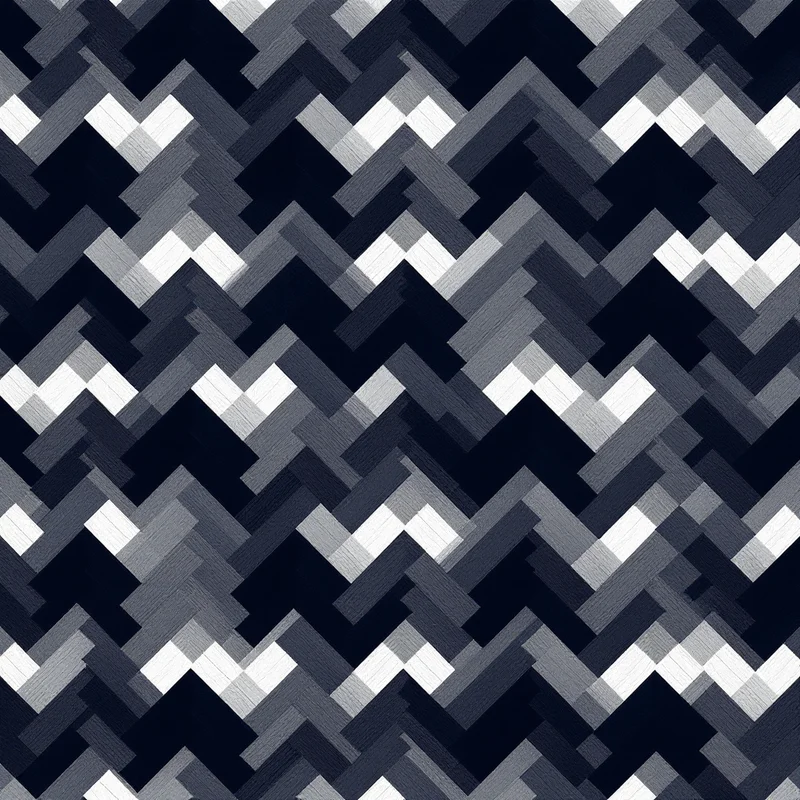
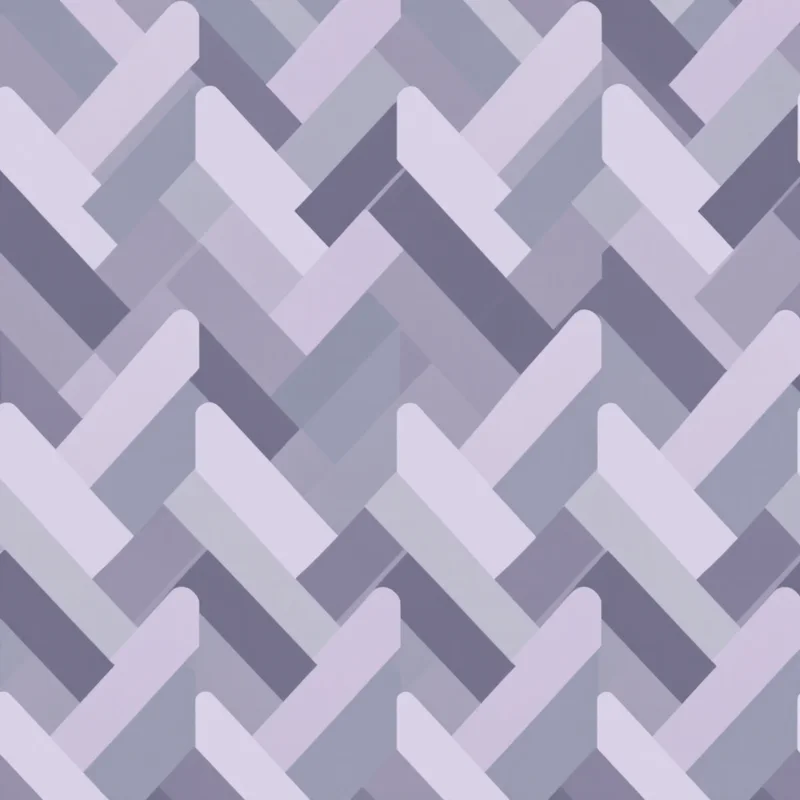
Herringbone is unusual among pattern motifs in that it began as an actual physical construction technique — in weaving and in masonry — before becoming a pattern reproduced independent of that original structure.
Herringbone's origin in real construction
The name and structure come from the actual pattern of a fish's bones, and the technique appears independently in two real-world crafts: as a twill weave in wool fabric, and as a brick or wood-flooring laying pattern where each plank or brick is offset at an angle from its neighbor. Both produce the same visual interlocking zigzag, arrived at through completely different physical processes.
Herringbone versus chevron
The two get confused constantly because they're visually similar zigzags. The structural difference: herringbone's V shapes offset and break at each column, so they interlock rather than meeting cleanly, producing the fish-bone texture. Chevron's V shapes meet at a clean, continuous point with no offset break. Herringbone reads more textured and tailored; chevron reads bolder and more graphic.
Fabric herringbone versus flooring herringbone
The same underlying structure behaves very differently at different scales and in different materials. Fabric herringbone, especially in menswear wool, is typically a fine, subtle woven texture — you register it as a slightly textured solid from a distance, with the herringbone structure only visible up close. Flooring herringbone, in wood or tile, is laid at a much bolder, larger scale specifically to be a visible design statement across a whole room.
Where herringbone works
Herringbone patterns are the default choice for anything wanting a tailored, classic-menswear feel at fine scale, or a bold architectural statement at large scale — the same geometric structure genuinely spans both registers depending purely on how large you draw it and how much contrast you give it.
Herringbone patterns at any scale, from fine woven texture to bold flooring-style statements, can be generated as a seamless, production-ready tile. Start in the free pattern maker with 3 free credits, or browse pattern styles for the full range.
Explore related pattern styles