Leaf patterns are easier to design when you stop thinking "green" and start thinking "silhouette." A leaf is read first by its outline, then by its veins, and only then by its color. Sorting leaves by shape tells you what layout will work.
Simple blades: olive, eucalyptus, laurel
One smooth leaf per stem, usually narrow or oval. Olive leaves are slim and silvery. Eucalyptus has round "coin" leaves on young stems and long curved leaves on older ones. Laurel is a glossy, pointed oval, and since ancient Greece and Rome the laurel wreath has stood for victory.
Simple blades suit sprig layouts: one stem, leaves in pairs, plenty of ground showing. They read as calm and are good for spa packaging, bedding and stationery. Palette: sage (#9CAF88), eucalyptus (#8FAF9E), olive (#6B7B3A) and cream.
Lobed leaves: oak, maple, fig, ivy
Leaves with rounded or pointed lobes. Oak has rounded lobes, maple has pointed ones, ivy has three to five angular points and fig has broad, deep lobes. Lobed leaves have strong, easily recognized silhouettes, so they work at small scale and in dense scatters.
They carry the seasons: green for spring and summer, rust and gold for fall. A scatter of oak leaves in #B5532A, #D9A23B and #7A4A21 is the classic autumn print. Ivy trails and vines make borders and wallpaper.
Pinnate leaves: fern, feather palm
Leaflets in two rows along a central rib, like a feather. Pinnate leaves repeat their own structure, which gives them a natural rhythm. They are excellent in:
- Borders. A single frond repeated along a strip.
- Diagonal repeats. Fronds layered in alternating directions.
- Tonal prints. Three greens, no outline.
See fern patterns for the Victorian-style fern look, and pair it with the Victorian dark-green palette of #1F4D3A, #3E7A55 and #CFE0C8.
Fan leaves: palmetto, ginkgo, fan palm
Leaves that radiate from one point. Ginkgo is a fan with a small notch, and its yellow in autumn makes a good warm accent. Fan palms are bigger and more segmented. They are naturally symmetrical, which makes them useful as medallion centers or mirrored pairs.
Oversized and architectural leaves
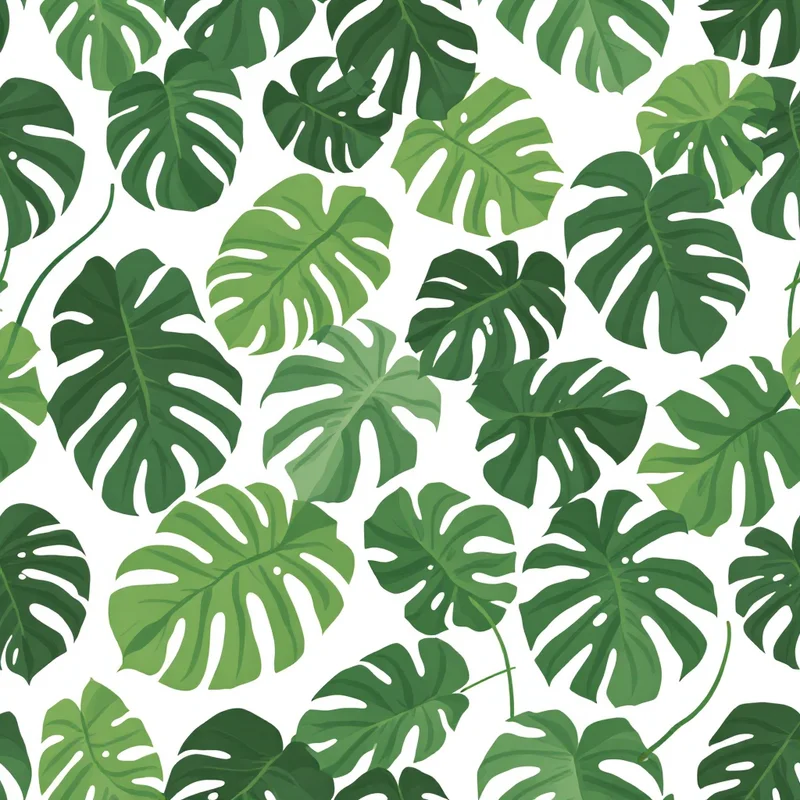
Monstera. Large, heart-shaped leaves with deep splits and holes. The cutouts are the point, so draw them with confident curves. Browse monstera patterns.
Banana leaf. Long paddles with a central rib, often with ragged splits. Strong diagonals, good for statement wallpaper.
Fiddle-leaf fig. A wide, violin-shaped leaf with a puckered surface. Reads as contemporary and interior-minded.
These belong to the tropical family covered in types of tropical patterns. Use one to three leaves per tile at large scale, with overlap and shadow tones for depth.
Needles and blades: pine, bamboo, grasses
Conifer sprigs are made of needles along a stem and work for winter and woodland prints. Bamboo, pampas and other grasses are drawn with long blades and light, arching lines.
Ornamental leaves: acanthus
Acanthus is a stylized, curling leaf that has decorated buildings since ancient Greece and Rome, appearing on the carved capitals of Corinthian columns. William Morris used it in a famous 1875 wallpaper design. If you want a heavy, ornate leaf, acanthus is the one. See the William Morris post for how he handled it.
Quick drawing checklist
- 1Outline. Get the silhouette right before adding anything.
- 2Midrib and veins. One center line plus two or three side veins is enough at small scale.
- 3Edge. Smooth, serrated or scalloped. This is what differentiates oak from laurel.
- 4Tone. Two greens per leaf, light on one side, dark on the other.
- 5Variation. Rotate, resize and flip each leaf. Identical copies look stamped.
Choosing a layout
| Layout | Best leaf types | Mood |
|---|---|---|
| Tossed | Lobed, simple | Casual, easy to cut |
| Sprig | Simple blades | Quiet, minimal |
| Trailing | Ivy, fern | Romantic, traditional |
| Dense jungle | Monstera, banana, palm | Bold, lush |
| Tonal | Any | Subtle, textured |
For the bigger question of when a leaf print beats a geometric one, see geometric vs botanical patterns. Start from botanical patterns for more.
To try silhouettes quickly, Browse Styles in Pattern Weaver lets you pick from 44 categories and 5,700+ styles, and each tile arrives in about 20 seconds.
Explore related pattern styles