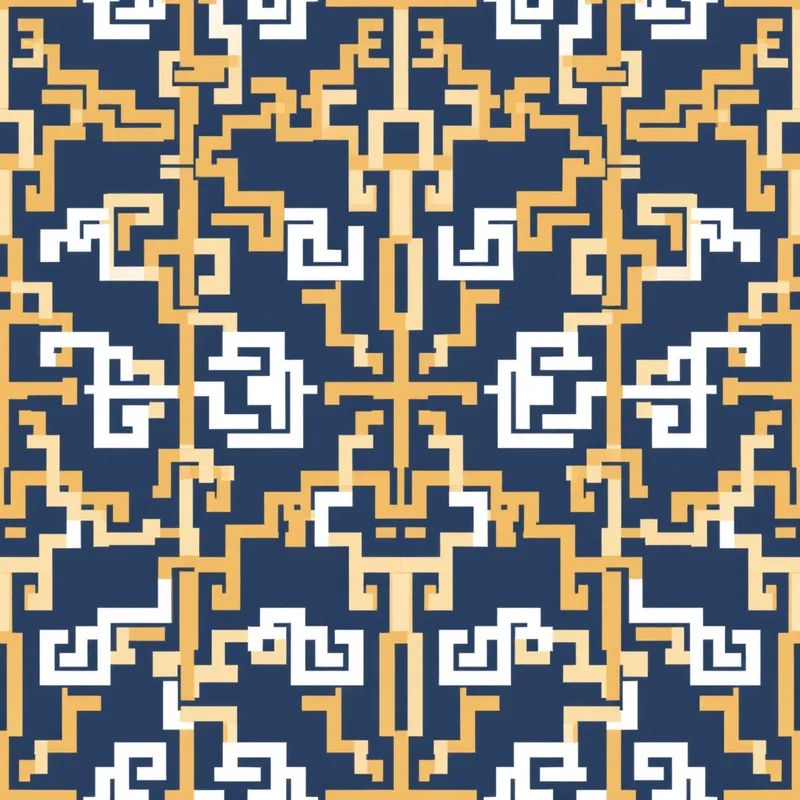
Shibori is not one technique but a family of them, all built on the same idea: control where dye can reach the cloth. The name comes from the Japanese verb shiboru, to wring or squeeze. Examples survive from Japan's Nara period in the eighth century, and shibori is still made in places such as Arimatsu and Narumi, near Nagoya. Most traditional shibori uses indigo, which is why the look is so closely tied to blue and white.
The main techniques
| Technique | How it is made | What it looks like |
|---|---|---|
| Kanoko | Tiny sections of cloth are bound with thread | Rings of dots, like a fawn's spots |
| Miura | Cloth is looped with a hook and bound | Wavy, looped lines |
| Kumo | Cloth is pleated and bound in sections | Spider-web radials |
| Nui | Lines are stitched, then pulled tight | Crisp lines and stitched shapes |
| Arashi | Cloth is wound around a pole and compressed | Diagonal, rain-like lines |
| Itajime | Folded cloth is clamped between boards | Mirrored squares, triangles and rectangles |
Each method leaves the same signature: a soft, feathered edge where indigo creeps beyond the resist, and slight variation in saturation. Nothing is perfectly crisp, and that is the beauty of it.
Resist dyeing is old and global. India has bandhani, a binding technique that produces tiny dots; Indonesia and Malaysia have plangi; and Yoruba makers in Nigeria produce adire, which includes tied and stitched resists. For wax resist, see the batik pattern guide. Shibori deserves to be named for itself, not lumped in with all tie-dye.
A palette that reads as indigo
- Deep indigo #1F3A5F
- Mid blue #4A6FA5
- Pale blue wash #A9BCD6
- Undyed cotton #F4F1EA
Real indigo sits on a spectrum from near-black to pale sky, depending on how many dips the cloth had. Using three blues plus white is enough.
Designing shibori-style seamless prints
Arashi. Draw diagonal bands at roughly 45 degrees, each with a dark core and a feathered edge. Vary band widths. For a seamless tile, make sure the bands exit and re-enter at the same points on opposite edges.
Itajime. Because the cloth is folded, the result mirrors along the fold lines. Build one motif, a square or triangle, and mirror it along two axes. Use a mirror repeat and let the dye halos overlap at the borders.
Kumo. Draw radiating, pleated lines around small centers. Place four or five centers in a half-drop so no single one dominates, and let the lines blur outward.
Nui. Use stitched-looking lines and small rounded shapes with a thin crisp edge and a halo. This is the most graphic technique and the easiest to read at small scale.
Kanoko. Scatter rings of white dots on indigo, each with a slightly irregular size. Keep the dot rings around 0.25 to 1 inch (6 to 25 mm) across for apparel.
For all of them, add a fine cloth texture, since a flat digital blue looks nothing like dyed cotton.
Keeping it believable in print
Digital shibori fails when it is too clean. Blur the edges of each shape by a few pixels, vary the blue inside a single shape from dark at the center to lighter near the edge, and avoid exact repeats of the same fold. A good test is to view the tile at actual size beside a photograph of dyed cotton.
Where shibori works
Shibori-style prints suit scarves, linen bedding, cushions, kimono-inspired jackets and packaging. They also work well in blue patterns, and share a palette with Japanese motifs; see the Japanese pattern design guide for seigaiha and asanoha. The tie-dye patterns category covers the looser, more colorful relative.
Respecting the craft
Shibori is a continuing craft with regional specialties, not a generic "Japanese" texture. If you sell a shibori-inspired print, say so, avoid claiming it is hand-dyed when it is digital, and consider linking to makers who do the real work. Digital imitation is best treated as homage and visual research.
With Browse Styles in Pattern Weaver you can start from the cultural patterns categories, then use Describe It to ask for a specific technique, for example "arashi shibori diagonal indigo lines on cotton, seamless tile".
Explore related pattern styles