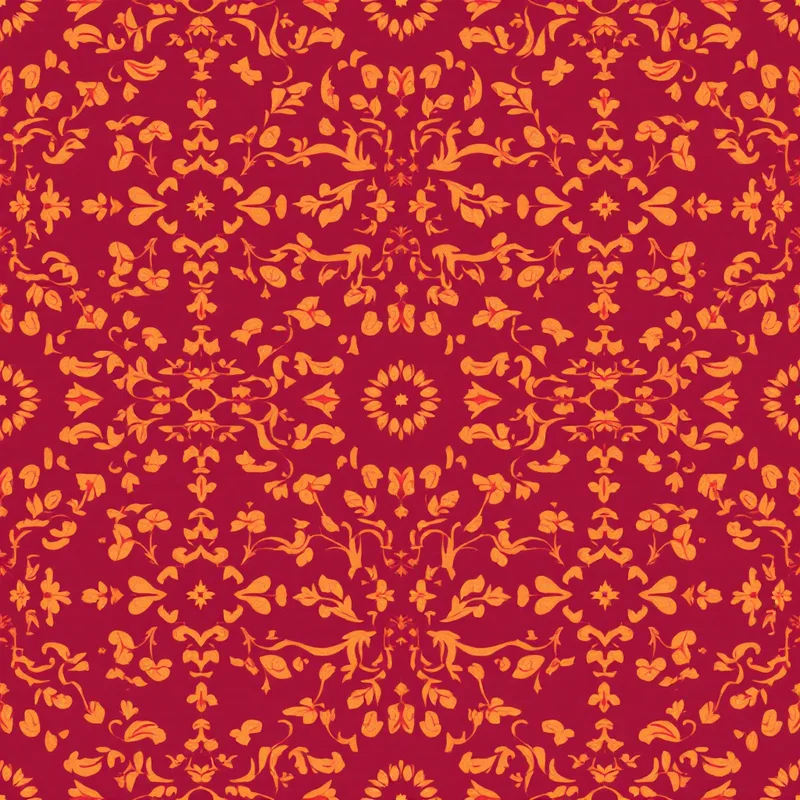
A chaniya choli is cut in three parts, and each part wants a different scale. The skirt flares into many yards of fabric that spin during Garba, the blouse is a small fitted area, and the dupatta drapes in long folds with contrast borders. Design for all three at once and the rest of a Navratri collection falls into place.
About the festival
Navratri means "nine nights" and honors the goddess in her various forms. The autumn festival, which falls in September or October depending on the lunar calendar, is the best known. In the evenings, people dance Garba in circles around a lamp or an image, and Dandiya Raas with decorated sticks. These dances come from Gujarat and are celebrated widely across India and in diaspora communities. Diwali comes a few weeks later in the same season, and the Diwali pattern design post covers that festival separately.
Because Navratri is a religious occasion, approach it as such. Use decorative and folk motifs for apparel and decor, and keep images of deities off garments as repeat decoration.
One outfit, three scales
| Piece | Scale | Pattern approach |
|---|---|---|
| Skirt (chaniya) | Large motifs, 4 to 8 inches, plus a bold hem band | Wide border at the hem, lighter field above |
| Blouse (choli) | Small motifs, under 2 inches | Dense dots, tiny florals or mirror-look clusters |
| Dupatta | Medium field with contrast borders | Bandhani dots or paisley, border at the ends |
Remember that the skirt moves. A bold hem border looks spectacular when it swings, while delicate detail in the middle of the skirt vanishes. Place the visual weight low.
Motifs from the dance floor
- Peacocks and parrots: common in Gujarati folk embroidery, drawn in profile with fanned tails
- Garbo pot and diya: the perforated clay lamp-pot at the center of the dance, and the oil lamp itself
- Dandiya sticks: crossed pairs, used as a graphic accent
- Marigold and lotus: festival garlands, doorway hangings and offerings
- Mandala and rangoli geometry: radial, symmetrical designs that suit circular compositions; see mandala patterns
Elephants, mango leaves and paisley can also feature, but choose one or two focal motifs so the print stays readable at speed.
Getting the mirror-work look in print
Mirror work, called shisha or abhla bharat, is hand-stitched embroidery that holds small mirrors in place. It is a living craft and a print cannot replace it. What you can do is reference it honestly:
- Draw small circles in clusters of five to seven, with a ring of fine stitch lines around each
- Add a crescent highlight in pale gold or silver inside each circle
- Use a metallic foil pass if your printer offers it
- Describe the product as "mirror-work inspired" rather than "mirror work"
For shimmer ideas beyond mirrors, sequin patterns offers scale-like and glittering textures.
Bandhani dots
Bandhani is the tie-dye tradition of Gujarat and Rajasthan, where cloth is bound in tiny knots before dyeing to create dotted designs. A bandhani-style print uses small clustered dots in diamonds or flower shapes, with an uneven edge to each dot. Keep dot size consistent within each cluster and let the cluster pattern repeat on a half-drop. The Indian block print pattern design guide covers another handcraft tradition for reference.
Palette
Navratri outfits are famously bold. Start from combinations like:
- Rani pink #D81B60 with turquoise #00A6A6
- Mustard #E5A823 with indigo #2B2F6B
- Parrot green #3E9B4F with fuchsia and gold
Some communities wear a designated color on each of the nine nights, but the sequence varies by year and region. If you create a nine-color collection, check the current year's list and avoid presenting a single list as the standard.
Leave out
- Deity portraits or sacred text as all-over decoration
- Sacred symbols used only because they look pretty
- Claims that a print is handmade or traditional when it is machine printed
If you are not part of the community, ask a Gujarati designer or reader to look over your work before you publish. Name the origin of each motif in your listing, and browse cultural patterns for more reference.
Timing
Autumn Navratri lands in September or October. Garment makers need fabric well in advance, so finish tiles by spring and list yardage by early summer, leaving time for sampling and tailoring.
To explore, use Browse Styles to pick from 44 categories and 5,700+ styles, then use Describe It for something specific, such as "bandhani dot clusters in rani pink and turquoise on indigo". Each tile is seamless in about 20 seconds, and Pro exports up to 8K for large skirt panels.
Explore related pattern styles