

A tree skirt is the one Christmas textile where the repeat has to bend. A tablecloth or pillow is flat and rectangular, and a standard tile fits it without thought. A skirt is a ring around a trunk, and a pattern that behaves perfectly on a rectangle can look off-center, upside down or cut in half on a circle.
Two ways to fill a circle
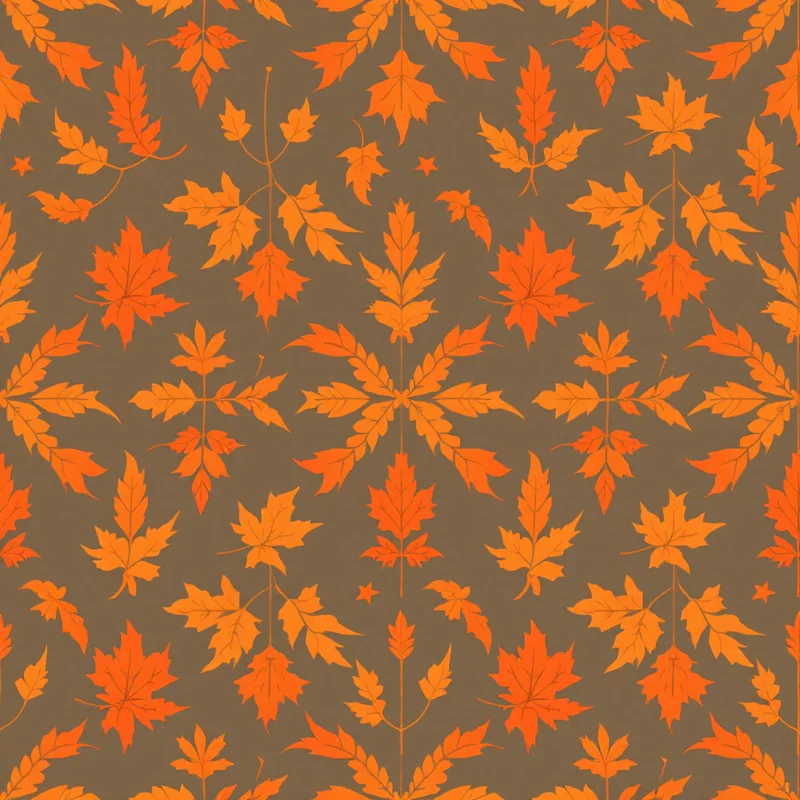
1. Crop a standard tile. The simplest route: lay a seamless repeat across the whole disc and trim it to a circle. It works with tossed and all-over prints, and it is how many printed skirts are made. The weakness is that nothing relates to the center, so it can feel like a square of fabric with the corners cut off.
2. Design radially. The pattern is built around the center, so rings and wedges give it a deliberate shape. This is the version that looks custom, and it is what mandala patterns do naturally.
Rings and the circumference problem
A ring that circles the trunk gets longer as it moves outward, so the number of motifs must grow with it. The circumference is 2 times pi times the radius, which gives this progression for motifs about 6 inches wide:
| Ring radius | Circumference | Motifs that fit |
|---|---|---|
| 6 in | about 38 in | 6 |
| 12 in | about 75 in | 12 |
| 18 in | about 113 in | 18 |
| 24 in | about 151 in | 25 |
If you keep the same number of motifs on every ring, the outer ones either spread thin or have to be drawn bigger. Both are valid choices; the point is to choose one on purpose. A common approach is to double the motif count at each step outward and scale the motifs slightly, so the ring edges feel evenly packed.
Wedges: the easy way to a radial repeat
Divide the circle into equal slices, draw one wedge and rotate it around the center. Eight wedges are 45 degrees each, twelve are 30 and sixteen are 22.5. Twelve is a common choice because it divides the circle into tidy 30 degree steps. Mirroring alternate wedges, like a kaleidoscope, hides seams and gives a snowflake feel.
If your design is a quilt-block look, quilted patterns show how wedge piecing handles a circle in fabric.
Where the slit goes
Every skirt has an opening from the edge to the center so it can wrap around a trunk. Plan it:
- Put it on a wedge boundary or along the center of a stripe so it disappears into the design.
- Avoid cutting through a face, a large motif or a name.
- If the skirt overlaps at the opening, add a few extra inches of pattern on one side so the lines continue.
What people actually see
The center is covered by the stand and trunk, and the inner ring is hidden under branches, gifts and sometimes a basket. In practice the visible area is the outer ring, a band of perhaps 8 to 12 inches. Put the best art there.
- Center: a quiet ground or a small repeat that no one will study.
- Mid ring: the main motifs, scaled so presents do not hide them all.
- Edge: a strong border such as scallops, a plaid band or a ring of stars. This is the frame guests see first.
Directional motifs on a circle
Motifs that have a top and bottom, like trees, stockings and reindeer, can be rotated to face outward from the trunk or kept upright. Facing outward means half the motifs are upside down from any viewing angle. Facing upright is more comfortable but breaks the radial rhythm. A good compromise is to use non-directional motifs (stars, snowflakes, baubles, holly sprigs) in the rings and reserve directional elements for the border, facing outward.
Palette and edge details
A tree skirt is surrounded by green, so reds, creams and golds read well, as do icy blues for a cold look. For a classic scheme: cranberry #8E1B3A, cream #F5EBDD and brass #B08D3C. Edge treatments, like pom-poms, ruffles or a bound edge in a contrasting color, can finish the design in a way no print can.
This skirt may live alongside matching items, so consider Christmas stocking pattern ideas and Christmas tablecloth and table linen patterns for a coordinated set, and Christmas patterns for the wider range of motifs. If you need a refresher on repeats first, the beginner's guide to repeat patterns is a good start.
Pattern Weaver makes seamless tiles, which suits the crop-a-tile route and the ground prints you will lay behind a radial border. Describe It lets you write the motif in your own words, and Pro exports up to 8K, enough resolution for a large circular print.
Explore related pattern styles