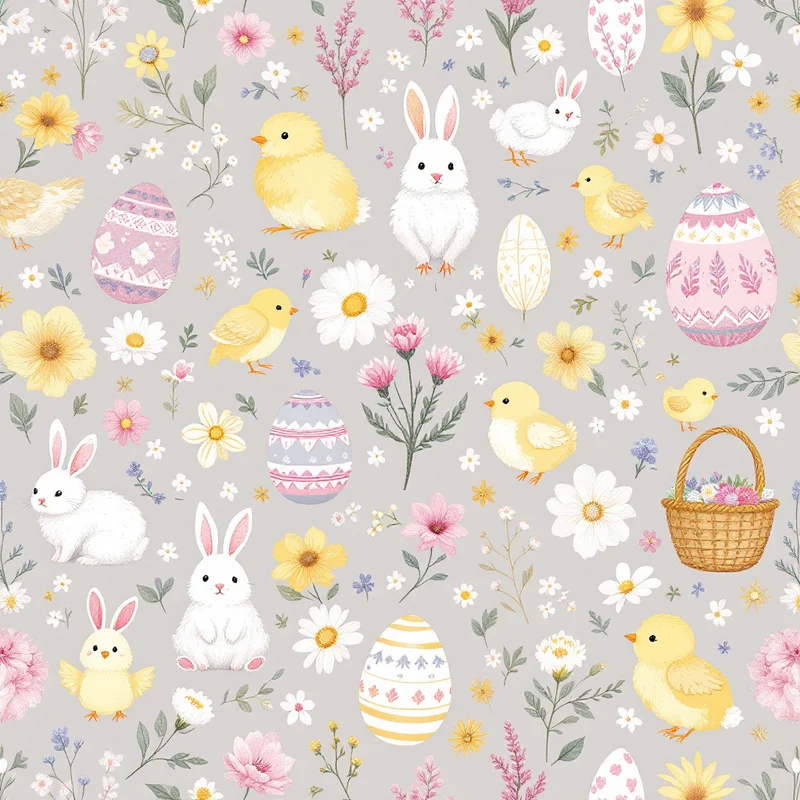


An early Easter changes the work. Western Easter can land anywhere from March 22 to April 25, and in 2027 it falls in late March, close to the earliest end. For anyone who designs, lists and promotes seasonal patterns, that pulls the whole spring forward: deadlines that felt comfortable in a late-April year are suddenly tight.
Everything that follows is a forecast, a set of directions to watch rather than a measured result. For the evergreen ideas, see our earlier post on Easter pattern ideas.
Past pastel, toward one loud accent
Pastel pink, mint and lilac will stay the baseline. What is moving in is the pastel print with one saturated accent that makes it feel current: butter yellow with tomato red, sage with chocolate brown, powder blue with a vivid cherry. Think of the accent as about a tenth of the print, used for the yolk of an egg, a ribbon or a flower center.
The butter yellow pattern guide shows how to keep that shade creamy instead of acidic, and the pastel patterns category is a good place to start the ground.
Eggs that look dyed, not printed
Expect the egg to move away from the perfect glossy ellipse. Natural-dye looks are the more interesting direction: the warm browns and golds that come from onion skins, the blues from red cabbage, speckled shells and mottled, uneven color that suggest a kitchen table rather than a factory. Draw each egg slightly differently, with a tiny wobble in the outline, and let color pool at one end.
A caution on pysanky. These wax-resist decorated eggs belong to Ukrainian folk tradition and carry specific symbols, so don't flatten them into a generic "folk egg" pattern. If you work with the style, research the motifs, credit the tradition and look at the Ukrainian patterns category for a respectful starting point.
Bunnies and hares, hand-drawn
The cartoon bunny is the most crowded corner of the category. The more distinctive direction is a hand-drawn animal with real proportions: long hind legs, a side-on silhouette, ears that move. The hare has its own history here, since the Easter bunny traces back to a German folk tradition of an egg-bringing hare. A print that nods to that, such as a hare in profile among wildflowers, will stand apart from rounded kids' clip-art.
Browse bunny patterns for a base, then simplify the line.
A cleaner split between faith and fun
Easter is a Christian holy day, and its buyers divide into two groups. Church and faith-based buyers want crosses, lilies, lambs and dove motifs, usually in calm palettes. Secular buyers want bunnies, eggs, baskets and spring flowers. Trying to serve both in one print usually fails both. Plan two small collections instead, sharing a palette so the shop still looks coherent.
Scale the egg to the product. A tossed egg at 1.5 to 2 inches suits gift wrap and paper plates, while a single large speckled egg at 6 inches or more suits a tote or a cushion. Leave generous gaps so the shell color reads against the ground.
Table first
An Easter table is as much a product as an egg basket. Expect more gingham, linen-look weaves, embroidered florals and egg-cup stripes, a quieter and more domestic take than a bunny toss. A tablecloth print wants a larger repeat than a napkin, so build the same motifs at two scales.
A capsule plan for an early Easter
- Now to mid-December: sketch and finalize 8 to 10 prints in one palette.
- Late December to January: make colorways and test on tablecloths and packaging.
- By mid-January: list for print-on-demand and digital shops.
Because Eid, Holi, Nowruz and St. Patrick's Day crowd the same weeks, the seasonal pattern calendar helps you sequence them.
New accounts in Pattern Weaver get 5 free credits, enough to try an accent-color palette across several tiles before you commit.
Explore related pattern styles