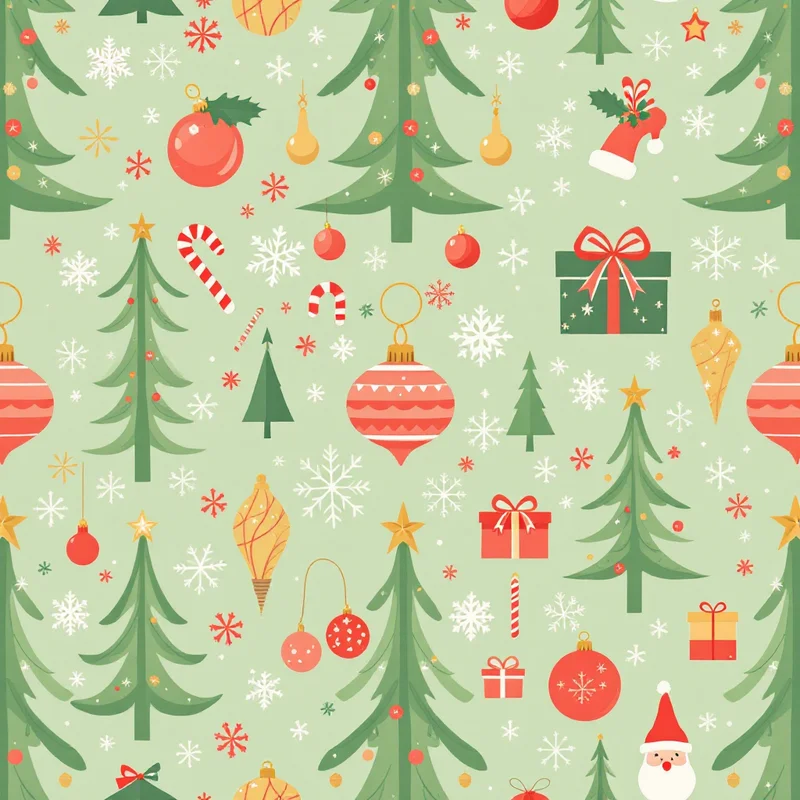
Kids spot a character before they spot a pattern. A reindeer with two dots for eyes will be noticed from across a room long before anyone registers that the tile is well-balanced. That is good news for designers, because it means a children's Christmas print is mostly a character problem with a layout wrapped around it.
Characters that work
Original, simple and friendly beats clever. The shapes that read best to small children are round, with large heads and minimal detail.
- Snowmen with a scarf and carrot nose
- Penguins and polar bears in woolly hats
- Reindeer with a bright nose and fuzzy antlers
- Gingerbread kids with icing buttons
- Elves and gnomes, whose pointed hats are easy to draw
- Sleepy Santa and sleigh
- Animals in Santa hats: dinosaurs, foxes, cats and dogs
- Stars and baubles with faces, a sweet fit for the youngest kids
Keep faces simple: two dots, a small smile, and rosy cheeks. Avoid anything frightening, and avoid branded characters, which you cannot use without a license. Original characters are also easier to build a collection around.
Pick a palette by age
| Age | Palette | Hex examples |
|---|---|---|
| Babies | Soft pastels, cream | #F7D9DD, #CFE3F0, #F6EBD3 |
| Toddlers | Bright primaries, mint | #E63946, #3FA796, #FFD166 |
| Young kids | Candy colors on dark | #FF6F91, #4CC9F0, #F9C74F |
| Older kids | Rich, graphic color | #1D3C78, #E0449B, #2F9E5B |
Baby items usually suit calm grounds, while toddler and young-kid items can carry saturated color. Check that adults will like it too, since they do the buying.
Scale by garment and product
A children's print must work on very small surfaces.
| Item | Motif size guide |
|---|---|
| Baby bodysuit | Half inch to 1.5 inches, tossed |
| Toddler tee | 1 to 3 inches, with one large hero |
| Pajamas | 1 to 2 inches, non-directional |
| Pillowcase, bedding | 2 to 5 inches |
| Wallpaper for a room | 3 to 8 inches |
Baby sizes crop heavily, so avoid large motifs unless they are placed prints. For matching family sets, see family matching Christmas pajama prints.
Printed versus sewn-on details
Parts that detach are a concern for young children. Buttons, sequins, bows and appliqué can become choking hazards for children under three, and sellers must follow the rules where they sell. A printed motif cannot come off, so print is a natural fit for baby and toddler items.
- Prefer printed details over sewn-on ones for the youngest sizes.
- Choose a printer who can provide compliance and testing information for children's products.
- Keep faces and details legible when printed small, since fine linework blurs.
- Think about sleepwear rules, which differ by market and cover fit and flammability.
Things to do on a page
Kids love finding things. Build play into the print:
- Hidden motifs. One tiny mouse, star or bird hidden in each repeat.
- Counting. Rows of one, two, three snowmen.
- Colors. A scatter of ornaments in a clear rainbow.
- Letters. A simple alphabet with a holiday word for each letter.
- Scenes. A village with doors, windows and chimneys to point at.
Layout for kids
Tossed, non-directional layouts are the practical answer for clothing and bedding. For wallpaper and wrap, add a few larger hero characters with smaller fillers around them. Keep the backgrounds clean, so the characters pop.
Sweet themes cross over: gingerbread pattern ideas is a ready source of cookie kids, and for the cute, pastel side of the genre, see cute Christmas wallpaper ideas. For where this year's kids' design is heading, kids' pattern trends for 2027 has the forecast, and kids patterns, Christmas patterns and kawaii patterns offer styles to start from.
In Pattern Weaver, Describe It lets you write a prompt in your own words, such as "friendly penguins in red scarves on mint", and Product Mockups, which are free, put the result on 20 products so you can judge scale before you order anything.
Explore related pattern styles