A 3-inch ornament is 900 pixels across at 300 DPI, and that is your whole canvas. Everything about a good ornament pattern follows from that small size: fewer motifs, thicker lines and a design that works from arm's length.
Know the blank before you draw
Sublimation ornaments are usually pre-coated blanks: flat rounds, stars, hearts and scalloped shapes in ceramic, aluminum or hardboard. Printed glass baubles and other curved shapes use different processes, such as wraps, decals or direct printing. Ask your supplier for their template and print method before you draw anything, because the template determines the size, bleed and hole position.
For a standard flat 3-inch round:
- Finished size: 3 by 3 inches, 900 pixels at 300 DPI
- With bleed: add 0.125 inch on every side, so 3.25 inches or 975 pixels
- Hanger hole: keep a clear zone of roughly 0.35 inch around it, and confirm against the template
The sublimation pattern design guide covers file prep in more detail.
Scale on a small canvas
The pattern scale guide explains scale as a relationship to viewing distance. On an ornament, that distance is short but the object is tiny, so details vanish quickly.
| Layout | Motif size on 3 in round | Notes |
|---|---|---|
| Single hero | 1.5 to 2 inches | One bold shape, centered |
| Tossed all-over | 0.5 to 1 inch | About three repeats across |
| Border plus center | Border band 0.4 inch, center 1.5 inches | Echoes a bauble's frame |
| Half and half | Two tones split by a diagonal | Simple and graphic |
Keep lines thicker than about 1 pt at the final size. Fine hairline details tend to fall away on a small, coated surface.
Composition that suits a circle
- Medallion. A symmetrical rosette, wreath or star radiating from the center. Circles love radial layouts.
- Cropped all-over. A seamless tile cropped to a circle. Slide the crop around until no motif is sliced awkwardly at the edge and nothing lands on the hole.
- Monogram or year. A name, initial or "2026" on a quiet pattern. Keep the text on a calm panel with enough contrast.
- Scene in a circle. A tiny landscape of pines and stars, like a snow globe. This takes the least pattern work and the most illustration.
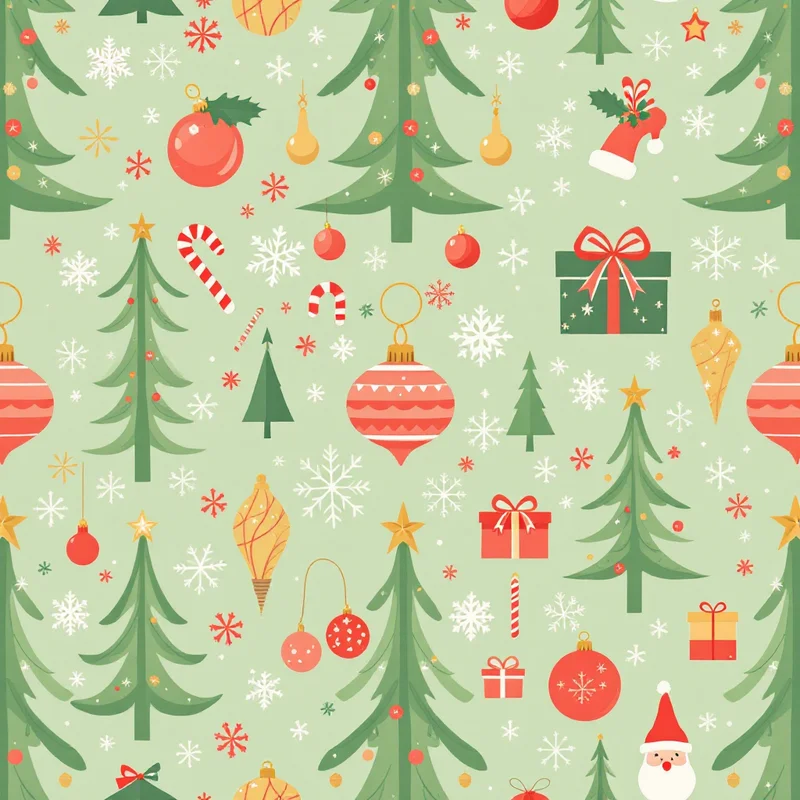
For ideas that suit the season, Christmas pattern design ideas lays out the major aesthetic directions.
Design the back, too
Many ornaments are printed on both sides or sold as sets. Use the front for the hero and the back for a coordinating small-scale tile in the same palette. A matched pair sells the idea of a collection, and it prevents a bare back from looking unfinished.
Colors and finishes
Sublimation prints with translucent dye inks. It cannot print white or metallic ink. In practice:
- White areas show the blank's color. On a white blank that is fine. On a colored or metal blank, plan for it.
- Gold prints as a warm yellow-brown. Build a gold-look palette (`#C79A3B` with a lighter `#E6C877` highlight and a darker `#8E6A22` shadow) and use shading to suggest shine.
- A real metallic look needs a different blank or process. Ask your supplier whether they offer metallic-finish blanks or foil options, and design to their notes.
If you need a more polished metallic effect in your artwork, see metallic patterns for reference looks that work as flat color.
A starter set of six
A small ornament collection can use a single palette of red `#A8323B`, green `#2F5D45`, cream `#F4ECDC` and gold-look:
- 1Tossed berries and holly sprigs
- 2A fir-tree medallion
- 3A woven-star all-over
- 4A plaid in red and cream
- 5A year-and-name panel on a snow-dot ground
- 6A winter village scene
Test each at 3 inches on screen. Zoom out until the ornament is the size of your thumbnail, and check the main shape still reads. If you plan to reuse a design on mugs or tags, read how to scale a pattern for different products first, since each product needs its own scale.
Making it
Browse Styles in Pattern Weaver lets you pick from 44 categories and 5,700+ styles, so you can start from Christmas patterns and describe a more specific direction. Each seamless tile takes about 20 seconds, so you can crop several to circles and judge the composition quickly, and Product Mockups, which are free, put a pattern on 20 products. New accounts get 5 free credits.
Explore related pattern styles