Ask a buyer for "a Christmas print" and the next question is always which kind. A tossed ornament print and a Christmas toile share a season and almost nothing else: different layouts, different scales, different products. Below are 18 named types, grouped by what drives each one, with a short definition and the place it does its best work.
Checks, plaids and stripes
1. Buffalo check
A large, even two-color check, classically red and black, with blocks an inch or more across. Best use: flannel pajamas, throws and cabin-style gift wrap. Start from buffalo plaid patterns and recolor from there.
2. Holiday tartan
Several stripe widths and colors crossing to form a sett. Black Watch (navy, green, black) and red-ground tartans are the ones that read as Christmas. Best use: ribbon, scarves, tree skirts and wrap. The Christmas plaid guide covers which setts work and why.
3. Red gingham
A small, even check where red crossing red makes a solid square and red crossing white makes a lighter middle tone. Best use: table linens, baking packaging and cottage-style ribbon.
4. Candy stripe
Narrow red-and-white stripes, straight or on the diagonal, borrowed from the candy cane. Best use: ribbon, tags, kidswear and as a blender beside a busier hero print.
Knit and folk looks
5. Fair Isle
Horizontal bands of small charted motifs (crosses, diamonds, stars, snowflakes), named for the island in Shetland. Best use: sweaters, mugs, mittens and printed "faux knit" fabric. See the Fair Isle guide for chart structure.
6. Nordic star and reindeer
Eight-pointed stars, reindeer and pines built on a stitch grid, the Norwegian ski-sweater look. Best use: knitwear, blankets and cards that need to feel warm without leaning on red and green.
7. Redwork
Line drawings in a single red on a white or cream ground, imitating the red-thread outline embroidery of the same name. Best use: tea towels, napkins and pillow covers.
8. Cheater quilt
A printed fabric that imitates pieced patchwork, often with Christmas blocks in a grid. Best use: quick quilts, table runners and tree skirts for makers who want the look without the piecing.
Botanicals
9. Holly sprig ditsy
Small holly leaves and berries scattered evenly at a half inch to an inch. Best use: quilting cotton, napkins and small packaging, where a busy small print hides seams and creases.
10. Poinsettia floral
Large, open poinsettias with their red bracts spread flat, often on a dark ground. Best use: tablecloths, feature wallpaper and premium wrap where a big motif has room.
11. Minimal geometric trees
Triangles, stacked lines or single-stroke trees in one or two colors with plenty of white space. Best use: modern cards, small-business packaging and anything that should look quiet next to traditional decor.
Novelty and conversational
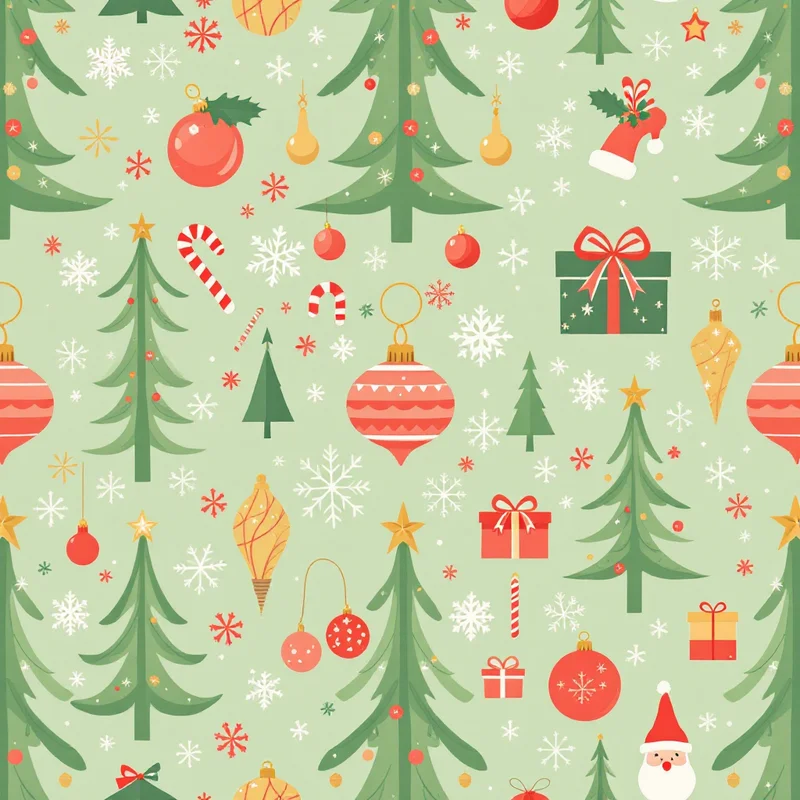
12. Tossed ornaments
Baubles scattered at varied angles with no up or down. Best use: gift wrap and fabric yardage, because it cuts in any direction without upside-down motifs.
13. Gingerbread conversational
Cookies, houses and icing details on a cream or kraft ground. Best use: aprons, kids' products and bakery boxes.
14. String lights
A wandering wire with colored bulbs. The line itself carries the eye across the repeat, so it hides the tile edge well. Best use: apparel, phone wallpaper and party goods.
15. Snowflake scatter
Six-pointed flakes in two or three sizes on a blue, navy or white ground. Best use: winter products meant to stay out through January.
Layout-led prints
16. Christmas toile
One-color scenic vignettes, such as sleigh rides, village churches and carolers, set out in the format of 18th-century French toile de Jouy. Best use: bedding, wallpaper and upscale wrap. The toile guide explains the layout.
17. Holiday damask
A symmetrical, mirrored ornament built from scrolls, with pine, holly or poinsettia worked into the shapes. Best use: formal tablecloths, wallpaper and luxury wrap, often tone on tone.
18. Border print
A one-way band running along one edge of the fabric: a tree line, a skyline of houses, a row of reindeer. Best use: tablecloth hems, skirts and the outer ring of a tree skirt.
Putting types together
Most holiday collections pair one hero type with one or two quieter ones. A Christmas toile hero might sit beside red gingham and a holly ditsy; a tossed ornament wrap might sit beside candy stripe and a solid. Keep the palette identical across the set and vary only the structure, and the group will read as one collection.
To try several of these side by side, Browse Styles in Pattern Weaver covers 44 categories and 5,700+ styles, and each result comes back as a seamless tile in about 20 seconds. The Christmas patterns category and the wider festive patterns range are good places to start.
Explore related pattern styles