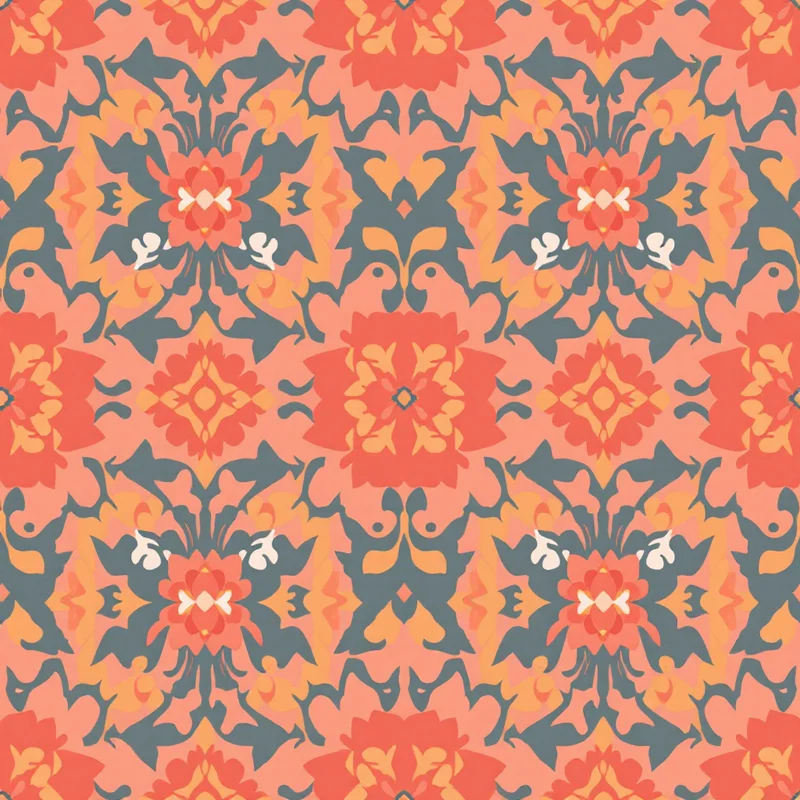
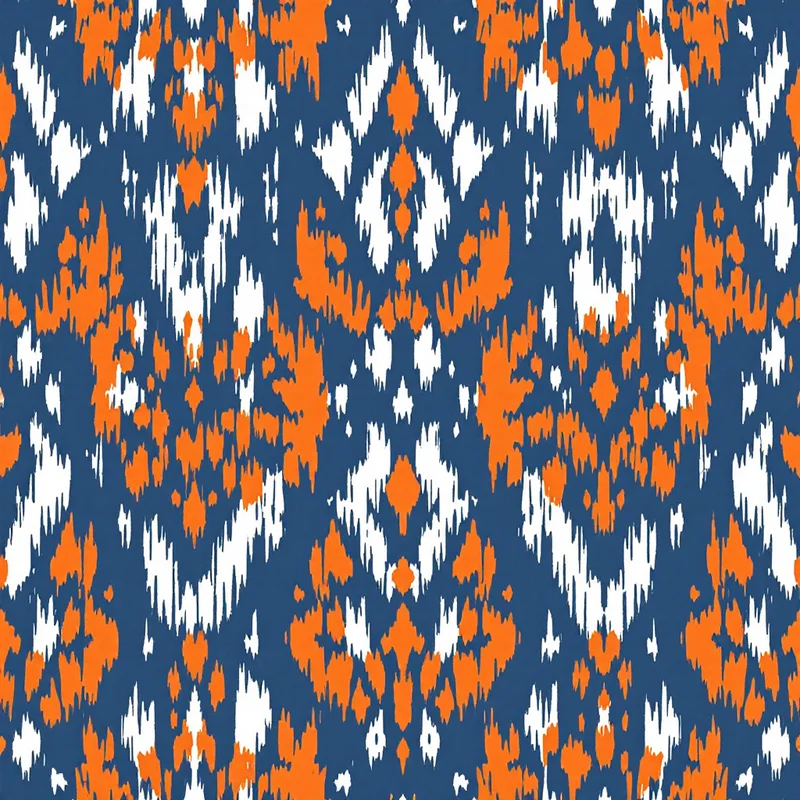
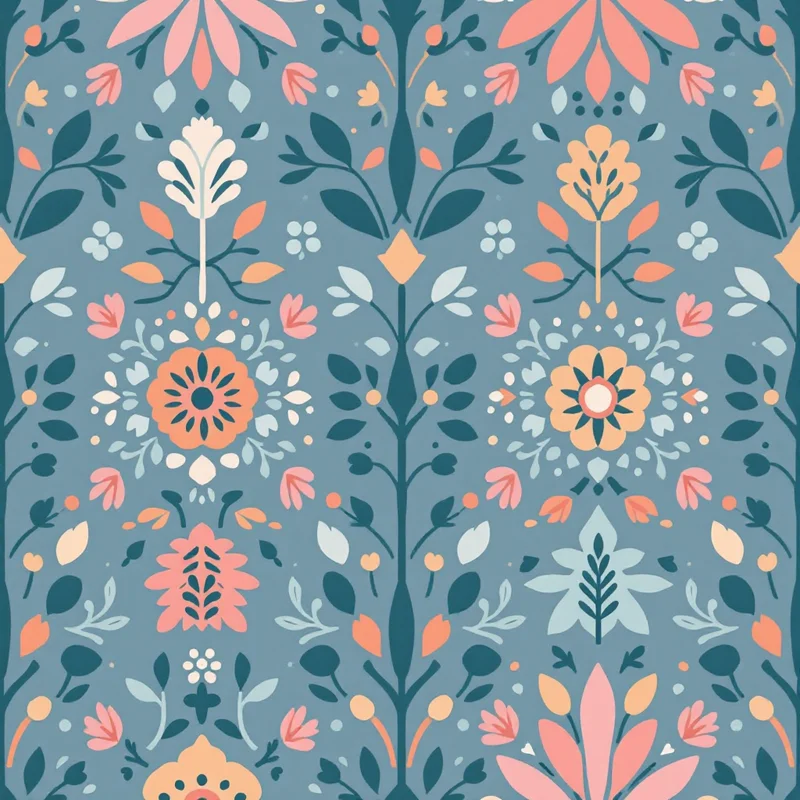
Boho pattern design draws from a deep pool of global textile traditions filtered through a free-spirited, maximalist sensibility. The aesthetic has endured because it offers something few other design languages deliver: warmth, cultural richness, and the feeling of an individual story behind every print. For designers, boho opens doors to home textiles, fashion, stationery, and interior decor markets that respond consistently to well-crafted patterns in this tradition.
Key takeaway: Boho is defined by borrowing — from Moroccan tilework, Indian block prints, African mudcloth, Native American weavings, and European folk embroidery. The successful boho designer respects the sources and combines them with restraint.
The Boho Palette
Authentic boho palettes favor earth tones with occasional jewel-tone accents. Rust orange, terracotta, ochre, burnt sienna, deep teal, olive green, cream, warm brown, mustard yellow, and dusty rose are the workhorses. Jewel accents — amethyst purple, sapphire blue, emerald — appear as punctuation rather than foundation colors.
The palette feels sun-warmed and aged rather than fresh. Pure white and pure black rarely appear; cream and charcoal stand in their places. This warmth in the palette is what separates boho from more contemporary bohemian-adjacent styles like modern Scandinavian.
Motif Traditions
Boho draws from specific cultural textile traditions. Understanding the source grammar produces stronger designs:
Moroccan influences — star patterns, eight-point motifs, tile-based geometrics, and arched doorway shapes. Often in terracotta, cream, and deep blue palettes. See the Moroccan pattern design guide for a deeper dive.
Indian block-print influences — paisley, mehndi-style florals, elephant motifs, and densely layered composite prints. Block prints have a specific character — slight registration imperfections where colors overlap — that makes them feel authentic. Explore paisley patterns.
African mudcloth (bogolan) — linear geometric motifs in warm rust, ochre, and cream. The patterns are highly graphic and read well at any scale. Works beautifully in contemporary home textiles.
Native American and Southwestern motifs — diamond shapes, stepped geometrics, and zigzag patterns in earth tones. Approach these traditions with cultural awareness; generic "tribal" designs have fallen out of favor in favor of specific, respectful references. See the tribal patterns library.
Folk embroidery — Eastern European, Mexican, and Central American embroidery traditions offer dense floral motifs in bold earthy palettes.
Mandala Patterns
Mandala pattern design has become one of the strongest commercial subcategories of boho. Round, radially symmetrical ornaments inspired by Hindu and Buddhist spiritual traditions translate beautifully into seamless repeats — usually by arranging mandalas on a grid or as a scattered repeat with smaller secondary motifs filling the gaps.
Mandala patterns sell especially well as wall tapestries, bedding, duvet covers, yoga mats, and meditation cushions. The market is substantial and buyers actively seek new designs.
Hand-Drawn Energy
One quality separates authentic-feeling boho from generic boho: the hand-drawn look. Lines should be slightly imperfect. Circles should not be mathematically round. Repetition should feel human-made rather than computer-generated. Hand-drawn render, linocut, woodcut, and ink rendering all produce this quality.
Hyperrealistic or overly clean vector rendering strips the boho feeling out. Even the most careful boho motif loses its character if rendered too cleanly.
Composition and Density
Boho patterns tend toward medium-to-high density. The aesthetic celebrates abundance and visual richness. Dense mandala grids, layered paisley prints, and overlapping geometric compositions all work. The constraint is palette discipline — a dense boho pattern can have many motifs and still read as cohesive if the color palette stays tight.
For layout, asymmetric and scattered compositions often feel more authentic than strict grids. A true tile-based geometric (like Moroccan zellige) is the exception — that tradition demands mathematical precision.
Product Categories
Home textiles — the largest boho market. Throw blankets, decorative pillows, curtains, duvet covers, bedspreads, and tapestries. Boho tapestries for dorm rooms and apartments are a massive category on Amazon, Redbubble, and Society6. See the home decor use-case.
Area rugs — boho rugs are a premium category. Patterns designed for rug production command significantly higher prices than the same design on a throw pillow. Rug manufacturers actively license new boho patterns.
Apparel — maxi dresses, kimonos, scarves, and cover-ups. Boho fashion is cyclical but never dies. Spring and summer are peak seasons.
Wallpaper — boho feature walls in bedrooms, bohemian cafes, and yoga studios. See wallpaper use-case.
Stationery — journals, planners, and notebook covers in boho patterns consistently rank among Etsy's best sellers. See stationery use-case.
Yoga and wellness products — yoga mats, meditation cushions, wellness journals, and essential oil labels. This is an underserved market with strong margins for designers who speak the aesthetic's visual language.
Avoiding Appropriation
Boho design depends on cultural borrowing, which requires care. A few rules help:
- Study the specific tradition you're referencing rather than designing from a generalized "tribal" or "ethnic" impulse.
- Avoid using sacred or ceremonial motifs (certain Native American patterns, religious iconography from living traditions) for commercial products.
- When working with a specific cultural tradition, credit the influence honestly in your marketing copy rather than calling your work "global" or "exotic."
The designers producing the strongest boho work treat their references the way a musician samples — deliberately, with knowledge of the source, and with something new added to the combination.
Building a Boho Collection
A coordinating boho mini-collection might include:
- A hero mandala or medallion pattern
- A linear mudcloth-style blender
- A paisley or block-print-inspired floral
- A simple geometric stripe
- A textured solid (linen-look or canvas)
All in a single earth-tone palette — terracotta, cream, deep teal, and charcoal. Open the pattern studio to start building, or see the pattern color palette guide for more on palette construction.
Explore related pattern styles
Patterns for