
Search "boho pattern" and you get macramé knots, paisley, mandalas, rainbows and pampas grass in one scroll. Those are different prints with different histories, and sorting them helps you design one properly instead of throwing every boho cliché into a single tile. The boho pattern design guide covers palette and approach. This post is the taxonomy.
1. Macramé and fiber-art looks
Knotted cord, fringe, braids and loose woven textures drawn as flat repeating shapes: diamond knot lattices, tassel borders, wall-hanging silhouettes. They read handmade without requiring a handmade surface. Works for cushions, tote bags and stationery. See macramé pattern ideas for the knotwork vocabulary.
2. Block print and paisley
Hand-block-printed florals and teardrop motifs, in a dense, slightly irregular repeat with visible registration shifts. The look comes from a South Asian tradition, which the Indian block print guide explains. Madder red, indigo and cream are the base colors. Use for bedding, kaftans and table linens.
3. Kilim-style geometry
Flat-woven rugs from Turkey, Central Asia and the wider region are built from stepped diamonds, hooked triangles and zigzag bands in dense horizontal stripes. The Moroccan Beni Ourain rugs of the Middle Atlas Mountains go the opposite way: sparse diamond outlines on a creamy ground. Both are common in boho interiors. Draw kilim patterns on a stair-step grid and keep the stripes rectangular. Browse kilim patterns for references.
4. Resist-dyed looks
Ikat's blurred edges, batik's cracked wax lines and shibori's folded-and-bound shapes. These are techniques from specific regions, and each has a recognizable edge quality. Soft, feathered contours are the cue for ikat. Fine crackle lines are the cue for batik.
5. Mandalas and medallions
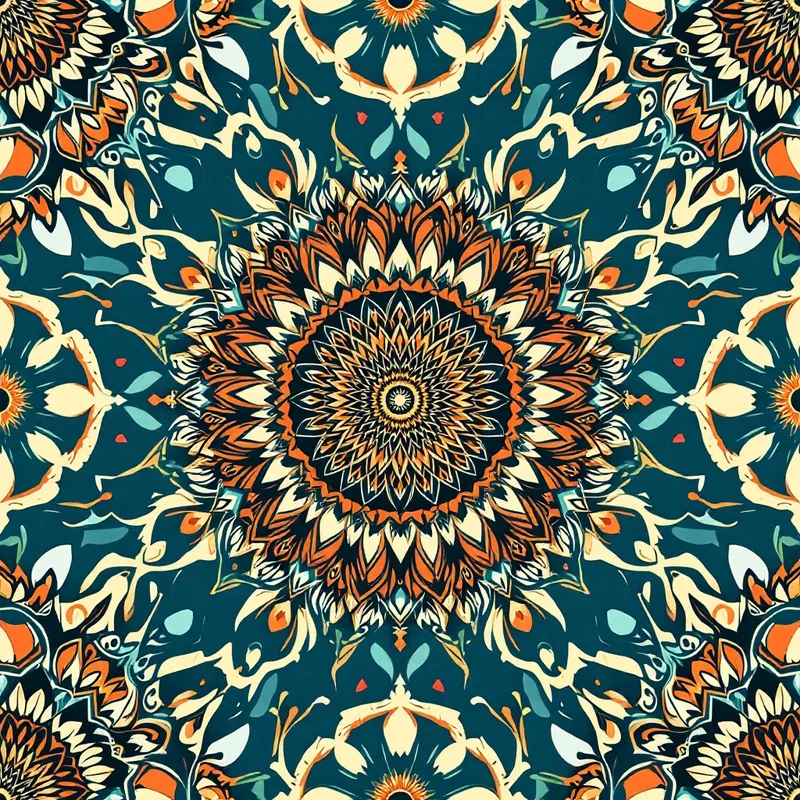
Radial designs that sit at the center of a tile or fill a repeat. In boho they appear on tapestries, towels and beach throws. The types of mandala patterns guide separates floral, geometric and dotted versions, and notes where the form carries religious meaning.
6. Wildflowers and 70s florals
Loose, hand-drawn wildflowers, daisies and poppies, often with long stems and wavy lines. This is the garden end of boho, and it blends with cottage and prairie looks. Keep the drawing loose and the colors slightly faded.
7. Celestial boho
Moons, suns with rays, stars and eyes in earth tones or deep blue. These use the language of the sky, with a hand-drawn imperfection. Gold or mustard on indigo (#1F2A5A with #D5A021) works well.
8. Modern boho
Arches, rainbows in muted tones, pampas grass, wavy lines and simple botanical stems. Palettes are cream (#F5EFE6), sand (#D9C5A7), terracotta (#C1694F) and sage (#9AA78B). This is the quieter, more minimal strand, and it fits nursery and renter-friendly decor.
Palette cheat sheet
| Family | Colors |
|---|---|
| Fiber-art | Oat, sand, tobacco |
| Block print | Madder red, indigo, cream |
| Kilim | Rust, mustard, deep teal, black |
| Wildflower | Faded rose, olive, butter yellow |
| Modern boho | Cream, blush, terracotta, sage |
Using boho patterns with care
Several boho looks come from living cultures: South Asian block printing, Turkish and Berber weaving, Indonesian and West African resist dyeing. Treat them as sources to credit, not as generic decoration. Name the technique if you are inspired by it, avoid labeling a vague mix as "tribal" or "ethnic," and look for makers from those traditions when you want authenticity. The mix of traditions is part of why boho can feel flat if you treat it as a theme instead of a set of choices.
Building a boho collection
A good starting kit is one hero from the family you like best, one coordinating geometric, and one tonal texture. For example: a block-print floral, a kilim-style stripe and a sand-colored linen texture. Browse bohemian patterns to see how the families combine.
When you are ready to make your own, Describe It in Pattern Weaver lets you write a prompt in your own words, such as "terracotta arches with pampas grass on cream," and each result is a seamless tile in about 20 seconds.
Explore related pattern styles