Kawaii — Japanese for "cute" — is one of the few aesthetic movements that has sustained global market demand for forty straight years. From Hello Kitty in 1974 to contemporary kawaii creators on Instagram and TikTok, the visual language has refined itself without losing its core appeal. For pattern designers, kawaii offers access to enormous markets in stationery, apparel, children's products, and phone accessories, with clear rules that reward designers who learn them.
Key takeaway: Kawaii is not just "cute." It follows specific rules about proportion, color, and character design that separate authentic kawaii from generic children's illustration. Learn the rules and your patterns read as kawaii worldwide.
The Kawaii Rule of Proportion
The single most important kawaii principle is oversized heads on small bodies. Characters — whether animal, food, or object — have head-to-body ratios closer to 2:1 than the realistic 6:1. Eyes sit low on the face, below the midpoint, giving characters a perpetually young, innocent appearance. Limbs are short and rounded with no sharp angles.
This proportion rule applies even to non-character motifs. A strawberry motif rendered kawaii-style has an enlarged "head" (the berry body) with tiny green leaves. A cloud motif has an enlarged cloud body with tiny raindrops. Scale drives the feeling.
The Kawaii Palette
Kawaii palettes favor pastels over saturated colors, but not every pastel works. Authentic kawaii leans into baby pink, sky blue, butter yellow, mint green, and lavender — typically with cream or white as a ground color. The palette stays soft throughout, with occasional accent colors used for highlights (small amounts of coral pink or peach yellow in a broader pink palette, for example).
Sanrio and similar brands established the canonical kawaii palette decades ago, and it hasn't shifted much. Working within this tradition produces patterns that read immediately as kawaii; working outside it produces patterns that read as "cute" but not specifically kawaii.
Motif Categories
Food motifs dominate kawaii design. Strawberries, cherries, mushrooms, cupcakes, bento boxes, onigiri rice balls, sushi, ramen bowls, peaches, and matcha treats. Food kawaii patterns sell exceptionally well because they cross demographic lines — kids love them, adults collect them, and food businesses license them for packaging.
Animal motifs — cats (especially white cats with facial features), bunnies, pandas, hamsters, unicorns, axolotls, corgis, shiba inus, and bears. Sea creatures (whales, turtles, jellyfish) are a growing subcategory.
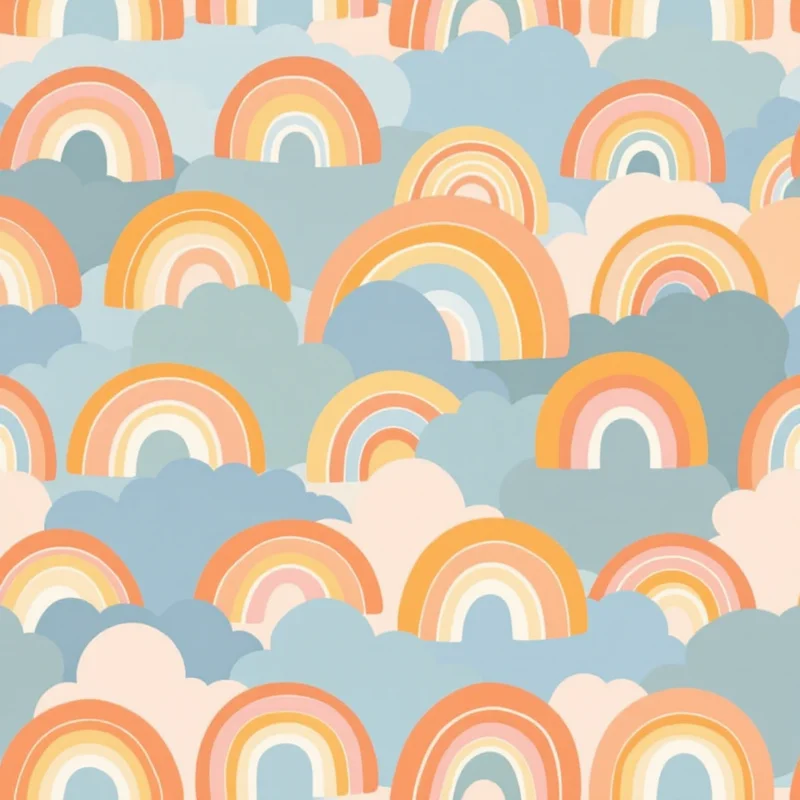
Nature motifs — clouds, stars, moons, rainbows, cherry blossoms, and raindrops. These work as standalone patterns or as secondary motifs in character-based designs.
Object motifs — stationery items (pens, pencils, erasers), cups and teapots, musical notes, hearts, and stars.
See kids patterns, food patterns, and romantic patterns for motif libraries.
Facial Expressions as Design Language
Almost every kawaii motif gets a face — even inanimate objects. A strawberry has eyes and a tiny mouth. A cloud has eyes and a smile. The face should be extremely simplified: two dots or oval eyes, a simple curved line or small "3" shape for a mouth. Blush circles on the cheeks are optional but common.
The smaller and simpler the face, the more universally kawaii it reads. Overly detailed faces with pupils, eyelashes, and defined mouths push into manga illustration territory, which is a related but distinct aesthetic.
Density and Composition
Kawaii patterns typically use ditsy scattered compositions — many small motifs spread across the surface with some white space. Half-drop repeats and brick tile repeats both work; strict grid alignment feels too rigid for the aesthetic.
The motif scale should stay small. A pattern with twenty small motifs per square inch reads more kawaii than one with four large motifs. See the half-drop repeat guide for technical layout details.
Product Markets for Kawaii
Stationery — by far the largest kawaii market. Notebooks, planners, washi tape, sticker sheets, bookmarks, and letter-writing sets. Kawaii stationery is a multi-billion dollar category globally. See the stationery use-case guide.
Phone accessories — cases, pop sockets, charging cables, AirPod cases. Kawaii phone cases dominate the 13–25 age demographic phone case market. See phone cases.
Apparel — children's clothing, pajamas, socks, and graphic tees. Adult sizes in kawaii prints have grown significantly in the past five years. See t-shirt patterns and baby products.
Home textiles — bedding, throw blankets, plushie pillows, and shower curtains. The children's room textile market is especially strong for kawaii patterns.
Digital products — phone wallpapers, Discord server assets, Twitch emotes, and custom GIFs. Kawaii creators on these platforms are a massive, underserved market.
Render Styles That Match Kawaii
Soft rendering with rounded edges works best. Watercolor and pastel render styles produce authentically kawaii output. Vector rendering works when kept soft and rounded rather than sharp and angular. Avoid realistic or highly textured render styles — they conflict with kawaii's cartoonish simplicity.
Building a Kawaii Collection
A coordinating kawaii mini-collection might include:
- A mixed food motif hero pattern (strawberries, cupcakes, and cherries)
- A cloud and star scatter
- A single animal hero (bunnies, cats, or pandas)
- A kawaii object mix (pencils, bows, hearts)
- A solid pastel ground color for blender fabrics
All in the same baby-pink-and-mint palette. See the pattern design trends for 2026 guide for how kawaii fits alongside other contemporary trends.
Open the pattern studio to start building your kawaii library.
Explore related pattern styles
Patterns for