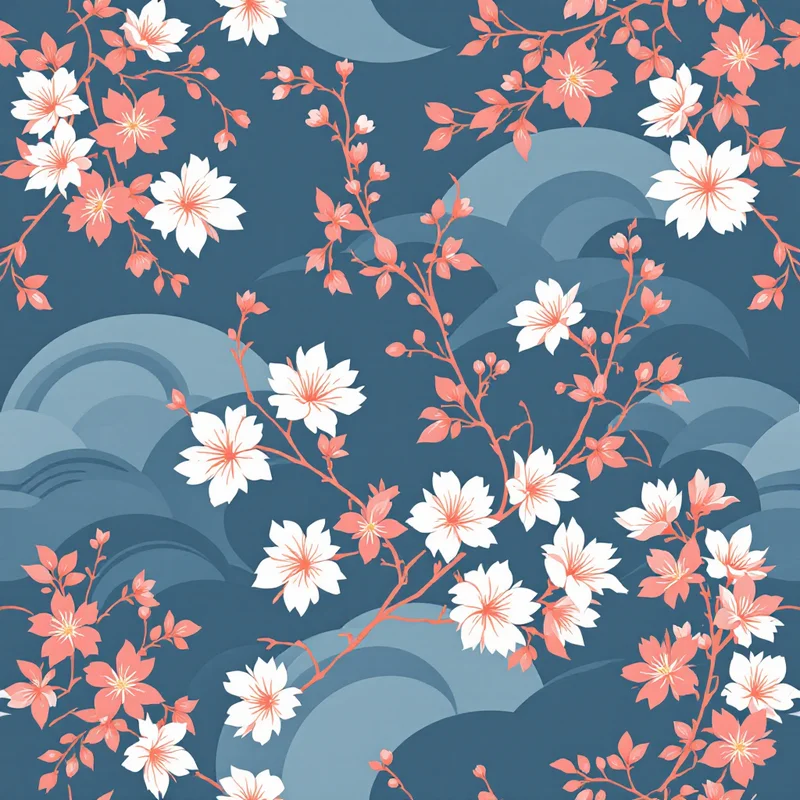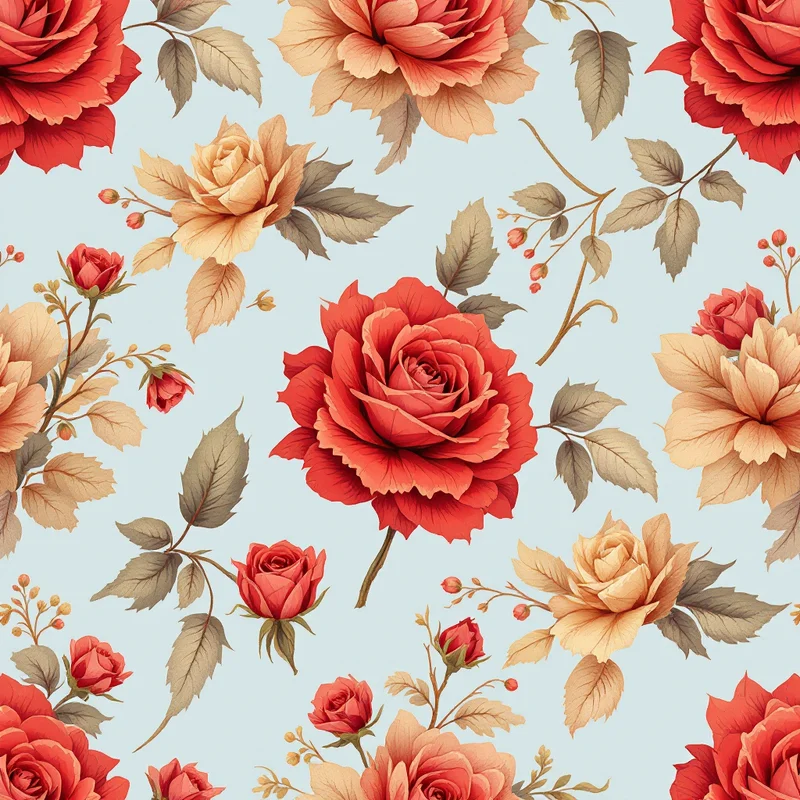
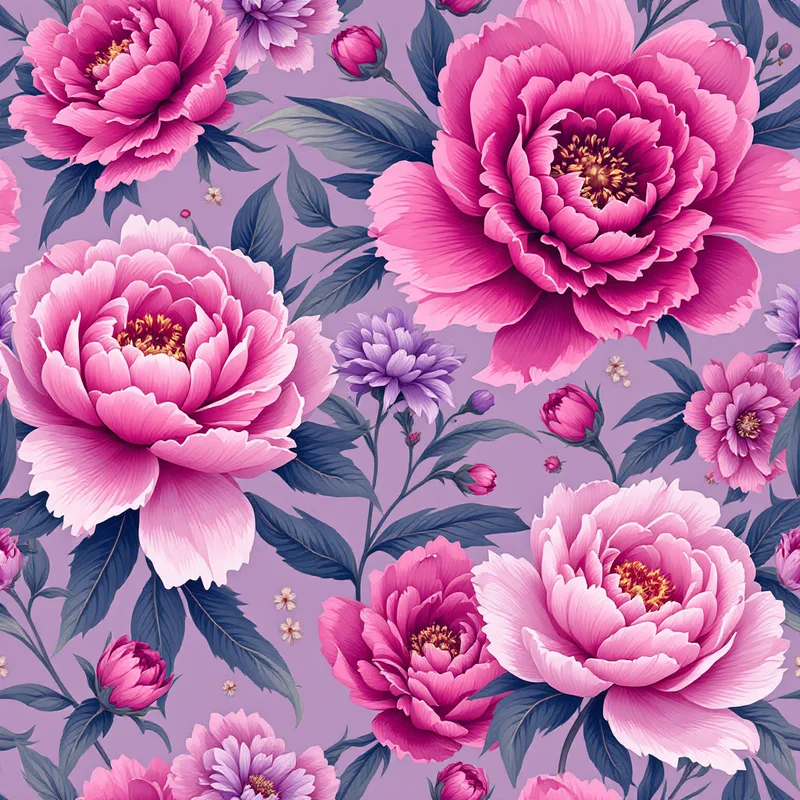


Watercolor florals have been the single most commercially dominant pattern category in surface design for over a decade, and the demand shows no sign of slowing. They appear on bedding at every price point from Target to Sferra, on stationery from Rifle Paper Co. to independent Etsy sellers, across fashion from fast retail to runway collections, and on wallpaper in both residential and hospitality settings.
The reason is partly aesthetic and partly practical. Watercolor florals are soft enough to be broadly appealing, detailed enough to feel premium, and visually complex enough to justify higher price points than simpler geometric or ditsy prints. They also photograph exceptionally well for e-commerce — the organic edges and color gradients read as handmade and artisanal, even when they are digitally generated.
But "watercolor floral" is a broad category, and the difference between a pattern that sells and one that sits in a portfolio is often in the technical details.
What Makes a Watercolor Floral a Watercolor Floral
Not every loose floral is a watercolor floral. The style has specific visual characteristics that distinguish it from painted florals, digital florals, or photographic florals. Understanding these is essential for creating convincing results.
Bleed and Bloom
The defining characteristic of watercolor is the way pigment behaves on wet paper. When a loaded brush touches damp paper, pigment flows outward from the stroke, creating soft, irregular edges. This is "bloom." When two wet color areas meet, their pigments bleed into each other, creating unpredictable gradients and color mixing at the boundary. In a digital watercolor floral, these effects must be present. Hard-edged florals painted in flat color are not watercolor — they are illustration.
Translucency and Layering
Watercolor is a transparent medium. Layers of color build up through glazing — applying a thin wash, letting it dry, then applying another on top. The earlier layers remain partially visible through the later ones. This creates a luminous depth that opaque media cannot achieve. In pattern design, this translucency means petals overlap with visible color interaction, leaves show veining through layered washes, and the background often glows through the thinnest parts of the motifs.
Color Granulation
Certain watercolor pigments settle into the texture of the paper, creating a granular, slightly uneven appearance. This is particularly visible in earth tones, blues, and violets. While subtle, this granulation is part of what makes watercolor feel organic and handmade. Digitally, it translates to a fine texture within color areas rather than perfectly smooth gradients.
Imperfect Edges
Real watercolor edges are never perfectly smooth. They undulate, feather, and occasionally form cauliflower-like backruns where wet paint meets a drying area. These "imperfections" are actually what give watercolor its character. Overly clean, smooth-edged florals read as digitally illustrated rather than painted, even if the color palette and composition are correct.
Best Products for Watercolor Floral Patterns
Not every product is equally suited to watercolor florals. The style's soft gradients and subtle color transitions require printing methods and substrates that can reproduce them faithfully.
Bedding and Home Textiles
This is the largest commercial market for watercolor florals. Duvet covers, pillowcases, sheets, and decorative pillows all benefit from the style's softness and broad appeal. Digitally printed cotton sateen and percale reproduce watercolor gradients well. The key consideration is scale — bedding patterns need to read from across a room, so motifs should be medium to large (individual flowers at 4 to 8 inches across minimum). Browse botanical patterns and floral patterns for starting points that work at bedding scale.
Stationery and Paper Goods
Greeting cards, journals, wrapping paper, and planners are the second-largest market. Paper is the ideal substrate for watercolor reproduction because it is the original medium — the tactile qualities translate directly. For stationery, watercolor florals can be more delicate and detailed because viewing distance is close. Small-scale blooms, fine stems, and subtle background washes all work at this scale.
Fashion
Watercolor florals on fabric require attention to the print method. Digital direct-to-fabric printing preserves the gradients and translucency. Rotary screen printing, which is more common for large production runs, can struggle with the soft edges and subtle color transitions — the screens impose a slight dot pattern that can flatten the watercolor quality. For fashion applications, the pattern needs to work with garment construction. Consider how the motifs will fall across seams, darts, and gathers. A large-scale watercolor rose that gets cut in half at a side seam loses its impact.
Wallpaper
Watercolor floral wallpaper has exploded in popularity for both residential and commercial interiors. The soft, organic quality of the painting style balances the permanence and structure of wallpaper as a medium. For wallpaper, the repeat must be seamless at a scale that works on a full wall — typically 20 to 27 inches wide. The watercolor quality helps disguise repeat edges because the organic, irregular edges of the motifs naturally blend across tile boundaries better than hard-edged geometric patterns.
Color Considerations
Watercolor florals require a different approach to color than other pattern styles. The transparency and layering inherent to the medium mean that your apparent color count is always higher than your actual palette — two overlapping washes create a third color automatically.
Warm palettes — blush pink, coral, warm peach, dusty rose, golden yellow — dominate the commercial market. These colors feel inviting and photograph well in the warm-lit interiors typical of lifestyle product photography. They are safe for broad-market applications like bedding and stationery.
Cool palettes — dusty blue, sage green, lavender, slate — appeal to a more design-conscious audience and work well in contemporary interiors. These palettes tend to perform better in wallpaper and higher-end home textiles than in mass-market bedding.
Moody palettes — deep burgundy, navy, forest green, plum on dark backgrounds — represent the premium end of the watercolor floral market. These dark-ground watercolor florals are more challenging to produce because the translucency of watercolor reads differently on dark backgrounds. The motifs need to be more opaque and saturated to maintain visibility, which pushes the aesthetic toward gouache territory. When executed well, moody watercolor florals command premium pricing across every product category.
A note on white space. The background color and the amount of white (or negative) space between motifs dramatically affect how a watercolor floral reads. Dense, edge-to-edge compositions feel lush and maximalist. Generous white space between motifs feels fresh and contemporary. Both are commercially viable, but they appeal to different buyers and suit different products.
Creating Watercolor Florals Digitally
Traditional watercolor floral patterns start with hand-painted elements that are scanned and digitally composed into seamless repeats. This process is time-intensive — painting the motifs, scanning at high resolution, cutting out individual elements, arranging them into a tile, and manually blending the repeat edges.
AI generation has compressed this workflow significantly. Tools that allow you to specify a watercolor style and combine it with floral subject matter can produce convincing watercolor florals in seconds. The advantage is speed and variation — generating multiple colorways or density variations to test which works best for a specific product.
Getting Convincing Results
The challenge with any digital approach to watercolor florals is avoiding the "too perfect" trap. Real watercolor is inherently imperfect, and the imperfections are what make it feel authentic.
- Vary your motif sizes. A pattern where every flower is the same size reads as stamped, not painted. Mix hero blooms (large, detailed) with supporting elements (smaller buds, leaves, stems, loose petals) at two to three different scales.
- Include organic filler. Real watercolor floral compositions rarely consist of flowers alone. Loose leaf sprigs, seed pods, berries, splatters, and abstract washes between motifs create breathing room and visual variety.
- Let colors interact. The most convincing watercolor patterns show color bleeding between adjacent elements. A pink petal overlapping a green leaf should show a subtle color shift at the intersection. If your elements look isolated from each other, the result will feel like clip art arranged on a page.
- Mind the background. A pure white background can work, but a very subtle warm wash (barely perceptible ivory or pale blush) behind the motifs adds warmth and makes the composition feel more cohesive, as if everything was painted on the same sheet of paper.
- Test at production scale. A watercolor floral that looks beautiful as a 4-inch tile on screen may lose its detail when printed at 24 inches across a duvet cover, or feel overwhelming when printed small on a greeting card. Always evaluate the pattern at the final production scale.
Preparing Watercolor Florals for Print
Once you have a watercolor floral pattern you are satisfied with, preparation for print production introduces its own set of requirements.
Resolution matters more for watercolor florals than for many other pattern styles. The soft gradients and subtle textures that define the watercolor look require high resolution to reproduce faithfully. For fabric printing, 150 DPI at final print size is the minimum. For paper printing, 300 DPI is standard. Upscaling a low-resolution watercolor pattern introduces artifacts that are especially visible in the smooth gradient areas.
Color mode depends on your production method. Digital fabric printing typically works in RGB. Offset and lithographic printing for paper products requires CMYK conversion, which will shift some colors — particularly bright pinks and saturated purples — toward duller equivalents. Always preview the CMYK conversion before sending to production.
File format should be TIFF or PNG for maximum quality. JPEG compression introduces artifacts in gradient areas that are particularly damaging to watercolor aesthetics. The compression blocks become visible in smooth wash areas where there should be seamless color transitions.
Watercolor florals succeed commercially because they occupy a specific emotional territory — they feel personal, organic, and artisanal in a market increasingly dominated by digital precision. The key to creating them well, whether by hand or digitally, is understanding that the "imperfections" of the watercolor medium are not obstacles to work around. They are the entire point.
Explore related pattern styles
Patterns for