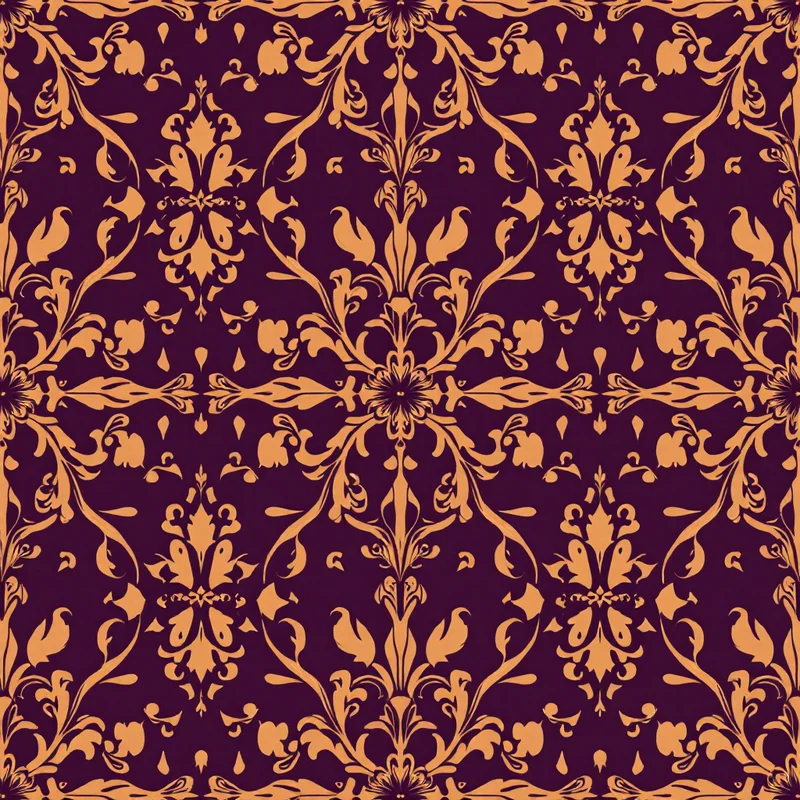
Damask is one of the oldest continuously produced pattern types in the world. Its origins trace back more than a thousand years, yet it remains one of the most commercially relevant pattern styles in contemporary interiors, fashion, and luxury goods. That longevity is not accidental — damask patterns occupy a specific visual territory that no other pattern type fully replicates: they are ornate without being busy, luxurious without being gaudy, and traditional without being dated.
Understanding damask means understanding both its historical context and its technical characteristics, because the two are inseparable. What makes a damask a damask — rather than a brocade, a jacquard, or a generic ornamental pattern — is a specific combination of structural, rendering, and compositional choices that evolved over centuries of textile production.
Historical Origins
The name "damask" derives from Damascus, the Syrian capital that was a major hub on the Silk Road trade routes during the medieval period. Damascus was not necessarily where damask weaving originated — the technique likely developed in China — but it was where European traders first encountered the fabric in significant quantities during the Crusades in the 12th and 13th centuries.
Early damask was a woven textile, not a printed one. The pattern was created through the weave structure itself: areas of satin weave (smooth, light-reflecting) alternated with areas of sateen or twill weave (matte, light-absorbing) using a single color of thread. The pattern emerged purely through the contrast between shiny and matte surfaces — this is why damask's fundamental visual identity is tone-on-tone rather than multicolored.
By the 14th century, Italian weavers — particularly in Lucca, Venice, and Florence — had mastered damask production and were creating elaborate designs for the European aristocracy and the Catholic Church. Damask vestments, altar cloths, and wall hangings became markers of institutional wealth and power. The patterns of this period established many of the motifs still associated with damask today: stylized pomegranates, thistles, pineapples, artichokes, and acanthus leaves, all arranged within formal geometric frames.
The 18th century brought damask to its widest European popularity. Silk damask covered the walls and furniture of grand houses from London to St. Petersburg. The patterns became lighter and more refined under the influence of Neoclassicism, incorporating urns, swags, and more delicate floral arrangements. This is the era that most people picture when they think of "classic damask."
Defining Characteristics
Several visual elements, used together, distinguish damask from other ornamental pattern types.
The Ogee Frame
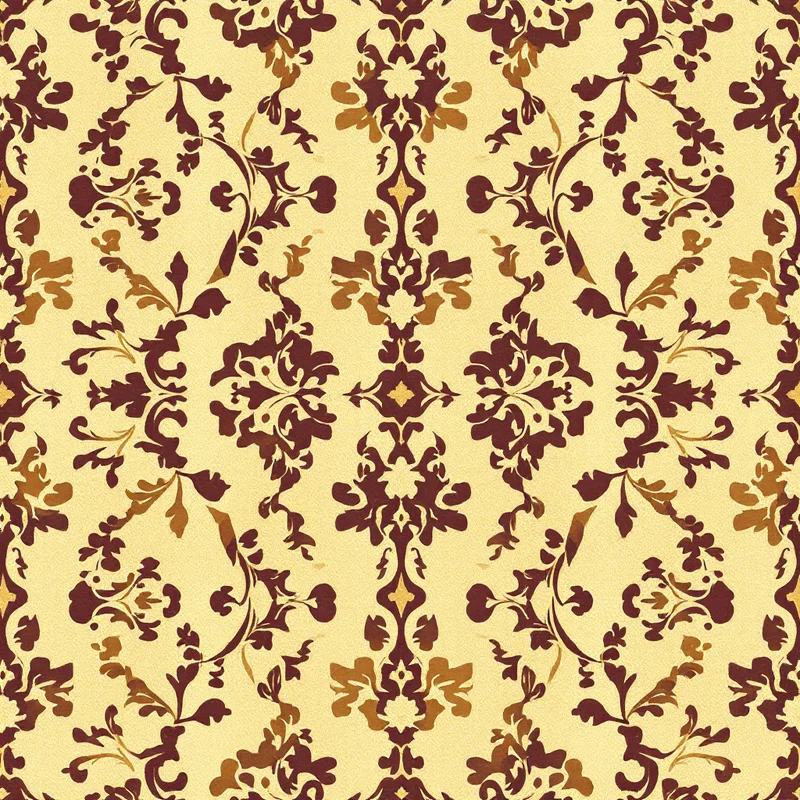
The ogee — an S-curved, onion-shaped lattice — is the most common structural framework for damask patterns. It creates a rhythmic grid of pointed oval cells, each containing a central motif. The ogee frame gives damask its characteristic sense of vertical flow and formal rhythm. Not every damask uses an ogee (some use diamond or hexagonal grids), but the ogee is the default and the most immediately recognizable.
Tone-on-Tone Rendering
Authentic damask uses a single hue at two tonal values — the motif in one tone and the background in a closely related tone. This creates the characteristic effect of a pattern that is visible but restrained, present but not shouting. The tone-on-tone approach directly descends from the woven original, where the pattern emerged from the contrast between satin and matte weave surfaces rather than from different colored threads.
This is perhaps the most important distinction between damask and other ornamental patterns. A multicolored floral in an ogee frame is not a damask — it is a panel print or a medallion print. True damask restraint comes from the discipline of working within a single color family.
Bilateral Symmetry
Damask motifs are almost always bilaterally symmetrical along their vertical axis. The left half mirrors the right half. This symmetry gives damask its formal, composed character and distinguishes it from more naturalistic floral patterns where asymmetry creates organic movement. In damask, nature is tamed, ordered, and made architectural.
Stylized Botanical Motifs
The motifs within damask patterns are botanical in origin but stylized to the point of abstraction. A damask rose is not a realistic rose — it is a formalized, symmetrical arrangement of petals that references a rose while conforming to the pattern's geometric discipline. Acanthus leaves curl with mathematical precision. Pomegranates split open in perfectly mirrored halves. This stylization is what allows botanical motifs to integrate with the rigid ogee framework without visual conflict.
Continuous Allover Repeat
Damask patterns tile seamlessly in all directions with no visible edges or borders. The ogee framework creates a continuous lattice that extends infinitely across any surface, making damask inherently suited to large-scale applications like wallpaper and upholstery where the pattern must cover extensive areas without interruption.
Modern Interpretations
Contemporary designers have pushed damask in several directions while maintaining its core identity.
Scale manipulation is the most common modern approach. Oversized damask — with the repeat blown up to 24 inches or more — transforms a traditional pattern into a bold, contemporary statement. The motifs become almost abstract at this scale, with the viewer seeing sweeping curves and tonal shifts rather than identifiable botanical forms. Conversely, micro-scale damask shrinks the pattern to near-texture, creating a surface that reads as sophisticated tone-on-tone without the overtly traditional associations.
Color reinterpretation breaks from the single-hue tradition while maintaining the tonal relationship. A damask rendered in charcoal on pale blush, or navy on dusty gold, uses a two-color approach that references the tone-on-tone original while adding a contemporary palette. More radical departures — neon on black, metallic on matte — push the pattern into editorial or avant-garde territory.
Distressed and deconstructed damask deliberately erodes the pattern's precision. Faded, worn, or partially obscured damask motifs suggest age, decay, and imperfection — a deliberate contrast to the style's historical associations with pristine luxury. This treatment has been popular in wallpaper and fashion for its ability to make damask feel current and irreverent rather than museum-piece traditional.
Hybrid damask combines the ogee structure and tone-on-tone rendering with non-traditional motifs. Skulls, industrial imagery, typographic elements, or pop culture references placed within a classic damask framework create a deliberate tension between tradition and subversion. This approach works for brands seeking to signal sophistication and rebellion simultaneously.
Commercial Applications
Damask's versatility and longevity make it commercially reliable across several major categories.
Luxury Wallpaper
Damask wallpaper remains a cornerstone of high-end interior design. It suits formal spaces — dining rooms, master bedrooms, hotel lobbies, boutique retail — where the pattern's historical associations with wealth and refinement serve the space's purpose. Explore geometric and cultural pattern options for wallpaper applications that complement damask in coordinated room schemes.
The tone-on-tone quality of damask makes it particularly effective as wallpaper because it adds visual richness and texture without competing with other elements in the room. A damask wallpaper recedes into the background more gracefully than a multicolored print, serving as an elegant backdrop rather than demanding attention.
Upholstery and Home Textiles
Damask upholstery fabric — particularly in silk, cotton, or linen blends — remains the standard for formal seating. Dining chairs, headboards, and accent chairs in damask signal a level of traditional refinement that few other patterns achieve. For home textiles, damask appears on table linens, bedding, and decorative cushions, typically in the same tone-on-tone rendering that defines the woven original.
Fashion
In fashion, damask appears most frequently in evening wear and tailored garments. Damask-patterned jacquard is used for blazers, vests, corsets, and structured dresses. The pattern's formality suits occasions that call for dressed-up elegance — galas, weddings, holiday events. Damask-printed silks and satins appear in scarves, ties, and pocket squares, where the small surface area allows the pattern to read as a refined accent.
Packaging and Branding
Luxury brands use damask patterns on packaging — particularly gift boxes, shopping bags, and tissue paper — to communicate heritage, quality, and tradition. Wine labels, perfume boxes, and premium stationery frequently incorporate damask elements. The pattern's association with centuries of luxury production makes it an efficient visual shorthand for "this is a premium product."
Creating Damask Patterns
Traditionally, damask patterns were designed by specialized textile designers who understood the constraints of jacquard weaving — a discipline requiring knowledge of loom mechanics and thread behavior. Creating a convincing damask pattern from scratch remains challenging because the balance between motif complexity, ogee proportions, and tonal contrast requires significant experience.
AI pattern tools have made the style more accessible. Within Pattern Weaver, selecting ornamental or heritage substyles and keeping the palette constrained to a tone-on-tone relationship produces results that capture the essential damask character. The structured parameter approach — style, substyle, colors, density, scale — maps well to damask design because the style itself is highly structured.
Tips for Convincing Damask
- Stay tone-on-tone. The single most common mistake in damask design is using too many colors. Two tonal values of the same hue, or two closely related hues, is the maximum. If you need more color variation, use it in the surrounding room or product, not in the damask itself.
- Maintain strict symmetry. Every element should mirror along the vertical axis. Even subtle asymmetries break the damask illusion and push the design toward general floral territory.
- Use the ogee structure. If your motifs are floating freely without a containing framework, you have an allover floral, not a damask. The ogee lattice — or some geometric framework — is structurally essential.
- Scale the density to the application. For wallpaper, medium density with clear negative space between motifs creates the classic damask rhythm. For fabric at smaller scale, tighter density prevents the motifs from appearing isolated.
- Reference historical examples. The Victoria and Albert Museum, the Metropolitan Museum of Art, and the Textile Museum in Washington all have extensive damask collections online. Studying authentic historical examples trains your eye for the proportions and motif conventions that define the style.
Damask endures because it solves a specific design problem better than any alternative: how to create a pattern that is rich, formal, and luxurious while remaining visually quiet enough to live with over time. That balance — ornament held in check by structural discipline and tonal restraint — is why damask has survived a thousand years of changing fashions and will likely survive a thousand more.
Explore related pattern styles