
A crochet blanket is the ultimate canvas for pattern design. With 150 to 250 stitches across and 200 or more rows tall, a blanket gives you tens of thousands of individual stitches to work with — enough to render detailed images, complex geometric tessellations, or flowing colorwork landscapes. Whether you call them afghans, throws, or blankets, these large-format projects showcase crochet patterns at their most impressive.
Key takeaway: Crochet blankets work best with patterns that have clear repeat units. A 20-stitch geometric repeat tiles beautifully across a 200-stitch blanket, while a single large motif (like a graphgan portrait) needs a chart as wide as your entire blanket.
Blanket Construction Methods
How you build your blanket determines which types of patterns work best.
Side-to-Side Construction
The most common approach. Chain your full width, then crochet rows back and forth until the blanket reaches the desired length. Every row spans the full width, and the pattern is worked row by row from bottom to top.
Best for: Repeating geometric patterns, stripe-based designs, tapestry crochet colorwork, mosaic crochet. The row-by-row construction makes it easy to follow a chart.
Gauge matters. A typical throw blanket is about 50 inches wide. At 4 stitches per inch, that is 200 stitches across. Your pattern repeat must divide evenly into your stitch count, or you will have a partial repeat at one edge.
Corner-to-Corner (C2C)
Worked diagonally from one corner to the opposite corner. Each "pixel" is a small block of double crochet stitches (typically 3 dc + ch 1). You increase one block per row until you reach the desired width, then decrease back down.
Best for: Picture patterns, graphgans, single-motif designs. The block-based construction is perfect for translating pixel art into crochet. Each pixel in your chart becomes one C2C block.
Scale note: Because each C2C block is approximately 1 inch square (depending on yarn and hook size), a 50x60 inch blanket needs a chart that is roughly 50 pixels wide by 60 pixels tall. At 3,000 pixels total, this is a manageable chart size that still allows for detailed images.
Modular Construction
Make individual units — granny squares, hexagons, triangles, or other shapes — and join them together. Each unit can be its own mini pattern with different colors or motifs.
Best for: Sampler blankets, scrappy designs using leftover yarn, planned color gradient layouts. AI pattern generators can design the overall color layout by generating a pattern where each repeat unit maps to one module's color scheme.
Joining method affects the finished look. Whip stitch creates a flat, invisible seam. Single crochet join creates a raised ridge that becomes a design element. Continuous join-as-you-go methods eliminate separate joining entirely.
Pattern Types for Blankets
Geometric Repeats
Tessellating geometric patterns are the most forgiving blanket designs because they tile infinitely. A single repeat unit — even one as small as 12 stitches wide — creates a cohesive, professional-looking blanket when repeated across the full width and height.
Popular geometric patterns for blankets include:
Diamond lattice — interlocking diamonds in 2-3 colors create a classic, timeless design. The diamond shape naturally accommodates both the zigzag of increases/decreases and the straight rows of tapestry crochet.
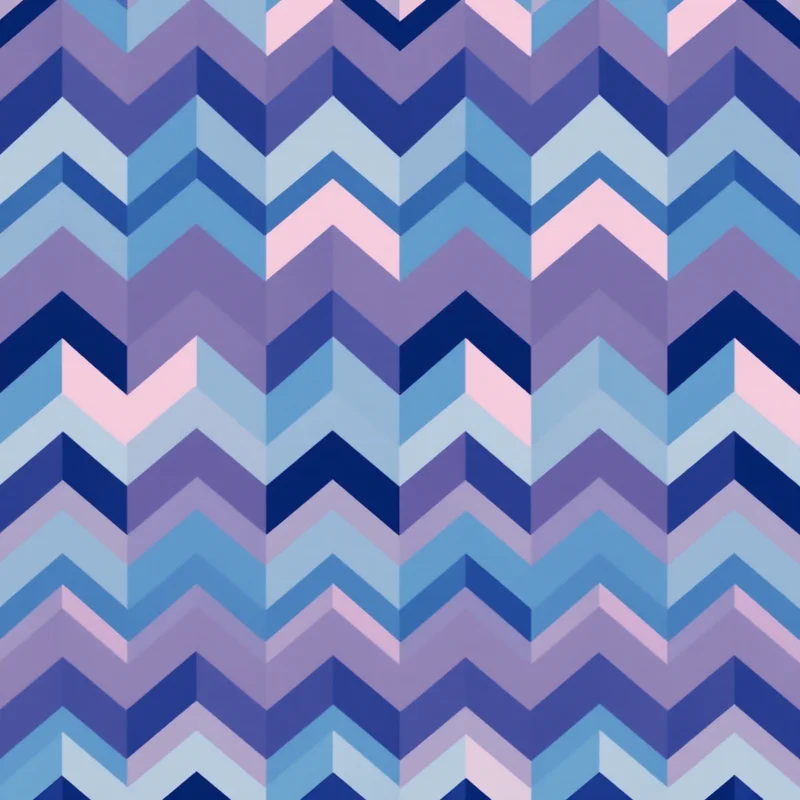
Chevrons and zigzags — formed by regular increases and decreases, chevrons create a ripple effect. Each color stripe follows the zigzag, creating movement across the blanket. Chevron blankets are among the most popular crochet blanket patterns for good reason — they look complex but use only basic stitches.
Hexagonal tessellation — hexagons tile without gaps and create a honeycomb effect. In side-to-side construction, the hexagon shapes are approximated with stepped edges. In modular construction, actual hexagonal motifs are joined together.
Greek key and meander — continuous angular spirals that tile horizontally. These patterns work beautifully in 2-color tapestry crochet and create a sophisticated, architectural quality.
Mosaic Crochet Patterns
Mosaic crochet has exploded in popularity because it produces intricate-looking colorwork using only one color per row. The technique works by strategically skipping stitches and working into rows below, allowing the alternate color to show through from the row beneath.
The result looks like complex tapestry crochet but is much easier to execute. You never carry a second color. You never change colors mid-row. Each row is a single color with some stitches skipped.
Pattern requirement: Mosaic crochet patterns must follow specific rules — no two adjacent stitches in a row can be skipped, and every other row is a simple all-same-color row. AI-generated geometric patterns in high-contrast 2-color palettes are excellent starting points, though they may need minor adjustments to meet the no-adjacent-skips constraint.
Graphgans
A graphgan (graphic afghan) uses a chart where each cell represents one stitch (or one C2C block), colored to form an image. Popular subjects include animals, landscapes, sports logos, portraits, and pop culture characters.
Resolution determines detail. A 50-pixel-wide chart at 4 stitches per inch creates a 12.5-inch-wide image. For a full-width throw blanket image, you need a chart 180-200 pixels wide. At this resolution, you can render surprisingly detailed images — faces, animals, text, and scenes all become recognizable.
Color management is critical. A graphgan with 20 colors means 20 separate yarn bobbins, which is unwieldy. Professional graphgan designers typically reduce their images to 8-12 colors using palette optimization. AI pattern generators can help here — set your color count to your target palette size and the generator will optimize the design around those constraints.
Planned Pooling
An advanced technique where self-striping or variegated yarn is worked at a specific stitch count to align the color changes into argyle, plaid, or other geometric patterns. The pattern emerges from the yarn's color sequence rather than from intentional color changes.
Planned pooling requires precise stitch counts and consistent gauge. AI pattern generators are not directly useful here — the pattern comes from the yarn — but they can help you visualize what a specific color sequence will produce at different stitch counts.
Designing Your Blanket Pattern
Step 1: Determine Dimensions
Standard blanket sizes:
| Type | Width | Length | Stitches (at 4 st/inch) |
|---|---|---|---|
| Baby blanket | 30" | 36" | 120 x 144 |
| Lap throw | 36" | 48" | 144 x 192 |
| Throw blanket | 50" | 60" | 200 x 240 |
| Twin bed | 66" | 90" | 264 x 360 |
| Queen bed | 90" | 90" | 360 x 360 |
Your stitch count determines which repeat widths work. A 200-stitch throw works with repeats of 4, 5, 8, 10, 20, 25, 40, or 50 stitches. A 13-stitch repeat would leave a partial repeat at the edge.
Step 2: Choose Your Technique
Match your pattern to your construction method:
- Repeating geometrics → side-to-side tapestry or mosaic crochet
- Picture or image → C2C graphgan
- Multicolor sampler → modular granny squares
- Simple stripes and chevrons → side-to-side basic colorwork
Step 3: Generate Your Pattern
Use an AI pattern generator to create your design. Set the style to geometric or the specific motif family you want. Choose 2-4 colors that work well in your chosen yarn. Generate at a scale that matches your repeat width.
For repeating patterns, you only need one tile — it will repeat across the blanket naturally. For graphgans, you need the full chart at the resolution of your blanket.
Step 4: Create Your Chart
Convert your generated pattern to a chart using crochet charting software. Verify that:
- Colors are reduced to your target count
- No color float spans more than 5-7 stitches (for tapestry crochet)
- The repeat width divides evenly into your total stitch count
- Single-stitch color changes are eliminated (they add bulk and are invisible)
Step 5: Calculate Yarn Requirements
A rough estimate for worsted weight single crochet:
- Each stitch uses approximately 1.5 inches of yarn
- Multiply total stitches by 1.5, then divide by 36 for yards
- Add 15% for tails, color changes, and mistakes
- Divide by the yards-per-skein of your chosen yarn
A 200x240 stitch throw uses roughly 200 × 240 × 1.5 ÷ 36 = 2,000 yards total, split across your colors proportionally.
Color Planning for Blankets
Blankets use a lot of yarn, so color planning prevents expensive mistakes.
Warm and cool contrast. Pair warm colors (red, orange, gold) against cool colors (blue, green, purple) for maximum visual impact. The temperature contrast creates depth that same-temperature palettes lack.
Value distribution. Ensure your lightest and darkest colors are used for the most important pattern elements. Mid-value colors work for backgrounds and transitions. If all your colors are the same value (all pastels, all darks), the pattern will lack definition.
Test before committing. Buy one skein of each color and crochet a small swatch of your pattern — at least 2-3 complete repeats. The colors will look different in yarn than on screen, and you will spot problems before investing in a full blanket's worth of materials.
A blanket is a significant time investment — 40 to 200 hours of crocheting depending on size and complexity. Spending 30 minutes generating and refining your pattern digitally before casting on is the best insurance against frogging 50 rows because the colors do not work or the pattern does not read the way you expected.
Explore related pattern styles
Patterns for