Art deco is one of the few design movements that never truly goes out of style. Born in the 1920s and reaching its peak in the 1930s, it remains one of the most commercially requested pattern styles across packaging, interiors, fashion, and branding. The reason is straightforward: art deco patterns communicate luxury, precision, and confidence through geometry alone. No ambiguity, no softness — just clean lines arranged with mathematical elegance.
Understanding what actually makes a pattern "art deco" rather than merely geometric is the difference between a design that reads as intentional luxury and one that reads as generic.
The Defining Elements of Art Deco Patterns
Art deco draws from an unusual mix of influences — Egyptian archaeology (King Tut's tomb was discovered in 1922, right as the movement was forming), Cubism, Futurism, and the machine aesthetics of early industrialization. These converge into a set of recurring motifs that define the style.
Fan and Shell Motifs
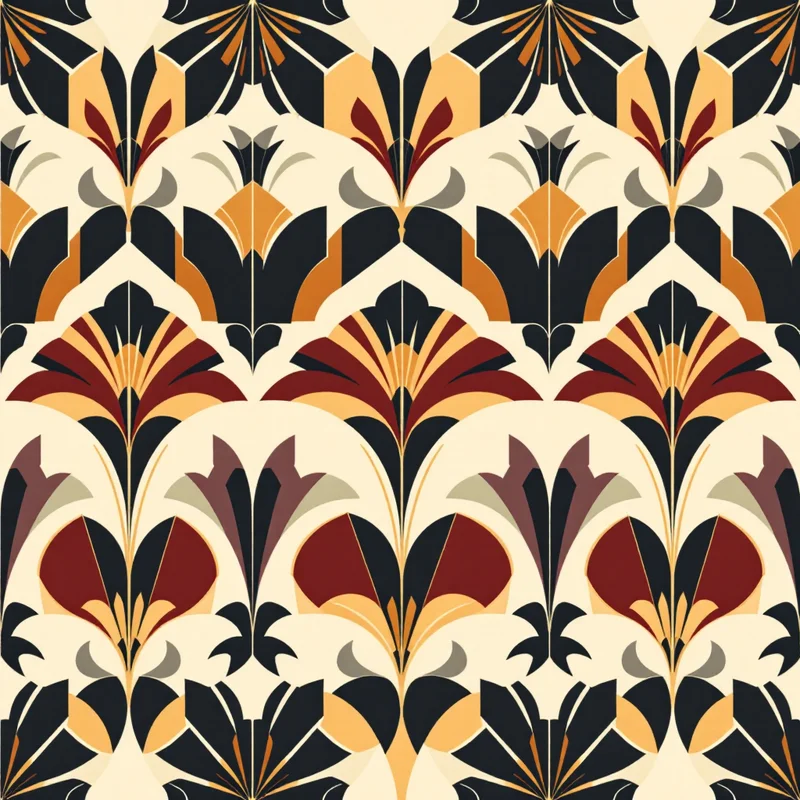
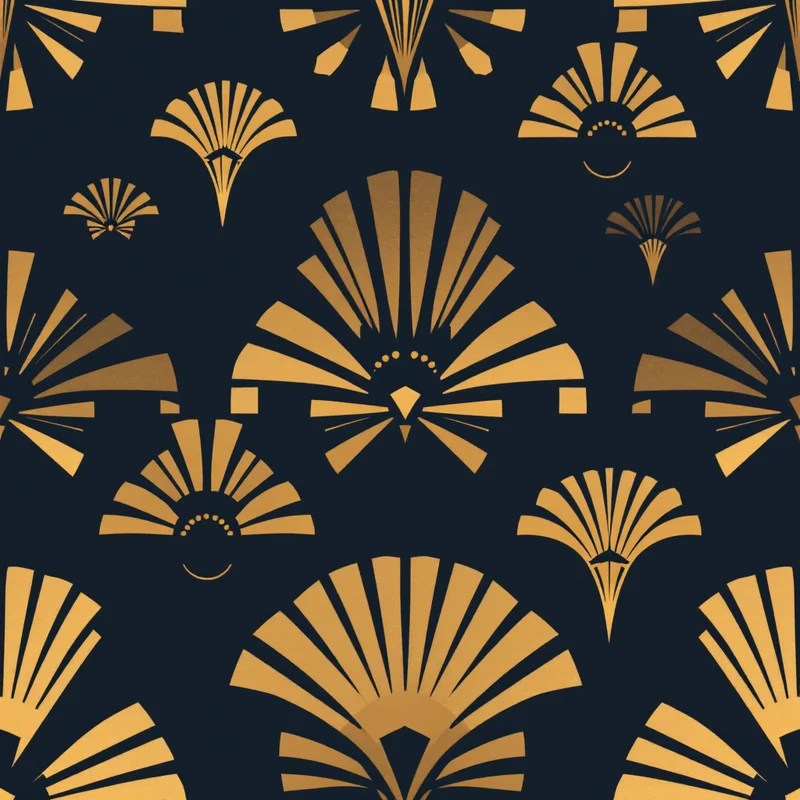
The scalloped fan shape — sometimes called the palmette or clamshell — is arguably the most recognizable art deco motif. Rows of overlapping fans create a rhythmic, scale-like pattern that tiles seamlessly. The key to authenticity is the radiating lines within each fan. Without them, you have a scallop pattern. With them, you have deco.
Sunburst and Ray Patterns
Radiating lines emanating from a central point, often truncated into a half-circle or quarter-circle. Sunbursts express optimism and energy — they were everywhere in 1930s architecture, from the Chrysler Building's crown to cinema facades. In pattern design, sunburst motifs work as hero elements or as repeating units in a grid.
Zigzag and Chevron
Sharp, angular zigzags stacked in parallel rows. Unlike casual chevron patterns (which appear in boho and mid-century contexts), art deco zigzags are precise, evenly weighted, and often rendered in high-contrast metallic palettes. The angles are typically steep — 60 to 90 degrees — giving the pattern a vertical thrust.
Stepped and Tiered Forms
The stepped pyramid shape, borrowed from Aztec and Egyptian architecture, appears constantly in deco borders, frames, and allover patterns. These stepped forms create a sense of ascending grandeur. In seamless patterns, they often appear as repeating columns or as framing devices around central motifs.
Geometric Symmetry
Art deco patterns almost always exhibit bilateral or radial symmetry. Motifs are mirrored along vertical axes, rotated in precise increments, or arranged in rigid grid structures. This symmetry is not incidental — it is the core organizing principle. A pattern can use deco motifs but will not read as deco if the arrangement is organic or scattered.
Color Palettes That Define the Style
Color is where many art deco pattern attempts fall apart. The motifs might be correct, but the palette undermines them. Art deco palettes are high-contrast, limited in hue count, and lean heavily on metallics.
Gold and black is the signature combination — it references the gilded excess of the Jazz Age and remains the default for luxury applications. Gold can be rendered as a flat warm yellow, a gradient suggesting metallic sheen, or actual metallic ink in print production.
Emerald and cream offers a slightly softer alternative that still reads as unmistakably deco. The deep green references the jade and malachite materials popular in 1920s decorative objects, while cream provides warmth that pure white would not.
Navy and silver skews cooler and more contemporary. This palette works particularly well for masculine-leaning applications — men's accessories, corporate packaging, hotel interiors — while maintaining the deco character.
Burgundy and gold, teal and bronze, and black and white round out the classic deco palette range. The common thread is always contrast: deco patterns need a clear distinction between foreground motif and background field. Muted, tone-on-tone approaches undermine the style's inherent boldness.
A useful rule: if your palette would also work for a watercolor floral, it is probably wrong for deco. These patterns demand decisiveness.
Commercial Applications
Art deco patterns enjoy remarkably broad commercial demand because they sit at the intersection of luxury and accessibility — recognizable enough to signal premium positioning, geometric enough to be visually clean.
Luxury Packaging
Cosmetics, spirits, chocolate, perfume, and premium stationery all draw heavily from deco aesthetics. A gold-foil fan pattern on matte black card stock is practically a formula for high-end packaging. The geometric precision translates well to production processes like foil stamping, embossing, and spot UV coating that would blur or distort more organic patterns.
Hotel and Hospitality Interiors
Art deco wallpaper is a staple of boutique hotel design. The style's association with the grand hotels of the 1920s and 1930s — The Savoy, The Waldorf — makes it a natural fit for hospitality spaces aiming to evoke glamour. Deco patterns work at scale in lobbies and at intimate scale in guest room accents. Explore geometric pattern options for this direction.
Fashion and Accessories
Deco patterns appear regularly in evening wear, particularly in beaded and sequined garments where the geometric structure guides the placement of embellishment. In printed fashion, deco motifs work on silk scarves, ties, pocket squares, and structured garments like blazers and shift dresses. The patterns' inherent structure complements tailored silhouettes.
Event and Wedding Design
The "Great Gatsby" aesthetic remains one of the most popular wedding themes globally. Deco patterns appear on invitations, menus, table runners, and signage. For event designers, having a coordinated set of deco patterns — a bold hero print, a simpler geometric secondary, and a subtle texture blender — provides the flexibility to dress an entire event cohesively.
Creating Art Deco Patterns
Designing convincing art deco patterns manually requires precision drafting skills. The geometry must be exact — slightly uneven fan radiations or inconsistent zigzag angles immediately break the illusion of mechanical perfection that defines the style.
AI pattern generation has made this more accessible. Tools like Pattern Weaver allow you to select geometric styles and substyles, set a constrained color palette, and generate seamless tiles that maintain the mathematical precision deco demands. The structured approach — selecting style parameters rather than writing open-ended prompts — tends to produce more consistent results for geometric styles where precision matters.
Tips for Authentic Results
- Limit your color count. Two to three colors maximum for the pattern itself, plus a background. Art deco is about restraint within luxury.
- Keep density medium to high. Sparse deco patterns look incomplete. The style's power comes from rhythmic repetition — fans tessellating edge to edge, zigzags marching in tight parallel rows.
- Respect symmetry. If you are composing manually, mirror everything. If using a generator, look for bilateral or radial symmetry in the output.
- Consider the production method. If the final application involves foil stamping or embossing, design with clear separation between the elements that will receive the treatment and those that will not. Clean, isolated shapes translate to production far better than overlapping or blended ones.
- Scale to application. A fan motif at 2 inches across suits a gift box. The same motif at 12 inches across suits a feature wall. Deco patterns are forgiving of scale changes because the geometry remains crisp at any size.
Pairing Deco Patterns in Collections
A single art deco pattern rarely carries a project alone. Strong deco collections include three types of pattern working together:
The hero pattern uses the most complex motif — a detailed fan arrangement, an elaborate sunburst grid, or an interlocking stepped frame. This pattern anchors the collection and appears on the primary surface.
The supporting geometric simplifies the hero's geometry into a secondary rhythm. If the hero is a fan pattern, the support might be a simple zigzag or a thin stripe that echoes the fan's radiating lines.
The texture or blender provides visual rest. In deco collections, this is often a subtle tone-on-tone geometric — a very fine grid, a micro-scale stepped pattern, or a stippled metallic texture. It fills the gaps without competing for attention.
This three-tier approach gives designers enough variety to cover multiple surfaces — a hero wallpaper panel, a supporting upholstery fabric, and a blender for smaller accessories — while maintaining a cohesive visual identity.
Art deco's endurance as a design style is not nostalgia. It is a testament to the power of precise geometry and confident color. The patterns work because they are unambiguous: every line has a purpose, every angle is deliberate, every color choice is decisive. That clarity is what makes them read as luxury across every application and every era.
Explore related pattern styles