
Design characteristics
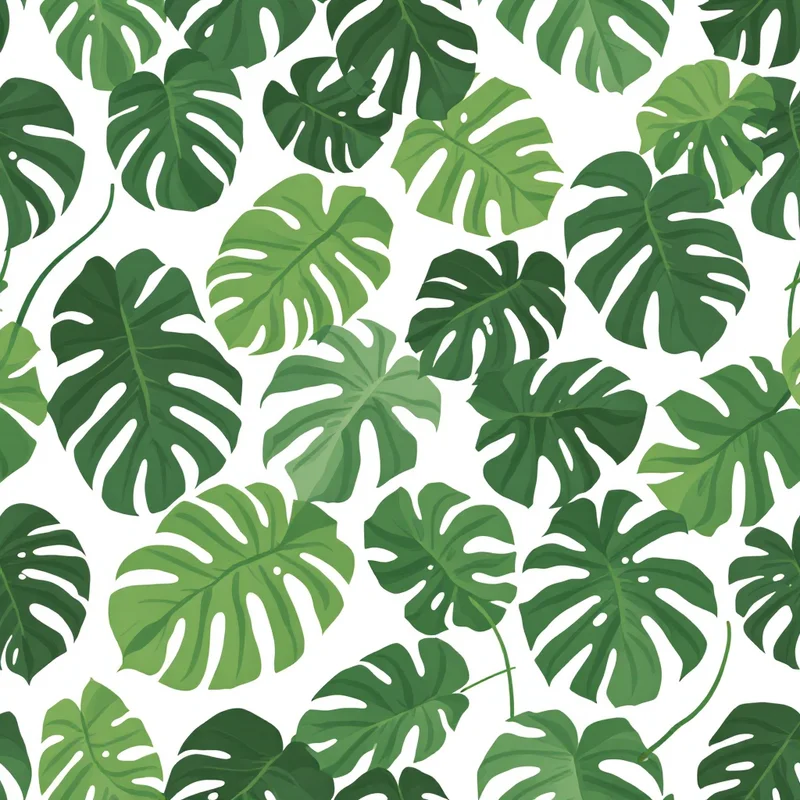
Motifs gravitate naturally toward the botanical because green is the color of chlorophyll and growth. Common building blocks include monstera and palm leaves, ferns, eucalyptus sprigs, ivy trails, moss textures, pine boughs, and rolling topographic or hillside silhouettes. But green is not limited to foliage. It also anchors geometric grids, art-deco fans, damask scrolls, and abstract brushstroke layouts, where the color carries a heritage or biophilic mood while the structure stays purely graphic. Historically, deep greens dominated Victorian and William Morris arts-and-crafts wallpapers, while seventies decor leaned on avocado and olive, and these references still inform retro and vintage green palettes today.
Commercial applications
Designers reach for green patterns because the color is commercially versatile and rarely polarizing. Sage and eucalyptus shades dominate the wellness, organic, and spa categories; forest and emerald signal luxury, holiday, and heritage; lime and kelly bring energy to sportswear and kids' lines. A single green family can be tuned to read as natural, premium, or playful simply by shifting value and adding a metallic, cream, or charcoal accent.
Where to use green patterns for seamless surface design patterns
The same pattern moves cleanly across products. On apparel, sage florals and olive camo work for dresses, scarves, and loungewear; in interiors, forest damask and botanical repeats cover wallpaper, upholstery, cushions, and bedding. Packaging and branding use green patterns to flag eco, herbal, and plant-based products, while stationery, gift wrap, tote bags, phone cases, and ceramics all carry the same motif at different scales. A true seamless repeat tiles in every direction, so it scales from a small repeat on a label to a full wallpaper drop without visible seams.
Customization & export
Inside Pattern Weaver you control exactly how the green reads. Adjust the color sliders to dial a precise palette, from monochrome sage to a contrasting emerald-and-gold scheme, then set density to choose between airy negative space and a lush, packed jungle look, and tune scale so the motif suits a small accessory or a large wall. The studio compiles those choices into a clean, tileable design rather than a one-off image.
Once a design lands, Pattern Weaver exports production files up to 8K (8192x8192) in PNG, JPG, WEBP, TIFF, PDF, and SVG, with CMYK conversion and bleed for print. That means the same green pattern is ready for print-on-demand fabric, large-format wallpaper, packaging artwork, or a web background straight out of the studio. Available across the Free, Starter, Pro, and Max plans, the workflow lets you iterate on shade and density quickly, then take the winning repeat all the way to a press-ready file.